17-10-2026
Writing a book involves more than creating chapters and finishing the manuscript. A professionally prepared book also contains several supporting sections that introduce the work, provide essential information and help readers navigate its contents.
Two important parts of this structure are front matter and back matter. Front matter includes the pages that appear before the main content, while back matter contains supporting material placed after the main text.
These sections may look simple, but they serve several purposes. They establish the book's identity, provide publication information, acknowledge contributors, explain important concepts and help readers discover additional resources.
Whether you are preparing a novel, poetry collection, academic book, self-help guide or non-fiction publication, understanding front matter and back matter can help you organize your manuscript more professionally.
In this guide, you will learn what front matter and back matter mean, which sections they typically include, how they differ and how to arrange them before publishing your book.
Front matter refers to the pages that appear before the main body of a book begins. These pages introduce the book, identify its author and publication details, and provide useful information to readers.
Front matter may contain several sections, depending on the book's genre, length and purpose. A novel may need only a few preliminary pages, whereas an academic or technical book may require a detailed contents page, a preface and a list of figures.
Common front matter elements include:
Half-title page.
Title page.
Copyright page.
Dedication.
Epigraph.
Table of contents.
Foreword.
Preface.
Acknowledgements.
Introduction, depending on the book's structure.
Not every book needs every element. The goal is to include the pages that serve a meaningful purpose rather than adding unnecessary sections.
A half-title page usually displays only the book's main title. It is a traditional design element, particularly in printed books, and is generally simpler than the full title page.
It is optional in many book formats, especially when the author wants to keep a short book compact.
The title page identifies the book and its author. It generally includes:
Book title.
Subtitle, if applicable.
Author's name.
Publisher or imprint information, where appropriate.
The title page should be clean, readable and consistent with the book's cover and publication details.
The copyright page contains publication and rights-related information. Depending on the book, it may include the copyright notice, publication year, edition details, ISBN, publisher information and relevant disclaimers.
Authors should ensure that the information is accurate and that any legal notices are appropriate for the work.
A dedication is a short personal message in which an author dedicates the book to a person, group or cause.
For example, an author might dedicate a novel to a family member or a poetry collection to someone who inspired the writing.
A dedication is optional and is usually kept brief.
An epigraph is a quotation or short passage placed near the beginning of a book or chapter. It helps establish a theme, mood or idea connected to the work.
If you use a quotation written by someone else, verify the source and any applicable permission requirements before including it.
A table of contents lists the main chapters and, where useful, important subsections in their reading order. It usually includes page numbers in printed books and can provide navigational links in digital editions.
It is especially useful for non-fiction, academic and instructional books, although it can also be included in novels and other genres.
A foreword is generally written by someone other than the author. It introduces the book, provides context or explains why the work may be valuable to its intended readers.
A foreword is optional and should be included only when it adds meaningful context.
A preface is usually written by the author. It may explain why the book was written, how the project developed, what the author hopes to achieve or how readers can use the book.
A preface focuses on the creation and purpose of the book rather than necessarily presenting the main subject in detail.
Acknowledgements recognize people who helped the author develop or complete the book. These may include editors, researchers, mentors, colleagues, friends or family members.
Acknowledgements can appear in the front matter or back matter, depending on the author's preference and the publication's structure.
An introduction prepares readers for the main subject. It may explain the book's purpose, scope, central questions or organization.
In non-fiction books, an introduction often belongs to the main text itself, even though it appears before the following chapters. Its placement and pagination should reflect the book's structure.

Back matter refers to the supporting material that appears after the main body of a book. It provides additional information, explains references, introduces the author or directs readers toward related resources.
Back matter is particularly useful when the book contains information that would interrupt the flow of the main text if placed inside its chapters.
Common back matter elements include:
Epilogue or afterword.
Appendices.
Endnotes.
References or bibliography.
Glossary.
Index.
Acknowledgements.
About the author.
List of other books by the author.
Further reading or additional resources.
As with front matter, the appropriate sections depend on the book's purpose. A short novel may need only an author biography, while a research-based book may require extensive references, notes and appendices.
An epilogue appears after the main narrative of a work of fiction or certain narrative non-fiction books. It may show what happens after the main events or provide additional context about the story's conclusion.
An epilogue is optional and should serve a clear narrative purpose.
An afterword appears at the end of a book and provides additional reflections, context or commentary. It may be written by the author or another contributor.
For example, an author might use an afterword to explain how a book's subject has developed since the manuscript was completed.
Appendices contain supplementary information that supports the main text but does not need to appear within the chapters.
Examples include:
Detailed tables or datasets.
Questionnaires and survey forms.
Technical explanations.
Supporting documents.
Extended examples.
Additional exercises or reference material.
Appendices are especially common in academic, educational, research and professional books.
Endnotes provide explanations, source references or additional comments connected to specific sections of the book. Unlike footnotes, which appear at the bottom of individual pages, endnotes are collected in a separate section.
They can be useful when detailed notes would interrupt the reading experience.
A references section identifies sources cited in the book. A bibliography may include a broader list of sources consulted or recommended for further reading.
The exact distinction and formatting requirements depend on the book's subject and chosen citation style.
Academic and research authors should check the requirements relevant to their discipline.
A glossary explains specialized words, technical expressions or important concepts used in the book.
For example, an academic book may include definitions of subject-specific terminology so that readers can quickly review unfamiliar terms.
A glossary is most useful when the book contains vocabulary that readers may not already understand.
An index is an organized list of topics, names or terms with references to where they appear in the book.
It is particularly valuable in reference books, textbooks, research publications and detailed non-fiction works.
An index is different from a table of contents: the TOC follows the book's chapter order, while the index generally organizes entries alphabetically.
An author biography introduces the person who wrote the book. It may describe relevant experience, qualifications, interests or previous publications.
Keep the biography accurate and appropriate for the intended audience. A short, informative introduction is usually more effective than an unnecessarily long personal history.
Authors can use back matter to list other books they have written or recommend additional resources relevant to the subject.
This section can help readers discover related work without interrupting the main content.
If you include links to your website or other resources, verify that they work and are relevant to the reader.
The main difference is their position and purpose. Front matter prepares readers for the book, while back matter provides supporting information after the main content.Both sections contribute to the overall organization of a book, but neither needs to contain every possible element.
The best approach is to choose the sections that support your book's purpose and readers' expectations.
There is no single mandatory sequence for every book, because conventions vary by genre, publication format and publisher requirements. However, a clear and consistent order makes a book easier to navigate.
For a typical printed book, you may use the following sequence:
Half-title page, if included.
Title page.
Copyright page.
Dedication, if included.
Epigraph, if included.
Table of contents, where appropriate.
Foreword, if included.
Preface, if included.
Acknowledgements, if placed at the beginning.
Introduction, depending on the book's structure.
You do not need to include every item. For example, a short novel may not need a foreword, preface or detailed contents page.
A practical sequence might be:
Epilogue or afterword, if applicable.
Acknowledgements, if placed at the end.
Appendices.
Notes or references.
Bibliography or further reading.
Glossary.
Index.
About the author.
Other books by the author or relevant reader resources.
Adjust the order to suit your book's content. For example, an index may be particularly important in a reference book, while an author biography may be sufficient for a short novel.
For print books, page layout conventions may also influence where certain sections begin. For digital books, navigational headings and links deserve particular attention.
Different types of books need different supporting sections. Choosing the right elements helps you avoid clutter and ensures that readers can find the information they need.
A novel commonly includes a title page, copyright page and optional dedication. It may also include an epigraph, table of contents, acknowledgements, epilogue and author biography.
The structure should support the reading experience rather than reveal too much about the story.
A poetry collection may include a title page, copyright information, dedication, contents page and acknowledgements.
The back matter might contain an author biography, notes about selected poems or information about other collections. Additional sections should be included only when they add value.
Academic books often require more detailed front and back matter.
Front matter may include a preface, table of contents, lists of tables or figures and an introduction. Back matter may include references, endnotes, appendices, a glossary and an index.
Accuracy and consistency are especially important because readers may use these sections to locate evidence or verify information.
Self-help and non-fiction books may include an introduction, chapter contents, acknowledgements and practical resources.
Back matter can contain worksheets, checklists, recommended reading, references, an author biography or information about related resources.
The purpose is to make the book easier to use and help readers continue exploring the subject.
Once you know which sections your book needs, prepare them carefully before the final formatting stage.
Confirm the chapter sequence and decide which supporting sections belong at the beginning and end.
Check the title, subtitle, author's name, edition details and other publication information. Ensure that the copyright page is accurate and appropriate for your book.
Generate a contents page based on the final chapter structure. If you use an automatic contents tool, apply heading styles consistently and update the TOC after editing.
Place appendices, notes, references, glossary entries and other supplementary content in a logical order.
Use consistent headings, typography, spacing and page breaks. The front and back matter should match the overall design of the book.
Printed books may use Roman numerals for preliminary pages and Arabic numerals for the main text, depending on the selected design. Follow a consistent system and check the final pagination.
Check the contents page, copyright information, references, links, author biography and all supporting sections. Review the final exported file rather than relying only on the editable manuscript.
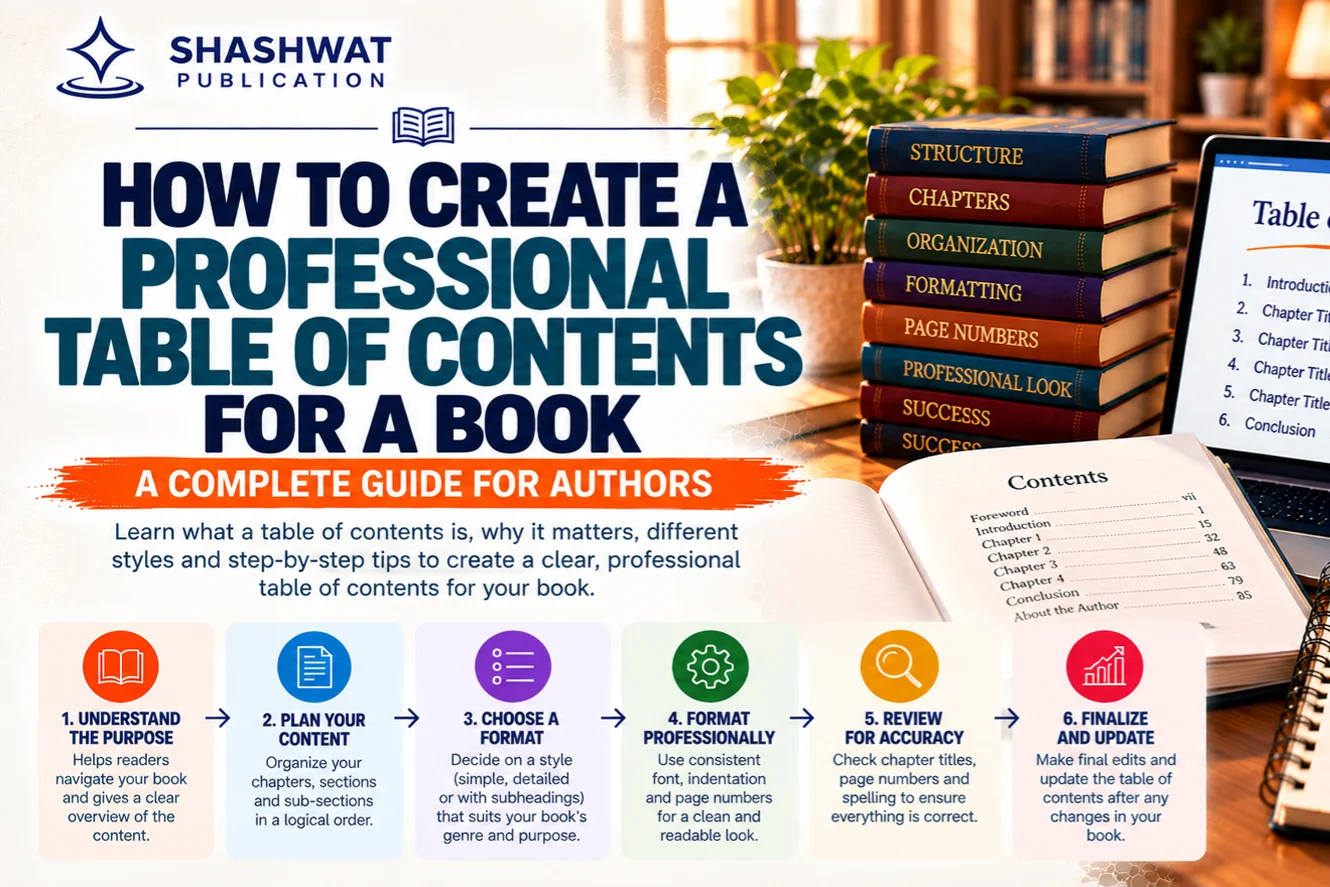
For further guidance on organizing your manuscript, explore this guide to creating a professional table of contents for a book.
Authors can make their books more professional by avoiding a few common mistakes.
Including unnecessary sections: Do not add a foreword, glossary or appendix simply because another book contains one. Each section should have a purpose.
Using inconsistent information: Make sure the title, author name, edition information and other details match throughout the publication.
Forgetting to update the contents page: If chapters move or page numbers change, update the table of contents before finalizing the book.
Placing references incorrectly: Keep citations and supplementary material organized so readers can locate them easily.
Writing an overly long author biography: Include relevant information rather than turning the biography into a complete career history.
Ignoring digital navigation: For eBooks, ensure that major sections can be accessed through the available navigation features.
Failing to proofread supporting pages: Errors in the copyright page, references or author biography can make an otherwise polished book appear unfinished.
Preparing a book for publication involves organizing the manuscript, checking its structure and ensuring that the final files are professionally presented.
Authors can explore Shashwat Publication to learn about its book publication services and available publishing options.
You can also review the information on book publication services and book publishing packages to understand the options available for your project.
Before selecting a service, confirm the specific deliverables, charges, timelines and responsibilities. Do not assume that every package includes editing, interior formatting, cover design or assistance with every front matter and back matter element.
Front matter and back matter are important parts of a professionally organized book. Front matter introduces the work, identifies its author and provides useful information before the main content begins. Back matter adds supporting material, references, explanations and information that readers may need after finishing the main text.
The sections you include should depend on your book's genre, length and purpose. A novel may need only a few supporting pages, while an academic publication may require references, appendices and an index.
By choosing the right elements, arranging them logically and checking the final formatting, you can create a book that is easier to navigate and more professional in presentation.
+91 99930 01841 | +91 99936 08164 | ssupport@shashwatpublication.com
2nd Floor, HN 46, Balaji Residency, Seept Road, Bilaspur, C.G 495001

Can’t find what you are looking for? Drop an email to support@shashwatpublication.com
Front matter includes the pages before the main content of a book. Common examples are the title page, copyright page, dedication, table of contents, foreword and preface.
Back matter includes supplementary sections after the main text, such as appendices, references, a bibliography, glossary, index, acknowledgements and author biography.
Most books benefit from basic front matter, especially a title page and appropriate publication information. Other sections are optional and should depend on the book's purpose and format.
No. The required sections depend on the type of book and its publication requirements. A short novel may need very little back matter, while an academic book may require extensive references and supporting material.
Front matter is the entire group of preliminary pages before the main content. A table of contents is just one possible section within the front matter.
Yes. Acknowledgements may appear near the beginning or at the end of a book. Choose the placement that suits the book's structure and follow any applicable publishing guidelines.
Not every novel requires a table of contents. It can be useful for books with titled chapters or a complex structure, but some novels use only chapter numbers or omit a contents page.
A glossary explains important or specialized terms used in a book. An index lists subjects, names or terms and directs readers to the pages where they appear.
An author biography is commonly placed in back matter. It gives readers a brief introduction to the author and may mention relevant experience, qualifications or other publications.
Authors can contact Shashwat Publication to confirm which manuscript preparation, formatting and publication services are available. The exact scope and cost should be verified before proceeding.


Dear Team, I would like to express my sincere appreciation for the seamless book publishing experience. As this is my debut publication, I will certainly be recommending Shashwat Publication.
I write this to express my deep sense of appreciation and gratitude to Shashwat Publication for publishing my first book in a time bound and professional manner. The first call from Ms Swati and her subsequent interactions, followed by dealing with ... Read More
Very Good publications
Publishing Experience with Shashwat Publications My experience with Shashwat Publications has been a fulfilling and memorable journey. From the initial stages of manuscript preparation to the final publication of my book, The Dental Prescriber: Fro... Read More
About Publishing Experience with Us As a first-time author with Shashwat Publications, I look forward to a professional, collaborative, and enriching publishing experience. I appreciate the opportunity to present this work to students and educators... Read More
I am satisfied with the work, it was not too long time taken by the publishers. Also the price is appropriate for publishing the book. I recommend other authors too, must have experience once with this publication. Worthy experiences. Thanks :)

B-75, Krishna Vihar, Koni, Bilaspur, C.G 495001
support@shashwatpublication.com
Timing
Important Pages
All rights are reserved by Aadeera Corporation Private Limited
Terms & Condition Apply