27-10-2026
Choosing a professional book publisher is an important step in an author's publishing journey. A good publisher should help transform a manuscript into a well-prepared book, explain the publication process, and provide the services agreed upon before work begins. The support required may differ depending on whether the author is publishing a novel, poetry collection, academic work, biography, or nonfiction guide.
Professional book publishing involves much more than printing pages and designing a cover. It can include manuscript assessment, editing, proofreading, interior formatting, ISBN guidance, printing, distribution, marketing, and post-publication assistance. However, the exact services depend on the publishing model and the agreement between the author and the publisher.
Understanding these services helps authors evaluate publishing options, compare costs, and select a partner whose capabilities match their goals
A professional publisher should have a clear process for assessing a manuscript before it moves into production. This assessment helps determine whether the content is ready for publication and what improvements may be necessary.
For fiction, the assessment may consider the storyline, character development, dialogue, pacing, and consistency. For nonfiction, it may examine the organisation of ideas, clarity of explanations, relevance to the intended audience, and overall structure. Academic manuscripts may require additional attention to references, research presentation, terminology, and subject-specific requirements.
Manuscript evaluation should help authors understand the work required before publication. The publisher should explain whether the assessment is included in the selected service and whether it results in editorial recommendations, a revision request, or a decision about proceeding.
Authors should also understand that manuscript evaluation is different from full editing. A preliminary assessment identifies areas that may need attention, while editing involves working directly on the manuscript to improve its quality.
Editing and proofreading are essential services for authors who want to present a clear and polished book. Although the terms are sometimes used together, they serve different purposes.
Developmental editing focuses on the larger structure and effectiveness of the manuscript. It may address the sequence of chapters, the development of arguments, the flow of a narrative, or gaps in the content. Copyediting concentrates on grammar, sentence clarity, consistency, punctuation, and language usage. Proofreading is generally performed near the end of production to identify remaining errors in the final text and layout.
A professional publisher should explain which editorial stages are available and which are included in the agreed service. Authors should not assume that a basic proofreading service will provide the same level of work as substantive editing.
The editorial approach should also reflect the type of book. A poetry collection may need careful attention to line breaks and the author's voice, while an academic book may require consistent terminology and references. A novel may need continuity checks and attention to character and plot development.
Clear editorial expectations help authors understand what will be improved, what revisions they may need to make, and whether additional editing costs will apply.
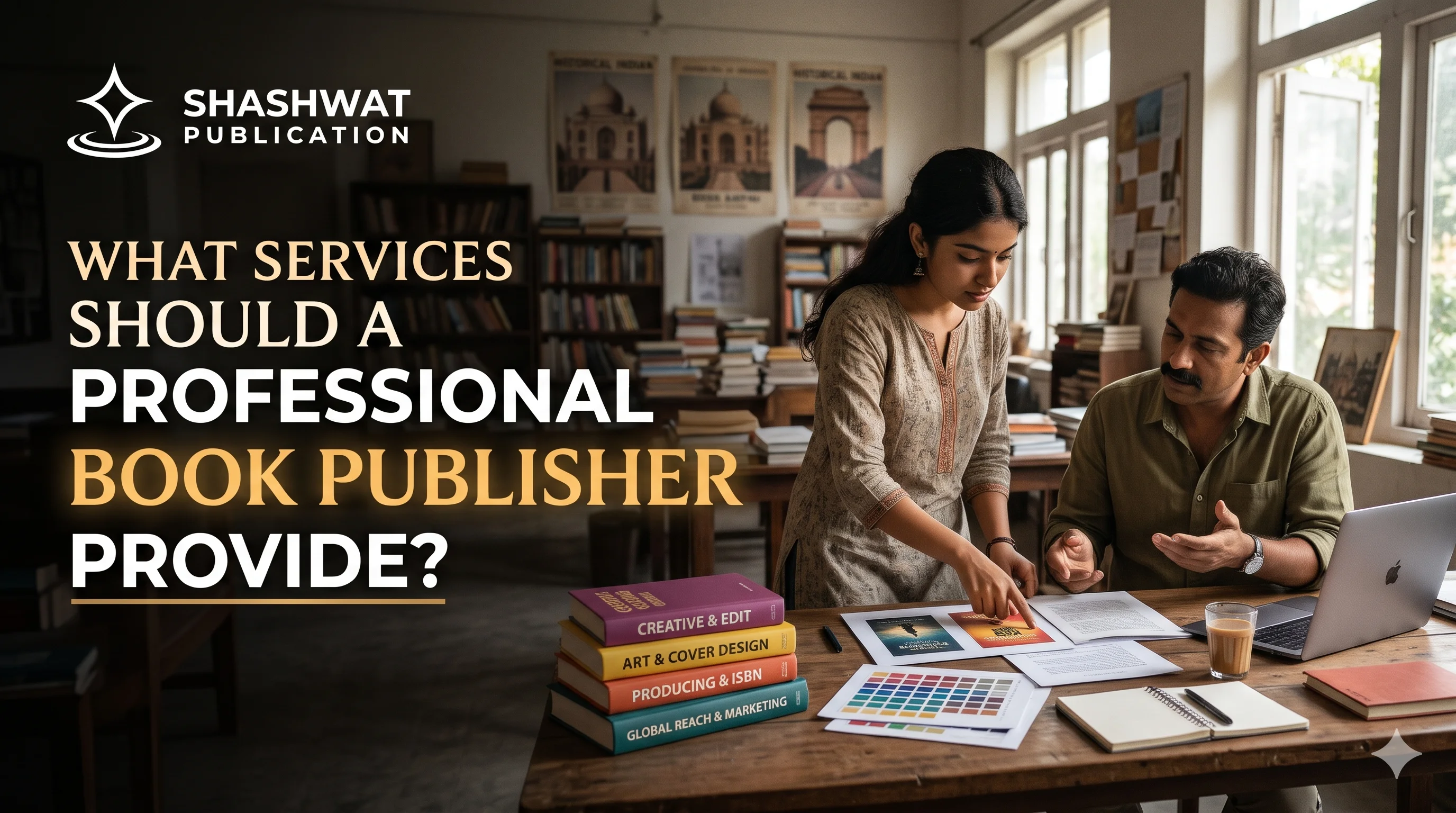
A book cover helps communicate the subject, genre, tone, and intended audience of a publication. It is often the first visual element readers notice, so it should be designed with the book's content and readership in mind.
A professional publisher should offer a cover design process that considers the title, subtitle, author name, typography, visual hierarchy, and overall presentation. The cover should remain legible when displayed as a small digital thumbnail as well as when printed at full size.
Different types of books require different visual approaches. A literary novel may need a design that conveys its atmosphere, while an academic publication may require a clear, subject-focused presentation. A children's book may need illustrations that suit the intended age group and complement the story.
Authors should understand how the design process works, how many revisions are included, and whether additional changes incur extra costs. The agreement should also explain the rights associated with the artwork and which final design files, if any, will be provided to the author.
Interior formatting determines how the text, headings, page numbers, images, tables, and other elements appear inside a book. Professional formatting makes a publication easier to read and gives it a consistent appearance.
A publisher should prepare the layout according to the book's content and intended format. A novel generally requires a different layout from an academic reference book, illustrated children's publication, or poetry collection. The typography, margins, spacing, chapter openings, and page dimensions should support the reading experience rather than distract from it.
Print production requires suitable margins, pagination, image resolution, and print-ready files. Digital editions may need different formatting so that the text remains readable across supported devices.
A professional process should include an opportunity for the author to review the final proof. This allows errors in headings, page breaks, images, and other layout elements to be identified before production is completed.
Authors should ask whether formatting is included in the publishing package, which formats are covered, and whether corrections after proof approval will involve additional charges.
An ISBN, or International Standard Book Number, identifies a particular book publication or edition. It supports the identification and ordering of books through relevant bibliographic and distribution systems, but it does not establish copyright ownership or guarantee commercial success.
A professional publisher should explain whether ISBN assistance is included and clarify who will be recorded as the publisher associated with the identifier. This matters because an ISBN-related arrangement can affect the publication details associated with a book.
The publisher should also help ensure that the title, subtitle, author name, language, edition information, and other bibliographic details are accurate. These details should be checked carefully before the publication information is finalised.
The official Indian ISBN portal provides guidance on ISBN applications and publication requirements. Its guidance also addresses the identification of different publication formats. <Cite refs={["turn905712search12","turn905712search13"]}/>
Authors should clarify whether the selected service covers only ISBN assistance or also includes preparation of the book's publication details and related documentation. These are distinct tasks, and the scope should be explained before the project begins.
For authors choosing a print edition, printing is a significant part of the publishing process. A professional publisher should explain the available production specifications and how they affect the appearance, durability, and cost of the finished book.
The options may include paperback or hardcover binding, different paper types, black-and-white or colour interiors, and varying book dimensions. The appropriate choice depends on the manuscript, intended readership, budget, and expected use.
Before approving production, authors should understand the planned print quantity, estimated timeline, printing specifications, and procedure for correcting production errors. If a physical proof or sample copy is available under the selected service, reviewing it can help identify issues that may not be obvious in a digital file.
The publisher should also explain how printing costs are calculated and whether shipping, packaging, storage, or additional author copies are charged separately. Clear production terms help prevent misunderstandings about the final deliverable.
Authors may wish to publish a book in print, digital form, or both. A professional publisher should explain the available options and the requirements associated with each format.
A printed book requires appropriate production files and physical manufacturing. A digital edition requires suitable file preparation, readable formatting, accurate metadata, and arrangements for making the publication available to the intended audience.
The choice should reflect the book's subject, readership, and publishing goals. Some readers prefer physical books, while others value the convenience of digital reading. Certain illustrated or highly formatted books may require particular attention when being adapted to a digital edition.
Authors should confirm which formats are included in the agreed service, whether separate production work is required, and how the rights and distribution arrangements apply to each version.
For authors who want to explore available publishing categories, the books section provides a relevant starting point for understanding different types of published works.
Distribution helps make a published book available to potential readers. It is important to understand what a publisher means when it describes a book as distributed or available through particular channels.
Some arrangements involve making a book available for ordering, while others may include additional services related to printing, fulfilment, or supplying copies to selected outlets. Availability does not necessarily mean that every bookstore will keep physical stock or actively promote the title.
A professional publisher should explain the distribution channels covered by the agreement, the territories in which the book may be available, and any associated costs or conditions. Authors should also understand how orders are fulfilled and whether returns, shipping, and stock management are part of the service.
If international distribution is important, ask which countries and formats are covered and whether additional arrangements are needed. The answer should be specific to the service being offered rather than relying on broad claims of worldwide availability.
Publication is an important milestone, but readers still need to discover the book. Marketing support can help authors communicate what their book offers and reach people who may be interested in its subject.
Depending on the agreement, promotional services may include preparing book descriptions, creating promotional materials, supporting online visibility, coordinating announcements, or developing a marketing plan. A professional publisher should describe the actual deliverables, timing, responsibilities, and any additional advertising costs.
Marketing requirements differ across genres. An academic book may benefit from outreach to relevant institutions and subject communities, while a novel may require a different approach to reader engagement. Poetry and nonfiction also have distinct audiences and promotional opportunities.
Authors should be cautious about promises of guaranteed sales, reviews, or bestseller status. Book performance depends on factors such as reader demand, quality, pricing, discoverability, distribution, and the effectiveness of promotional activities.
You can explore the book marketing and promotion services page to learn more about the type of support relevant to your publishing goals. Confirm the exact activities and deliverables before selecting any service.
A professional publisher should explain its pricing and contractual terms clearly before beginning work. The total cost may depend on the manuscript's length, editing requirements, design complexity, printing specifications, distribution arrangements, and optional services.
A written proposal should make it clear what is included, what is excluded, and when payments are due. It should also explain the charges that may apply if the author requests additional revisions, changes the specifications, or adds services later.
The publishing contract is equally important because it defines the relationship between the author and the publisher. It should address the services being provided, copyright ownership, publishing rights, exclusivity where applicable, payment terms, royalties where relevant, distribution permissions, and the process for ending the agreement.
Authors should not assume that paying for publishing services automatically transfers copyright ownership to the service provider. The actual position depends on the agreement and applicable law.
Before signing, review the contract carefully and ask for clarification about any unclear provision. For significant rights transfers or complex contractual terms, consider obtaining independent legal advice.
Publishing involves several connected stages, and authors need to understand how their manuscripts move from preparation to final production. Good communication makes this process easier to manage.
A professional publisher should explain the workflow, identify the decisions the author must make, and provide realistic estimates for each stage. The author should know when editorial feedback is expected, when design approvals are required, and when the final proof must be reviewed.
The publisher should also provide a clear way to ask questions, submit revisions, and receive project updates. If a delay occurs, the author should be informed about the reason and the revised expectations.
For first-time authors, communication is particularly important because many publishing terms and production decisions may be unfamiliar. A supportive process should explain these matters in understandable language rather than leaving the author uncertain about the next step.
Clear responsibilities and regular updates can reduce avoidable delays and help both parties work toward the same publication goals.
A publisher's responsibilities may not end on the day a book is released. Depending on the agreement, post-publication support can include assistance with distribution questions, metadata corrections, reprints, new editions, or promotional activities.
Authors should ask which services remain available after publication and whether they are included in the original fee or charged separately. It is also useful to understand how corrections to publication information will be handled and who should be contacted if a production or distribution issue arises.
Future editions may require new editorial work, revised files, updated publication information, or additional rights checks. A clear process helps authors understand what will be required if they decide to revise or expand their book later.
The academic books section may be useful for authors exploring publishing options for educational or research-oriented manuscripts.
A professional publisher should be able to explain its services, demonstrate the quality of its work, and provide clear written terms. Authors can assess suitability by reviewing relevant published work, understanding the production process, comparing service scopes, and asking specific questions about the proposed arrangement.
The best publisher for one author may not be the best for another. A writer who needs extensive editorial assistance may have different priorities from someone whose manuscript is already edited and ready for production. An academic author may need subject-specific support, while a novelist may focus more on editing, cover design, and distribution.
Before making a decision, ensure that the proposed services match your manuscript and budget. Compare the actual deliverables, production standards, communication process, rights terms, and distribution arrangements rather than relying on package names or general marketing claims.
Authors can learn more about the publishing options offered by Shashwat Publication and evaluate which services fit their needs. Review the exact scope, costs, timeline, and contractual terms before proceeding.
A professional book publisher should provide clear guidance and the services required to prepare a manuscript for publication. Depending on the agreement, these may include editorial assessment, editing, proofreading, cover design, interior formatting, ISBN assistance, printing, digital production, distribution, marketing, and post-publication support.
The most important factor is not the number of services listed in a package but the quality, clarity, and suitability of the services being delivered. Authors should understand the publishing model, compare the actual scope of work, review their rights, and confirm all important terms in writing.
Taking the time to evaluate these areas can help authors choose a publishing partner that supports their book's requirements and long-term goals.
+91 99930 01841 | +91 99936 08164 | ssupport@shashwatpublication.com
2nd Floor, HN 46, Balaji Residency, Seept Road, Bilaspur, C.G 495001

Can’t find what you are looking for? Drop an email to support@shashwatpublication.com
A professional book publisher may provide manuscript assessment, editing, proofreading, cover design, interior formatting, ISBN assistance, printing, digital production, distribution, marketing, and post-publication support. The exact services depend on the publishing model and written agreement.
Not necessarily. Some packages include proofreading or basic language checks, while others offer more extensive editorial services. Authors should confirm the exact type of editing included before committing.
A publisher may provide ISBN assistance as part of its service, depending on the arrangement. Authors should clarify who will be recorded as the publisher associated with the ISBN and which publication formats are covered.
Some publishers provide distribution support, but the scope varies. Authors should confirm the channels, territories, formats, fulfilment arrangements, and costs covered by the agreement.
Marketing may be included in certain packages or offered separately. Authors should ask for a clear description of the promotional activities, deliverables, timeline, and any additional advertising expenses.
Copyright ownership depends on applicable law and the agreements signed by the author. Authors should review the contract carefully to understand whether they retain copyright and which publishing rights, if any, are being granted or assigned.
Review the service scope, fees, payment schedule, rights, exclusivity, royalties where applicable, distribution arrangements, production timeline, and termination conditions. Seek independent legal advice if important terms are unclear.
No. Publishing and distribution can make a book available to readers, but sales depend on demand, content quality, pricing, discoverability, distribution, and marketing. Be cautious of guaranteed sales claims.


Dear Team, I would like to express my sincere appreciation for the seamless book publishing experience. As this is my debut publication, I will certainly be recommending Shashwat Publication.
I write this to express my deep sense of appreciation and gratitude to Shashwat Publication for publishing my first book in a time bound and professional manner. The first call from Ms Swati and her subsequent interactions, followed by dealing with ... Read More
Very Good publications
Publishing Experience with Shashwat Publications My experience with Shashwat Publications has been a fulfilling and memorable journey. From the initial stages of manuscript preparation to the final publication of my book, The Dental Prescriber: Fro... Read More
About Publishing Experience with Us As a first-time author with Shashwat Publications, I look forward to a professional, collaborative, and enriching publishing experience. I appreciate the opportunity to present this work to students and educators... Read More
I am satisfied with the work, it was not too long time taken by the publishers. Also the price is appropriate for publishing the book. I recommend other authors too, must have experience once with this publication. Worthy experiences. Thanks :)

B-75, Krishna Vihar, Koni, Bilaspur, C.G 495001
support@shashwatpublication.com
Timing
Important Pages
All rights are reserved by Aadeera Corporation Private Limited
Terms & Condition Apply