13-10-2026
Organizing a book reading event is an excellent way for authors to connect with readers, introduce their books to a wider audience and build a literary community. Whether you have published your first novel, written a poetry collection or created a non-fiction book, a well-planned reading event can help people discover your work and understand the ideas behind it.
In India, book reading events can take place in bookstores, libraries, colleges, community halls, cafés, literary festivals and online meeting spaces. The format can be simple and intimate or structured around a formal book launch, author conversation and audience interaction.
However, a successful event requires more than choosing a venue and reading a few pages. You need a clear objective, a suitable audience, a realistic budget, an engaging programme and an effective promotional strategy.
This guide explains how to organize a book reading event in India, step by step.
Before booking a venue or inviting guests, decide what you want to achieve. Your objective will influence the event format, budget, audience and promotional activities.
Common objectives include:
Introducing a newly published book to readers.
Promoting an existing book and increasing awareness.
Building a personal connection with readers.
Encouraging discussion about a particular subject.
Connecting with students, educators or members of a literary community.
Generating interest in future readings, workshops or author appearances.
For example, a poetry reading may focus on live performances and audience interpretation, while an academic book reading may involve a discussion about research, methodology and practical applications.
If you are organizing your first event, keep the objective simple. A focused event with 20 genuinely interested attendees can be more valuable than a large gathering where the audience has little connection with the book.
Your book determines whom you should invite. A reading event becomes more engaging when attendees are interested in the subject and comfortable participating in a discussion.
Consider the following audience groups:
Fiction readers: Readers interested in novels, short stories, thrillers or literary fiction.
Poetry enthusiasts: People who enjoy poetry readings, spoken-word performances and discussions about language.
Students and educators: Suitable for academic books, educational resources and thought-provoking non-fiction.
Professional communities: Relevant for business, management, self-help and career-related books.
Families and children: Appropriate for children's stories, picture books and storytelling sessions.
Local literary communities: Reading clubs, writers, aspiring authors and people interested in literature.
Create a guest list based on the audience you want to reach. You can invite existing readers, personal contacts, local writers, teachers, college societies and relevant community groups.
Personal invitations are especially useful for a small event because they help establish genuine interest before you spend money on promotion.
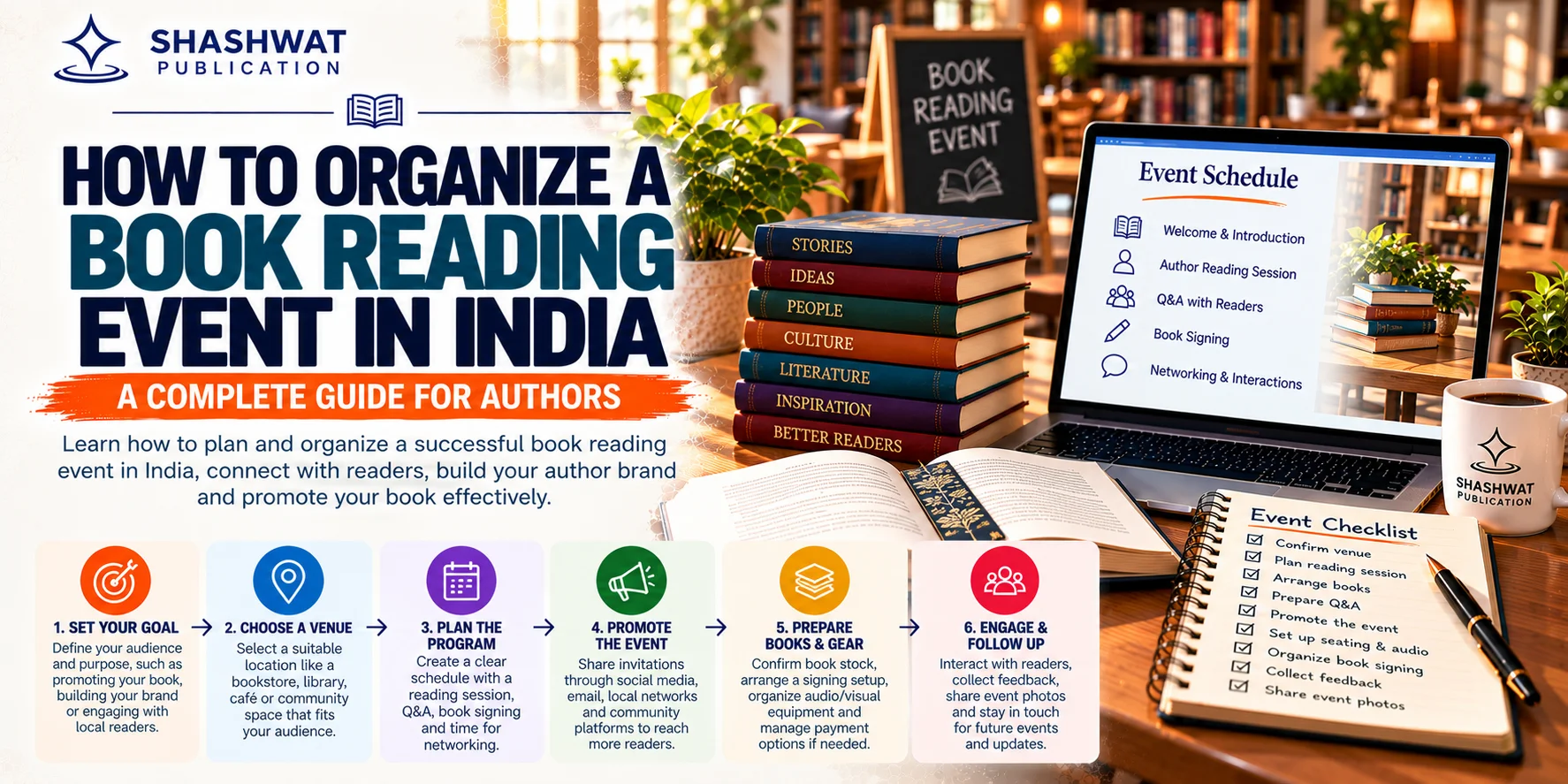
The venue influences the atmosphere, accessibility and overall cost of your event. You do not necessarily need a large auditorium. Select a space that suits your expected attendance and the type of book you are presenting.
Bookstores: A bookstore can provide a natural setting for a reading event and may attract people who already enjoy books. Discuss seating, event timing, book sales and promotional responsibilities with the venue.
Libraries: Libraries can be suitable for literary discussions, poetry sessions, educational readings and community events. Check whether the library accepts external event proposals.
Colleges and universities: These venues can work well for academic books, student-oriented literature and discussions with young readers. Contact the relevant department or event coordinator.
Cafés and community spaces: Smaller spaces can create a relaxed environment for independent authors and intimate reading sessions. Confirm whether the venue permits outside guests, book sales and event photography.
Auditoriums and conference halls: These may be suitable for larger gatherings, panel discussions or formal book launches, but can increase costs.
Online platforms: A virtual reading can help you reach readers across different cities without requiring a physical venue.
Confirm the following details with the venue:
Maximum seating capacity.
Rental charges, deposits and cancellation terms.
Availability of microphones, speakers and lighting.
Accessibility, washrooms, parking and public transport.
Permission to display or sell books.
Internet access and recording facilities, if required.
Food and beverage rules.
Setup and closing times.
Always inspect the venue or request a live video tour before making a final payment.
Your event budget depends on the venue, audience size, equipment, refreshments and promotional requirements. A small reading session may need only basic arrangements, while a formal launch may involve additional production and staffing.
The following figures are illustrative planning estimates, not fixed market rates.
|
Expense |
Example budget |
|
Venue |
₹0–₹10,000 |
|
Seating, sound and basic equipment |
₹0–₹5,000 |
|
Posters and promotional materials |
₹500–₹3,000 |
|
Refreshments |
₹1,000–₹5,000 |
|
Photography or video |
₹0–₹5,000 |
|
Miscellaneous expenses |
₹500–₹2,000 |
For a small event, a practical starting budget might be around ₹2,000–₹10,000 if you secure an affordable venue and handle some tasks yourself. A larger or more formal event may cost considerably more.
To control expenses:
Choose a venue that already has chairs, lighting and a sound system.
Use digital invitations instead of printing large quantities of cards.
Keep refreshments simple.
Ask volunteers to help with registration and seating.
Request written quotations from service providers.
Keep a contingency amount for unexpected costs.
Decide in advance whether entry will be free, ticketed or invitation-only. If you plan to sell tickets, calculate the minimum attendance required to cover your costs.
A clear programme helps attendees understand what to expect and prevents the event from becoming unnecessarily long.
For a 60-minute book reading event, you could use this schedule:
|
Time |
Activity |
|
0–10 minutes |
Guest arrival and registration |
|
10–15 minutes |
Welcome and author introduction |
|
15–30 minutes |
Reading from the book |
|
30–40 minutes |
Discussion about the book and writing process |
|
40–50 minutes |
Audience questions and answers |
|
50–60 minutes |
Book signing, photographs and informal interaction |
Adjust the schedule according to the book and audience. A children's reading may include storytelling and interactive questions, while a poetry event may benefit from short readings followed by discussion.
Do not attempt to read the entire book. Choose a few passages that are understandable without extensive background information and give listeners a reason to explore the complete work.
For fiction, consider an engaging scene or a passage that introduces a central character. For non-fiction, select a section that explains an important idea or offers a practical insight. For poetry, choose pieces that suit the mood and duration of the event.
Practise reading aloud before the event. Pay attention to pronunciation, pacing, pauses and audience engagement.
Permission requirements depend on the venue, city, event size and planned activities. A small indoor reading in a private venue may have different requirements from a large public gathering with amplified sound, temporary structures or extensive technical arrangements.
Before confirming the event, ask the venue manager which approvals or documents are required. Depending on the circumstances, you may need to check local rules concerning public gatherings, fire safety, sound systems, building capacity, signage or other event activities.
For larger events, consult the relevant local authorities well in advance. India's live-event policy framework discusses coordination around permissions, safety norms and compliance; you can review the Ministry of Information and Broadcasting's live-event development information.
Do not assume that one approval automatically covers every activity. Confirm the requirements for your specific venue and programme.
Also arrange the following practical details:
Written venue confirmation.
A list of event staff and responsibilities.
A guest registration process.
An emergency contact and basic safety plan.
Consent arrangements for photographs and recordings.
Written confirmation of book-selling and payment arrangements.
Promotion should begin early enough for your intended audience to plan their attendance. The right approach depends on whether you are targeting local readers, students, professional communities or an online audience.
Prepare a clear event announcement containing:
Book title and author name.
Date, time and venue.
A short description of the reading.
Whether entry is free or paid.
Registration instructions.
Contact details for questions.
Use a readable design and make the key information easy to find. If the event has limited seating, state the registration deadline or capacity accurately.
Share the event announcement on your social media profiles and relevant community pages. Publish a short video explaining the book, introducing a passage or inviting readers to attend.
You can also share reminders as the date approaches. Keep every post informative rather than repeatedly publishing the same poster.
Reach out to reading clubs, colleges, libraries, book-focused groups and relevant local organizations. Ask whether they can circulate the invitation to interested members.
If you have previously written for a blog or maintained an author website, publish an event announcement there and link to the registration page.
Invite existing readers, friends, colleagues and people who are likely to appreciate the book. Personal invitations can be particularly effective for a small reading event.
You can also prepare a short author introduction and a few book details for anyone helping you promote the programme.
Organizing the programme is only part of the work. You should also prepare the materials that help the event run smoothly.
Use a checklist to confirm that you have:
Copies of the book for reading, display and sale.
A guest list or registration sheet.
Name cards or badges, if needed.
A microphone and backup equipment where appropriate.
A printed or digital event schedule.
Water for the author and speakers.
A book-signing pen and suitable signing space.
Payment options and clear pricing if books are being sold.
A phone or camera for approved event photography.
Contact details for the venue and event helpers.
If you are expecting more attendees than the available seats, establish a registration or waiting-list process. Do not confirm more guests than the venue can safely accommodate.
Readers are more likely to remember an event when they have an opportunity to participate. A reading should not feel like a long speech with no room for conversation.
You can add a few simple activities:
Audience questions: Invite attendees to ask about the book's theme, characters, research or writing process.
A short writing activity: For a creative writing event, ask participants to write a few lines inspired by a prompt.
Reader reflections: Invite attendees to share what a passage made them think or feel.
Book signing: Allow time for personal messages and informal conversations after the formal programme.
Group photographs: Arrange photographs with the author's permission and respect attendees who do not wish to be photographed.
Keep activities relevant to the book. Too many unrelated games or presentations can distract from the main purpose of the event.
A book reading event can introduce readers to your work, but selling books should not overwhelm the experience.
Display copies where attendees can browse them easily. Make the price visible and explain the available payment methods. If you plan to offer a special event price, communicate the terms clearly and avoid making promises you cannot fulfil.
Prepare a brief introduction that tells readers what the book is about, who might enjoy it and what makes it meaningful. Avoid pressuring guests to purchase a copy.
For authors who are still preparing their manuscripts, exploring the book publication services offered by Shashwat Publication can help them understand the steps involved in bringing a book to publication.
The event should not end when the last guest leaves. Follow-up helps maintain relationships with readers and provides useful information for planning future events.
Within a few days, consider:
Sending thank-you messages to attendees and venue staff.
Sharing approved photographs or short event highlights.
Publishing a recap on your website or social media.
Responding to questions that could not be addressed during the session.
Collecting feedback through a short form.
Recording the number of attendees and books sold.
Keeping a list of readers who have explicitly agreed to receive future updates.
Review what worked and what needs improvement. For example, you may discover that the venue was too large, the reading was too long or the audience wanted more time for questions.
Use these observations to improve your next event rather than relying only on attendance numbers.
First-time organizers can avoid several common problems through careful planning.
Choosing an oversized venue: A smaller room with engaged attendees can create a better atmosphere than a large, nearly empty hall.
Promoting too late: Begin outreach early and send reminders as the event approaches.
Reading for too long: Select a few strong passages and leave time for discussion.
Ignoring technical checks: Test microphones, speakers, lighting and internet access before guests arrive.
Failing to confirm book sales: Agree on pricing, payment methods, stock and venue rules in advance.
Overlooking permissions: Verify the requirements that apply to your venue and activities instead of assuming none are needed.
Skipping follow-up: Thank attendees and use feedback to maintain reader relationships.
Use this checklist during the planning process.
Define the purpose and target audience.
Select the date, time and venue.
Prepare the budget.
Confirm venue terms and applicable permissions.
Finalize the event programme.
Select and practise the reading passages.
Design the event announcement.
Send invitations and promote registration.
Arrange books, equipment and event materials.
Confirm responsibilities with helpers.
Test the venue and equipment before guests arrive.
Conduct the reading and audience discussion.
Thank attendees and share approved event highlights.
Review feedback, attendance and book sales.
Organizing a book reading event in India does not have to be complicated or expensive. The key is to understand your audience, choose a suitable venue, prepare a focused programme and promote the event through relevant communities.
A successful reading event gives people an opportunity to experience your book, ask questions and connect with you as an author. Even a small gathering can help you build meaningful reader relationships when it is planned thoughtfully.
If you are preparing to publish your first book, explore Shashwat Publication to learn more about book publication and the steps involved in bringing your manuscript to readers.
+91 99930 01841 | +91 99936 08164 | ssupport@shashwatpublication.com
2nd Floor, HN 46, Balaji Residency, Seept Road, Bilaspur, C.G 495001

Can’t find what you are looking for? Drop an email to support@shashwatpublication.com
Start by defining your objective, identifying your audience, selecting a venue, setting a budget and preparing a programme. Promote the event, confirm applicable venue requirements and arrange books and equipment before the event date.
The cost depends on the venue, guest count, equipment, refreshments and promotion. A small self-managed event may cost a few thousand rupees, while a formal event can cost significantly more. Obtain local quotations before finalizing your budget.
Suitable venues include bookstores, libraries, colleges, cafés, community halls, auditoriums and online meeting spaces. Choose a location that fits your audience, budget and expected attendance.
There is no fixed number. A small event may work well with 10–30 attendees, while a larger programme may attract more people. Choose a venue based on realistic registration expectations and safe seating capacity.
Requirements depend on the location, venue, event size and activities. Ask the venue manager and relevant local authorities about any necessary permissions, safety requirements or sound restrictions before proceeding.
A one-hour event is a useful starting point for a small reading. You can adjust the duration for audience questions, a book launch, panel discussion, children's storytelling or other activities.
Use social media announcements, personal invitations, relevant community groups, local educational institutions and event listings where appropriate. Include the date, venue, book details and registration instructions in every announcement.
Selling books can be useful, provided the venue allows it and the arrangements are clear. Prepare copies, display the price, arrange payment options and allow time for signing after the reading.
Yes. Choose a suitable video meeting platform, share registration details, test your microphone and internet connection, and send attendees the joining instructions in advance. An online event can help you reach readers in different cities.
Authors preparing to publish a book can explore the publication information and services available through Shashwat Publication. Confirm the specific services, costs and deliverables directly before making a decision.


Dear Team, I would like to express my sincere appreciation for the seamless book publishing experience. As this is my debut publication, I will certainly be recommending Shashwat Publication.
I write this to express my deep sense of appreciation and gratitude to Shashwat Publication for publishing my first book in a time bound and professional manner. The first call from Ms Swati and her subsequent interactions, followed by dealing with ... Read More
Very Good publications
Publishing Experience with Shashwat Publications My experience with Shashwat Publications has been a fulfilling and memorable journey. From the initial stages of manuscript preparation to the final publication of my book, The Dental Prescriber: Fro... Read More
About Publishing Experience with Us As a first-time author with Shashwat Publications, I look forward to a professional, collaborative, and enriching publishing experience. I appreciate the opportunity to present this work to students and educators... Read More
I am satisfied with the work, it was not too long time taken by the publishers. Also the price is appropriate for publishing the book. I recommend other authors too, must have experience once with this publication. Worthy experiences. Thanks :)

B-75, Krishna Vihar, Koni, Bilaspur, C.G 495001
support@shashwatpublication.com
Timing
Important Pages
All rights are reserved by Aadeera Corporation Private Limited
Terms & Condition Apply