19-10-2026
Publishing a cookbook is an exciting opportunity to share your cooking knowledge, family recipes, culinary experiments and favorite dishes with readers. Whether you specialize in traditional Indian food, regional cuisine, healthy meals, baking, vegetarian recipes or everyday home cooking, a well-prepared cookbook can turn your knowledge into a useful and lasting resource.
However, publishing a cookbook involves more than collecting recipes and adding photographs. Each recipe needs to be tested, measurements must be accurate, instructions should be easy to follow, and photographs must represent the finished dishes clearly. The entire manuscript also needs professional formatting so that readers can use the book comfortably in the kitchen.
From planning your cookbook concept to preparing the final files, every stage contributes to the quality of the finished publication.
In this guide, you will learn how to publish a cookbook with recipes, photos and instructions, organize your content, prepare a professional layout and promote your book to the right audience.
Before writing recipes, define the purpose and audience of your cookbook. A clear concept helps you decide which dishes to include, how to organize the chapters and what type of photographs your book needs.
Some popular cookbook concepts include:
Traditional Indian recipes and regional cuisine.
Vegetarian and vegan cooking.
Healthy everyday meals.
Quick recipes for busy households.
Baking, cakes and desserts.
Street food and restaurant-style dishes.
Family recipes and culinary traditions.
Beginner-friendly cooking guides.
Festive meals and special-occasion recipes.
Specialized cookbooks focused on a particular ingredient or cooking method.
Choose a subject that matches your knowledge and the needs of your intended readers.
For example, a cookbook for beginners may focus on simple ingredients, basic techniques and short preparation times. A regional cookbook may include traditional dishes, local ingredients and stories about their cultural significance.
Ask yourself a few questions:
Who will use this cookbook?
What cooking skills do they already have?
Will they need photographs for every recipe?
Are the recipes intended for everyday meals or special occasions?
Will readers primarily use a printed book or a digital edition?
Your answers will influence the recipe selection, writing style, photography budget and final book format.
A cookbook should be organized so readers can find the recipes they need without searching through unrelated content.
Start by creating a list of recipes and grouping them into logical categories.
For an Indian cookbook, the structure might look like this:
Introduction
The story behind the cookbook
How to use the recipes
Measurement and ingredient guidelines
Chapter 1: Breakfast
Poha
Vegetable upma
Stuffed paratha
Chapter 2: Snacks and Starters
Vegetable cutlets
Paneer tikka
Homemade samosas
Chapter 3: Main Courses
Dal tadka
Vegetable pulao
Paneer curry
Chapter 4: Breads and Accompaniments
Chapati
Garlic naan
Mint chutney
Chapter 5: Desserts
Kheer
Besan ladoo
Homemade halwa
Back Matter
Glossary of ingredients
Recipe index
About the author
This is only a sample structure. Your cookbook may need a different arrangement depending on its cuisine, audience and number of recipes.
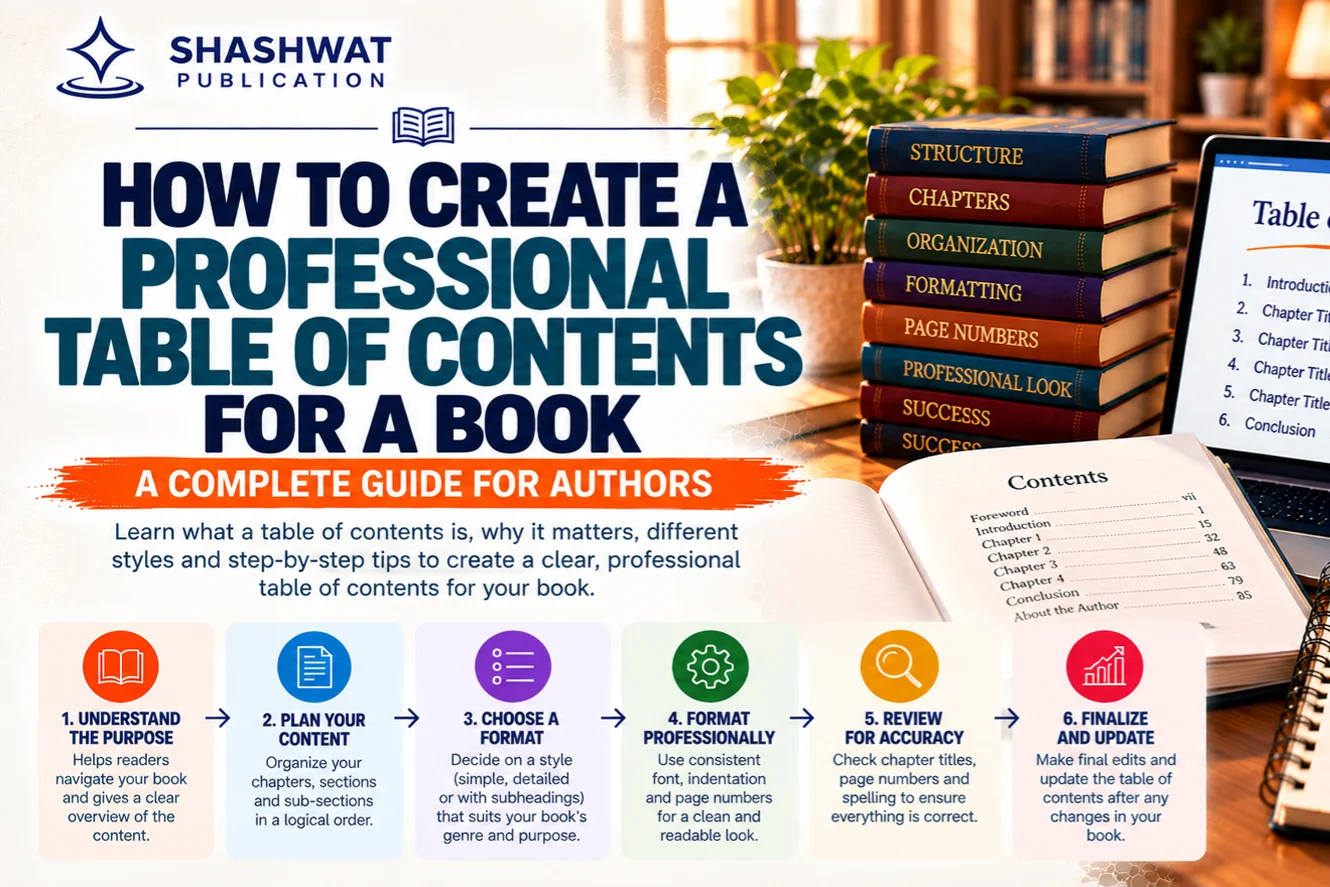
A useful table of contents makes the book easier to navigate, especially when readers want to locate a dish quickly while cooking.
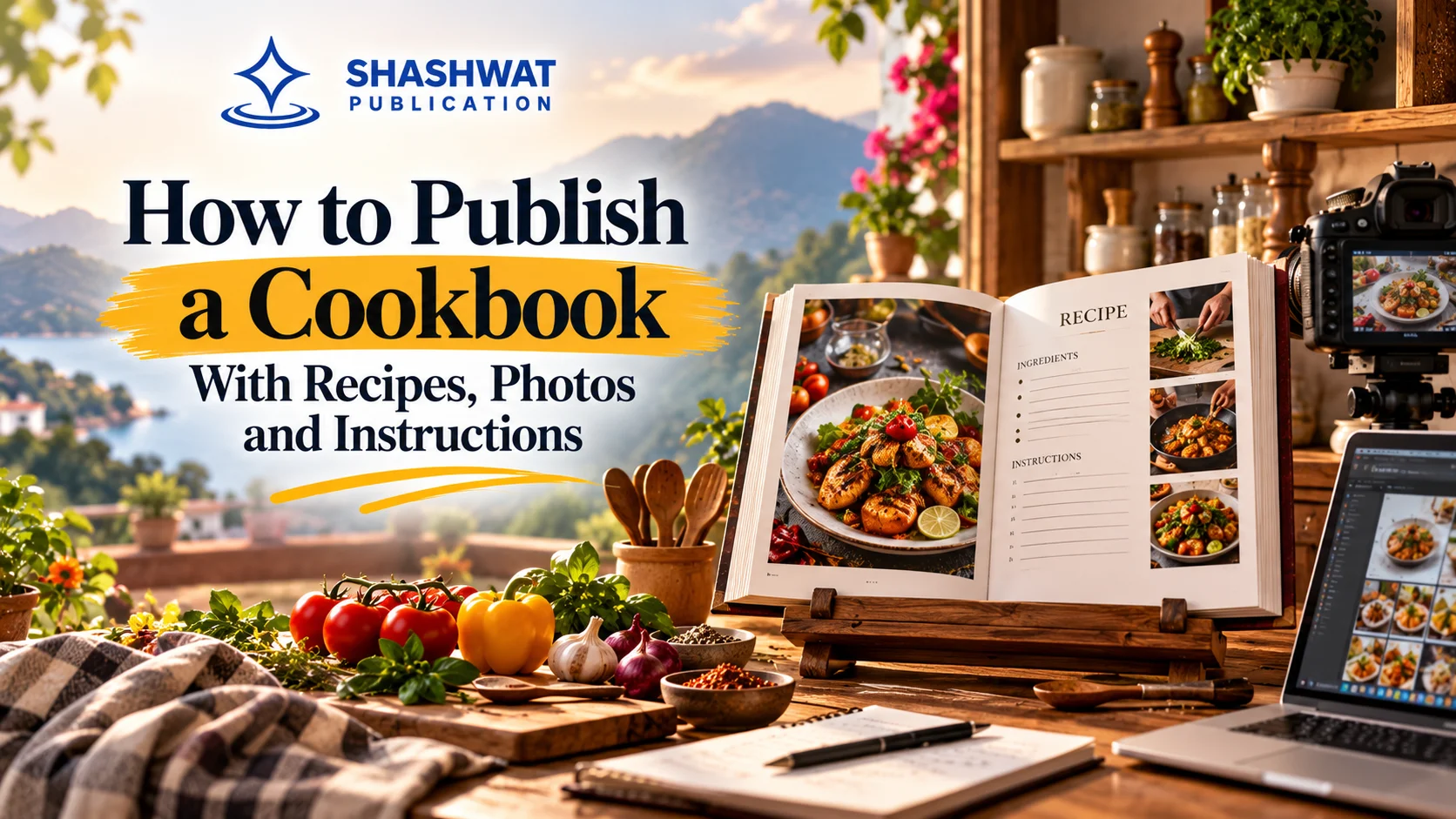
Recipe testing is one of the most important steps in cookbook publishing. A recipe may look appealing on paper, but readers need instructions that work reliably in an ordinary kitchen.
Before including a recipe, prepare it yourself and record the results. If possible, ask someone unfamiliar with the recipe to follow your instructions without additional guidance.
Every recipe should generally include:
Recipe name.
Short description.
Preparation time.
Cooking time.
Total time, where useful.
Number of servings.
Ingredient list.
Measurements.
Step-by-step instructions.
Cooking temperature, where applicable.
Useful tips or variations.
For example:
Vegetable Pulao
Preparation time: 15 minutes
Cooking time: 25 minutes
Servings: 4
Ingredients
1 cup rice
1 medium onion, sliced
1 cup mixed vegetables
2 cups water, adjusted for the rice variety and cooking method
1 tablespoon cooking oil
Salt and spices to taste
Instructions
Rinse the rice and prepare the vegetables.
Heat the oil in a suitable cooking pot.
Add the onion and cook until softened.
Add the vegetables, rice, seasonings and the appropriate amount of water.
Cook using the selected method until the rice is tender and the liquid has been absorbed.
Allow the rice to rest briefly before serving.
This is a basic illustrative recipe. Before including it in a cookbook, test the method, quantities and cooking time and refine the instructions for consistency.
Do not rely entirely on memory. Cooking results can vary with ingredient size, equipment, heat level and the type of ingredients used.
During testing, record:
Exact ingredient quantities.
Cooking temperatures and heat levels.
Approximate timing for each step.
Texture, color and consistency.
Final serving quantity.
Any adjustments needed to achieve reliable results.
If a recipe requires special equipment, mention it clearly. If an ingredient can be substituted, explain how the substitution may affect flavor, texture or cooking time.
A good cookbook should help readers prepare a dish without guessing what to do next.
Avoid vague directions such as "cook until ready" when a more useful explanation is possible.
Instead, describe the desired result. For example, explain that onions should become soft and lightly golden, or that a sauce should thicken enough to coat the back of a spoon.
Use short, numbered steps. Keep each step focused on one action or a closely related group of actions.
For example:
Preheat the oven to the specified temperature.
Combine the dry ingredients in a bowl.
Whisk the wet ingredients separately.
Add the wet mixture to the dry ingredients and mix until combined.
Transfer the batter to the prepared baking tin.
Bake until the specified visual and texture checks are satisfied.
The exact method and timings should be tested for the recipe.
If your target audience includes beginners, define terms such as blanching, folding, simmering, tempering and kneading when they first appear.
For a cookbook aimed at Indian readers, also consider whether ingredient names need regional equivalents or explanations.
Clear language makes the cookbook more accessible to readers with different levels of cooking experience.
Photographs can make a cookbook more attractive and help readers understand the expected appearance of a dish.
However, food photography requires planning. Lighting, composition, background, color and image quality all affect the final result.
You do not necessarily need a separate photograph for every recipe. The decision depends on your budget, page count and book design.
You might use:
A finished-dish photograph for each major recipe.
Step-by-step photographs for complex techniques.
Ingredient photographs for unfamiliar items.
Full-page images for selected signature dishes.
Chapter-opening photographs to establish the visual theme.
For beginner-focused cookbooks, step-by-step photographs can be particularly helpful for techniques that are difficult to describe in words.
Choose a visual style that suits the cookbook. For example, a traditional Indian cookbook might use familiar serving dishes and ingredients, while a baking guide might emphasize close-up photographs of texture and decoration.
Maintain consistency in:
Lighting and image quality.
Backgrounds and props.
Camera angles.
Color balance.
Food styling.
Cropping and composition.
Most importantly, photographs should accurately represent the dishes readers can prepare using the accompanying recipes.
Images that look sharp on a phone may appear blurry when printed at a larger size. Check image resolution at the intended print dimensions before finalizing the layout.
Some print-on-demand production guidelines recommend images at a minimum of 300 DPI for print quality. Actual file specifications depend on the publishing service and book format. <Cite refs={["turn639168search0","turn639168search1"]}/>
Do not assume that changing an image's DPI setting will improve its underlying quality. If a photograph lacks sufficient detail, a higher-quality original may be needed.
A cookbook's photographs are a significant part of its presentation. You should know who owns each image and whether you have permission to use it in your book.
Whenever possible, photograph the dishes yourself or work with a photographer under a clear written agreement.
If you hire a photographer, confirm the permitted uses of the images, including print publication, digital editions, marketing and future editions.
If you use third-party images, obtain the appropriate licence or permission and follow any attribution requirements.
Avoid copying photographs from recipe websites, social media or other cookbooks without authorization. An image being publicly visible does not automatically mean it is free to reproduce.
India's copyright framework recognizes photographs as artistic works, and original explanatory text and illustrations may also receive protection. The precise rights involved depend on the work and applicable law. <Cite refs={["turn789601search16","turn789601search2"]}/>
Consistency is essential when a cookbook contains many recipes.
Choose a measurement system and apply it throughout the manuscript. For example, you might use grams and millilitres, standard volume measures, or a carefully explained combination.
If you include conversions, test them rather than assuming that every ingredient converts identically by volume and weight.
Decide how you will display:
Ingredient quantities.
Fractions and decimal measurements.
Oven temperatures.
Preparation and cooking times.
Serving sizes.
Ingredient substitutions.
Optional garnishes.
Storage and reheating instructions.
For example, do not switch unpredictably between grams, cups, teaspoons and unlabelled quantities.
If a recipe serves four people, explain whether the ingredient quantities can be doubled or halved and whether any cooking adjustments may be needed.
Substitutions can make recipes more accessible, especially when readers cannot find a particular ingredient.
However, not every substitute behaves in the same way. Replacing one flour, fat, thickener or sweetener with another can change the texture and cooking time.
Test important substitutions before recommending them. If a substitution has not been tested, state that results may vary.
Once the recipes and photographs are ready, arrange them in a consistent interior layout.
The design should make it easy for readers to locate ingredients, follow instructions and refer to photographs while cooking.
A typical recipe page may contain:
Recipe title.
Short introduction.
Preparation and cooking times.
Serving quantity.
Ingredient list.
Step-by-step instructions.
Finished-dish photograph.
Tips, substitutions or storage notes.
Not every recipe needs all these elements, but using a consistent structure improves readability.
Your page size affects the space available for photographs, ingredient lists and instructions.
A compact book may be suitable for simple recipes, while a larger format may work better for cookbooks with full-page photography or detailed visual instructions.
Consider how readers will use the book. A layout that looks attractive on a screen should also be practical when printed and placed on a kitchen counter.
Use readable fonts and a clear visual hierarchy. Recipe titles should stand out, while ingredient lists and numbered steps should be easy to scan.
Avoid placing important text over busy photographs. Keep enough spacing between ingredients and instructions, and ensure that page margins remain suitable for the chosen binding.
You can publish your cookbook in print, digital format or both. Each option has different strengths.
A printed book can provide a practical cooking reference with photographs, page layouts and a physical format that readers can keep in the kitchen.
Consider the cost of color printing, paper, binding, image preparation and the number of pages. A cookbook with many full-color photographs may have different production costs from a text-focused book.
A digital edition can be convenient to distribute and update. It may also support clickable navigation, depending on the format and reading device.
However, photographs, tables and recipe layouts should be tested on different screen sizes. A design that works on a large screen may not display comfortably on a phone.
If your budget and distribution plan allow it, you can prepare both print and digital editions. The content should remain consistent, but the layout may need to be adjusted for each format.
For print files, check the publishing service's requirements for page size, margins, image resolution, bleed and embedded fonts. These specifications can vary by production method. <Cite refs={["turn639168search1","turn639168search2"]}/>
Before publishing, organize the publication details that identify your cookbook and explain relevant rights.
The copyright page may include the copyright notice, publication year, edition information, ISBN, publisher details and appropriate disclaimers.
For a cookbook, you may also want a note about ingredient substitutions, cooking equipment and the need to follow appropriate food-safety practices.
A recipe's basic ingredient list or method is not necessarily protected in the same way as original creative expression. In India, the Copyright Office's literary-work guidance explains that protection may extend to substantial written descriptions, explanations and illustrations accompanying recipes. Photographs may also qualify as artistic works. <Cite refs={["turn789601search16","turn789601search7"]}/>
This means you should write your own descriptions, instructions and introductory material, and make sure you have the rights needed to publish all photographs and illustrations.
For legal questions about specific recipes, collaborations or licensing arrangements, seek qualified advice.
An ISBN helps identify a particular book publication. In India, authors and publishers can consult the official ISBN agency for eligibility, application instructions and requirements. The agency provides guidance for individual authors as well as publishing organizations. <Cite refs={["turn639168search37","turn639168search38"]}/>
Check the requirements for your specific publication and format before finalizing the book's metadata.
Even if every recipe has been tested separately, the complete cookbook needs a final review.
Ask a proofreader or independent test cook to review the manuscript where possible.
Check the following:
Every ingredient appears in the instructions when required.
Quantities and serving sizes are consistent.
Cooking temperatures and timings have been verified.
Recipe titles match the table of contents.
Photographs correspond to the correct dishes.
Captions and ingredient labels are accurate.
Page numbers and cross-references work.
The copyright page and ISBN details are correct.
Images remain clear in the exported file.
The final print or digital preview is readable.
For safety-sensitive instructions, such as preserving food or preparing ingredients that require careful handling, rely on authoritative food-safety guidance and verify the instructions before publication.
A final proof copy can help you spot layout problems that are difficult to notice in an editable manuscript.
Once your cookbook is ready, create a promotion plan that reaches people interested in its specific subject.
Publish selected recipe previews, short cooking demonstrations or photographs of finished dishes. Make sure the content accurately represents the book and that you have the rights to use every image.
An author website can introduce the cookbook, provide information about the author and direct interested readers to the book's listing or purchase options.
You can also publish related articles, such as ingredient guides, cooking tips and explanations of techniques used in the book.
Consider cooking communities, food-related events, local groups and relevant educational or culinary organizations. Choose channels that align with the cookbook's subject rather than promoting it everywhere indiscriminately.
Invite readers to share their experiences without pressuring them to leave positive reviews. Genuine feedback can help you understand which recipes are most useful and what readers want to see in future books.
For additional guidance, explore the book marketing and promotion information available from Shashwat Publication.
Publishing untested recipes: A recipe that has not been tested may produce inconsistent results. Test each recipe and record the final measurements and method.
Using low-quality photographs: Blurry images can reduce the quality of a printed cookbook. Check resolution at the final image size.
Mixing measurement systems without explanation: Inconsistent quantities can make recipes difficult to follow. Choose a clear standard and explain any conversions.
Writing vague instructions: Readers should not have to guess about heat levels, timing or texture. Describe the expected result and include useful visual cues.
Using photographs without permission: Obtain the rights needed to publish photographs and illustrations.
Overcrowding the pages: Too much text and too many images can make a recipe difficult to use. Give ingredients and instructions enough space.
Ignoring print costs: Full-color photography can affect production costs. Calculate the budget before finalizing the page count and design.
Skipping the final proof: Errors in measurements, captions or page layout can undermine an otherwise excellent cookbook.
Publishing a cookbook requires careful coordination between manuscript preparation, recipe organization, image placement, book design and final production.
Authors can explore Shashwat Publication to learn about its publication services and available publishing options.
You can also review the details of book publication services and book publishing packages to understand the options available for your project.
Before choosing a service, confirm whether recipe formatting, color-image layout, editing, cover design, ISBN assistance and print production are included. Ask for a clear breakdown of costs, deliverables and timelines, especially if your cookbook contains many photographs.
Publishing a cookbook with recipes, photographs and instructions requires careful planning, consistent testing and professional presentation. Start with a clear concept, organize the recipes into useful categories and make sure every dish can be prepared using the written instructions.
Then select suitable photographs, obtain the necessary image rights, standardize measurements and format the manuscript for print or digital reading. Before publication, check the complete book for recipe accuracy, image quality, page layout and publication details.
A well-prepared cookbook does more than present attractive dishes. It gives readers clear, dependable instructions and helps them recreate the recipes with confidence.
+91 99930 01841 | +91 99936 08164 | ssupport@shashwatpublication.com
2nd Floor, HN 46, Balaji Residency, Seept Road, Bilaspur, C.G 495001

Can’t find what you are looking for? Drop an email to support@shashwatpublication.com
Start by defining the cookbook's subject, organizing the recipes and testing each one. Prepare original or properly licensed photographs, write clear instructions, format the manuscript, check publication requirements and choose a suitable print or digital publishing option.
There is no fixed number. The appropriate number depends on the cookbook's purpose, recipe complexity, page count and amount of photography. Focus on completeness, variety and usefulness rather than reaching an arbitrary total.
No. You can include photographs for selected recipes, signature dishes or important cooking steps. However, consistent and relevant images can be especially helpful in cookbooks aimed at beginners.
Many print-production guidelines recommend a minimum of 300 DPI at the intended print size. Confirm the requirements of your chosen publishing service and check that the images remain sharp in the final layout.
Do not copy another author's creative descriptions, photographs or other protected material without appropriate permission. Basic ingredient lists and methods may be treated differently from original explanatory writing and illustrations. Write your own instructions, verify the legal position for your circumstances and obtain the rights needed for all images.
Choose based on your readers, budget and design requirements. Print can suit photo-rich kitchen references, while digital editions can be convenient to distribute and update. You may publish both if your budget and distribution plan support it.
Check the requirements of the official Indian ISBN agency for your publication and format. An ISBN helps identify a particular book publication, and the application process depends on the relevant eligibility and documentation requirements.
Use numbered steps, consistent measurements, tested cooking times and clear descriptions of the expected texture or appearance. Explain unfamiliar cooking terms and identify equipment or special techniques where necessary.
Costs depend on editing, recipe testing, photography, page count, color printing, cover design, formatting and distribution. Request itemized estimates before committing to a publishing plan.
You can contact Shashwat Publication to ask which manuscript preparation, formatting and publishing services are available for cookbooks. Confirm whether food photography layout, color printing, editing and other specific requirements are included.


Dear Team, I would like to express my sincere appreciation for the seamless book publishing experience. As this is my debut publication, I will certainly be recommending Shashwat Publication.
I write this to express my deep sense of appreciation and gratitude to Shashwat Publication for publishing my first book in a time bound and professional manner. The first call from Ms Swati and her subsequent interactions, followed by dealing with ... Read More
Very Good publications
Publishing Experience with Shashwat Publications My experience with Shashwat Publications has been a fulfilling and memorable journey. From the initial stages of manuscript preparation to the final publication of my book, The Dental Prescriber: Fro... Read More
About Publishing Experience with Us As a first-time author with Shashwat Publications, I look forward to a professional, collaborative, and enriching publishing experience. I appreciate the opportunity to present this work to students and educators... Read More
I am satisfied with the work, it was not too long time taken by the publishers. Also the price is appropriate for publishing the book. I recommend other authors too, must have experience once with this publication. Worthy experiences. Thanks :)

B-75, Krishna Vihar, Koni, Bilaspur, C.G 495001
support@shashwatpublication.com
Timing
Important Pages
All rights are reserved by Aadeera Corporation Private Limited
Terms & Condition Apply