20-10-2026
Comic books and graphic novels combine storytelling with visual art to create engaging reading experiences. From action-packed adventures and fantasy stories to mythology, mystery, romance and realistic fiction, illustrated books allow authors and artists to communicate stories through both words and images.
If you are an aspiring comic book creator in India, publishing your work involves more than writing a story and drawing a few characters. You need a clear script, consistent artwork, well-designed panels, readable dialogue, professional page formatting and a publishing plan that suits your audience.
You must also consider copyright ownership, ISBN requirements, printing costs, distribution and marketing. These decisions become especially important when writers, illustrators, colorists and letterers collaborate on the same project.
Whether you are creating your first independent comic, a children's graphic novel or a longer illustrated story, this guide explains how to publish a comic book or graphic novel in India step by step.
Before developing your manuscript, decide what kind of illustrated book you want to create. Your format will influence the story length, artwork requirements, page count, production budget and target audience.
Common options include:
Comic books: Often released in shorter installments, with stories that may continue across multiple issues.
Graphic novels: Longer, book-length illustrated narratives that may tell a complete story or form part of a series.
Manga-inspired comics: Illustrated stories influenced by manga-style visual storytelling.
Children's comics: Stories designed for younger readers, often featuring accessible language and expressive illustrations.
Mythology and historical comics: Stories based on historical settings, cultural traditions or mythological themes.
Educational comics: Visual narratives designed to explain concepts, events or practical subjects.
Webcomics: Comics created primarily for digital reading, sometimes published in serialized episodes.
Choose a format that fits your story rather than forcing the story into a format simply because it is popular.
Consider the age group, interests and reading preferences of your intended audience. A comic for young children may need simpler dialogue and larger visual elements, while a graphic novel for adults may explore more complex themes and narrative structures.
Your target audience will also influence the book's language, artwork style, page design and promotional approach.
A compelling story is the foundation of a successful comic book. The illustrations may attract readers initially, but the narrative, characters and pacing encourage them to continue reading.
Start by defining the central idea of your story.
Ask yourself:
Who is the main character?
What does the character want?
What obstacle or conflict stands in the way?
Where and when does the story take place?
What makes the story different?
How does the story begin, develop and conclude?
Create a short synopsis before writing the complete script. This will help you identify the main plot points and determine whether the story is suitable for a single book or multiple installments.
Unlike a conventional novel, a comic book communicates through a sequence of visual panels. Your script should describe the action, dialogue and important visual details for each scene.
A simple example might look like this:
Page 1, Panel 1: A young explorer stands outside an abandoned fort at sunset.
Caption: The old fort had remained silent for a hundred years.
Page 1, Panel 2: The explorer notices a faint light beneath the main gate.
Dialogue: "Someone is inside."
Page 1, Panel 3: A shadow appears behind the gate.
This structure gives the artist a clear idea of the scene without dictating every unnecessary visual detail.
Plan the pacing carefully. Major revelations, emotional moments and action sequences may need different panel sizes and amounts of dialogue.
Readers should be able to recognize important characters throughout the story. Consistent character design is especially important when several artists contribute to the same project.
Prepare a character reference sheet containing details such as:
Character name and role.
Physical appearance.
Clothing and accessories.
Facial expressions.
Typical poses.
Important visual features.
Relevant background information.
You can also create reference sheets for locations, vehicles, objects and other recurring elements.
For stories inspired by Indian settings, consider how architecture, clothing, landscapes and cultural details contribute to the narrative. Research these elements carefully when accuracy matters.
Keep copies of your approved reference designs. They can help maintain consistency during revisions, coloring and future installments.
You can create comic artwork yourself, work with an illustrator or collaborate with a team that handles different stages of production.
A typical comic production workflow includes:
Thumbnails: Rough sketches showing the arrangement of panels on each page.
Pencils or rough artwork: More detailed drawings that establish character poses and composition.
Inks or clean line art: Refined outlines and visual details.
Coloring: Adding color, shadows, lighting and atmosphere where required.
Lettering: Placing dialogue, captions and sound effects.
Final cleanup: Checking consistency, readability and technical quality.
Some creators combine several of these stages or use digital illustration tools to complete the artwork.
Before producing the entire book, complete a sample page or a short sequence. This helps you evaluate the character designs, panel layouts, colors and lettering before investing in the full project.
Make sure the selected style matches the story and can be maintained throughout the book.
If you are a writer without illustration skills, you may need to collaborate with an artist. Depending on the project, you may also work with a colorist, letterer, editor or graphic designer.
Before beginning the collaboration, agree on:
The total number of pages.
The artwork style and deliverables.
Payment terms and milestones.
Revision limits and approval procedures.
Deadlines.
Credit and attribution.
Copyright ownership and licensing.
Permission to reuse characters and artwork.
Rights to publish print and digital editions.
Put these arrangements in writing. Do not assume that paying for illustrations automatically transfers every copyright or usage right.
If you plan to create a series, clarify whether the artist may be involved in future volumes and who controls the use of the characters, designs and other creative elements.
Clear agreements help avoid disputes and make it easier to continue the project.
Once the story and artwork are ready, arrange the pages into a consistent book layout.
Your layout must support both the visual storytelling and the technical requirements of the chosen publishing method.
Select a page size based on the type of book, the artwork and the intended reading experience. A compact comic format may suit a short installment, while a larger graphic novel may provide more room for detailed illustrations.
Confirm the page dimensions and production specifications with your chosen printer or publishing service before finalizing the artwork.
Panel arrangement should guide readers naturally through the story. Avoid confusing layouts that make it difficult to determine which panel comes next.
Keep important action, dialogue and character expressions visible. Ensure that speech balloons do not cover essential artwork.
Dialogue, captions and sound effects should remain clear at the final printed size.
Use consistent lettering styles and balloon shapes. Leave enough space around the text and avoid overcrowding panels with unnecessary dialogue.
If your comic is in Hindi or another Indian language, check the spelling, punctuation, font support and character rendering in the final export.
Check the printer's specifications for:
Trim size and page dimensions.
Bleed and safe margins.
Image resolution.
Color mode and color profiles.
Embedded fonts.
Page count and binding requirements.
Cover dimensions and spine width.
For artwork that extends to the edge of a printed page, follow the printer's bleed instructions. Keep important text and visual details inside the safe area.
Export the final pages using the required file format and inspect the complete proof before approving production.
Copyright is an important consideration because comic books combine several creative elements, including writing, drawings, character artwork and visual composition.
The Indian Copyright Act, 1957 recognizes original literary and artistic works. The Government of India's Copyright Office also provides specific guidance on comic books in its Practice and Procedure Manual for Literary Works. The manual distinguishes the literary element of a comic from its images for the purpose of copyright registration. <Cite refs={["turn303658search2","turn303658search12"]}/>
Before publishing, consider the following steps:
Keep dated copies of your scripts, drafts and original artwork.
Maintain written agreements with collaborators.
Clarify who owns the rights to the story, illustrations and characters.
Obtain permission to use third-party artwork, photographs, logos or other protected material where required.
Review licensing terms for any assets used in the book.
Consider whether copyright registration is appropriate for your project.
The Copyright Office provides an online copyright registration facility. Its published guidance explains the submission process for literary and artistic works. For comic books, check the applicable categories and requirements for the literary elements and images rather than assuming one application necessarily covers every component. <Cite refs={["turn303658search0","turn303658search1","turn303658search12"]}/>
Copyright registration is not the same as obtaining an ISBN. An ISBN identifies a book publication; copyright concerns rights in creative work.
For complicated collaborations, adaptations or licensing arrangements, consider seeking qualified legal advice.
An ISBN, or International Standard Book Number, is used to identify a particular book publication. It can help distinguish editions and formats in book distribution and cataloguing.
Authors and publishers in India can consult the official ISBN India portal for application instructions and eligibility requirements. The portal includes application categories for authors, self-publishers and publishing organizations. <Cite refs={["turn303658search13","turn303658search16"]}/>
Before applying, prepare accurate publication information, including:
Book title and subtitle.
Author and contributor details.
Publisher or imprint information.
Publication format.
Other details requested by the application process.
Check whether separate ISBNs are needed for different editions or formats. Do not assume that a single identifier automatically applies to every version of the book.
If you are publishing through a service, ask who will handle the application and how the assigned ISBN will be associated with your publication.
Comic books and graphic novels can be published in print, digitally or in both formats. Your choice should depend on your audience, budget, artwork and distribution plan.
A printed comic book offers a physical reading experience and allows you to control the page size, paper, binding and cover finish.
However, color artwork can increase production costs. Before deciding on the final format, request printing estimates based on the actual page count, color requirements, paper specifications and quantity.
A physical proof is useful for checking whether the artwork, lettering and colors reproduce as expected.
A digital edition can reach readers who prefer electronic books and may reduce the need to hold physical inventory.
However, a page designed for print may not work equally well on a small screen. Consider whether the comic will be read as complete pages or adapted for vertical scrolling.
Test the digital version on different devices and check that dialogue, panel transitions and important visual details remain readable.
You can prepare both print and digital editions if your budget and publishing plan support them. The content can remain consistent while the layout is optimized for each format.
The cost of publishing a comic book varies significantly depending on its length, artwork complexity, color requirements, editing, printing quantity and distribution plan.
There is no single reliable price for every comic book. A short black-and-white comic created by an individual may have very different costs from a full-color graphic novel with commissioned artwork on every page.
To manage the budget:
Finalize the page count before requesting quotations.
Obtain separate estimates for artwork, design and printing.
Confirm how many revision rounds are included.
Compare short-run printing with print-on-demand options.
Reserve funds for proof copies and unexpected corrections.
Decide how the book will be sold before choosing a print quantity.
Do not commit to a large print run until you understand your audience, expected demand and total production costs.
There are several ways to publish a comic book in India. The right choice depends on your budget, creative goals, resources and preferred level of control.
Self-publishing allows you to manage the creative process and make decisions about artwork, format, pricing and distribution.
You will generally need to coordinate the production process yourself or hire professionals for specific tasks.
This route may suit creators who want to retain greater control over the book and are comfortable managing its production and promotion.
A publishing service may offer assistance with manuscript preparation, cover design, interior formatting, printing and distribution. The precise scope depends on the service and agreement.
Review the costs, deliverables, copyright terms, ISBN arrangements and distribution details before committing.
If you want a publishing house to consider your comic or graphic novel, prepare a professional submission package.
Depending on the publisher's requirements, this may include:
A concise story synopsis.
Target audience and genre.
Character descriptions.
Sample script pages.
Completed sample comic pages.
Artwork samples.
Proposed page count.
Details about whether the story is complete or part of a series.
Follow the submission guidelines of the specific publisher you approach. A strong sample should demonstrate not only attractive artwork but also clear storytelling and readable lettering.
Publishing your book is only the beginning. Readers need to discover it, understand its appeal and know where to find it.
Use selected panels, character introductions and short story previews to introduce the book. Make sure your promotional material does not reveal major plot developments unnecessarily.
Create a consistent profile that explains your role as a writer, illustrator or creator. Share the inspiration behind the story and show selected stages of the creative process.
You could publish:
Character introductions.
Artwork previews.
Behind-the-scenes sketches.
Short, spoiler-free story teasers.
Cover reveals.
Release announcements.
Excerpts from the creative process.
Choose content that fits your audience and publishing schedule rather than posting without a clear purpose.
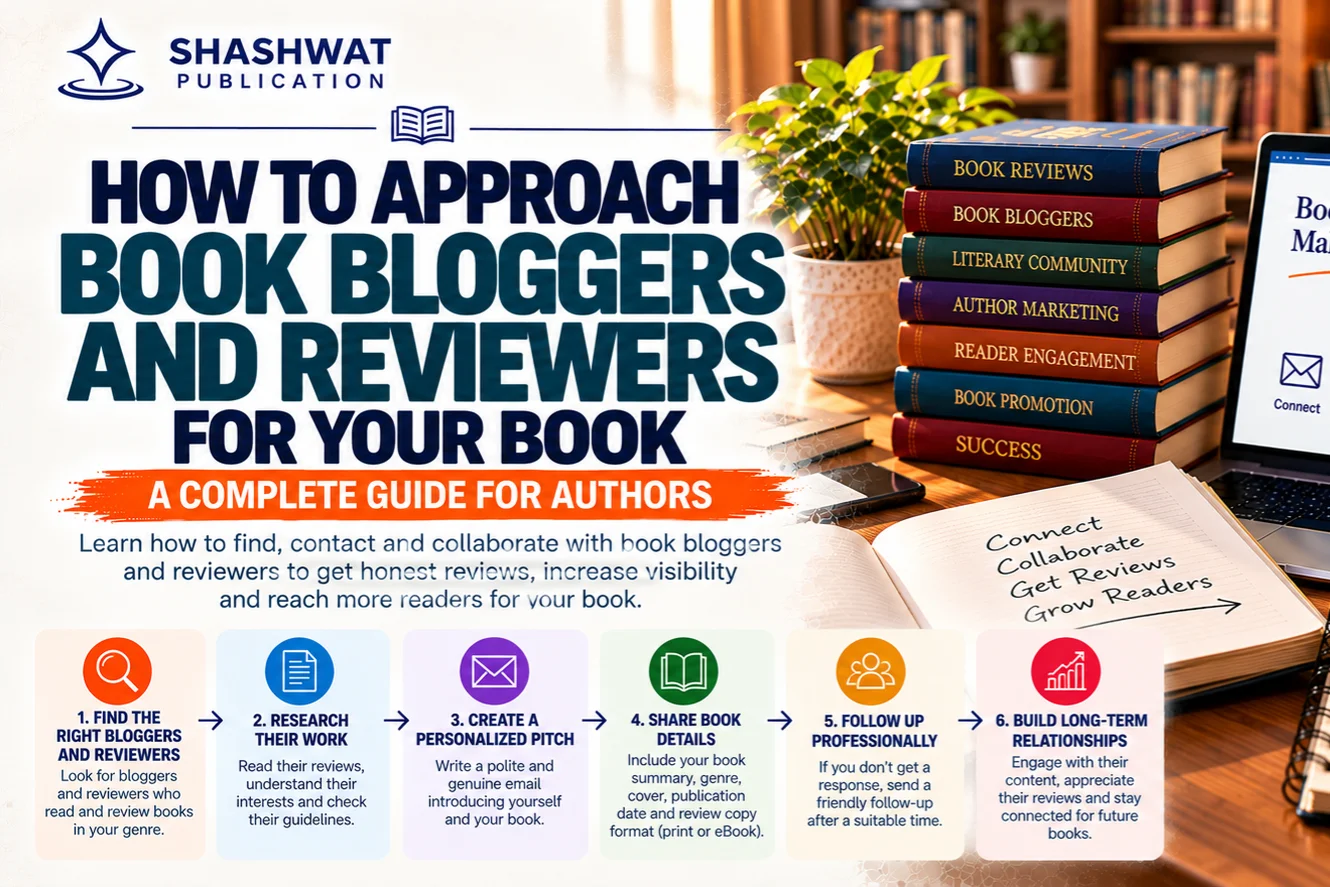
Reach out to readers interested in comics, illustration, fantasy, mythology, science fiction or the specific genre of your work. Consider appropriate book events, art gatherings and literary communities.
Invite readers to share their opinions and discuss the story. Use feedback to understand what resonates with your audience, but do not pressure readers to provide positive reviews.
For additional guidance, explore the book marketing and promotion services offered by Shashwat Publication.
Starting the artwork without a finished script: Major story changes can lead to expensive redraws. Finalize the script or agree on a controlled revision process before producing the complete book.
Ignoring lettering: Even excellent illustrations can become difficult to read if dialogue balloons are too small or overcrowded.
Using inconsistent character designs: Maintain reference sheets and approved designs throughout production.
Skipping print proofs: Colors, margins and lettering may look different in the final printed format. Check a proof before approving the full run.
Ignoring copyright agreements: Writers and artists should clarify ownership, licensing and credit before beginning a collaboration.
Underestimating production costs: Include artwork, coloring, lettering, formatting, printing and marketing in the budget.
Choosing the wrong publishing format: Consider how your intended audience prefers to read and how the artwork will work in the final format.
Promoting without a clear audience: Focus your marketing on readers who are likely to enjoy the genre and subject of your comic.
Publishing an illustrated book requires coordination between story development, artwork, page formatting, cover design and final production.
Authors can explore Shashwat Publication to learn about its publication services and available options.
You can also review the details of its book publication services and publishing services to understand the support available for book preparation, design and publication.
Before proceeding, confirm whether the service can accommodate a full-color comic or graphic novel, including panel layouts, lettering, image-heavy interiors, print specifications and digital conversion. Ask for a written breakdown of costs, deliverables, copyright responsibilities and timelines.
Publishing a comic book or graphic novel in India requires a combination of storytelling, visual creativity and careful production planning.
Start with a strong script, develop consistent characters and artwork, and make sure the dialogue and panel layouts are easy to follow. Then prepare the book's interior, confirm the required print or digital specifications, understand copyright and ISBN requirements, and select a publishing route that fits your goals.
Finally, build a promotional plan that introduces your characters and story to the right readers.
A professionally prepared comic book does more than look attractive. It brings writing and visual art together to create a clear, engaging reading experience that readers can enjoy and remember.
+91 99930 01841 | +91 99936 08164 | ssupport@shashwatpublication.com
2nd Floor, HN 46, Balaji Residency, Seept Road, Bilaspur, C.G 495001

Can’t find what you are looking for? Drop an email to support@shashwatpublication.com
Develop your story and script, create or commission the artwork, format the pages, confirm copyright and ISBN requirements, select a publishing route and prepare the book for print or digital distribution.
Comic books are often shorter and may be released in installments, while graphic novels are generally book-length illustrated narratives. The terms can overlap, and the best format depends on the story and intended audience.
Check the requirements of the official ISBN India portal for your publication and format. An ISBN identifies a particular book publication and can help with distribution and cataloguing.
Keep records of your original scripts and artwork, establish written agreements with collaborators and review the relevant copyright rules. The Copyright Office provides guidance on registering literary and artistic elements of creative works, including comic books.
Yes, if you can create the artwork yourself or use artwork that you have the appropriate rights to publish. If you collaborate with an illustrator, clarify payment, credits, ownership and licensing in writing.
The cost depends on page count, illustration complexity, coloring, lettering, editing, formatting, printing and distribution. Obtain itemized quotations based on your final specifications before setting the budget.
Choose according to your audience and budget. Print provides a physical reading experience, while digital publication can reach readers electronically. You can publish both formats if your production and distribution plan supports them.
Depending on the publisher's requirements, prepare a synopsis, genre, target audience, character descriptions, sample script pages, completed artwork samples and an estimated page count. Follow the submission guidelines carefully.
You should review the terms of the tools used, the applicable law, originality considerations and any relevant publishing policies. Keep records of the creative process and make sure you have the rights needed to use the images commercially. For complex rights questions, seek qualified legal advice.
You can contact Shashwat Publication to ask whether its services can accommodate your illustrated book. Confirm the availability of comic-specific formatting, full-color printing, lettering support, digital conversion, pricing and production timelines before proceeding.


Dear Team, I would like to express my sincere appreciation for the seamless book publishing experience. As this is my debut publication, I will certainly be recommending Shashwat Publication.
I write this to express my deep sense of appreciation and gratitude to Shashwat Publication for publishing my first book in a time bound and professional manner. The first call from Ms Swati and her subsequent interactions, followed by dealing with ... Read More
Very Good publications
Publishing Experience with Shashwat Publications My experience with Shashwat Publications has been a fulfilling and memorable journey. From the initial stages of manuscript preparation to the final publication of my book, The Dental Prescriber: Fro... Read More
About Publishing Experience with Us As a first-time author with Shashwat Publications, I look forward to a professional, collaborative, and enriching publishing experience. I appreciate the opportunity to present this work to students and educators... Read More
I am satisfied with the work, it was not too long time taken by the publishers. Also the price is appropriate for publishing the book. I recommend other authors too, must have experience once with this publication. Worthy experiences. Thanks :)

B-75, Krishna Vihar, Koni, Bilaspur, C.G 495001
support@shashwatpublication.com
Timing
Important Pages
All rights are reserved by Aadeera Corporation Private Limited
Terms & Condition Apply