23-10-2026
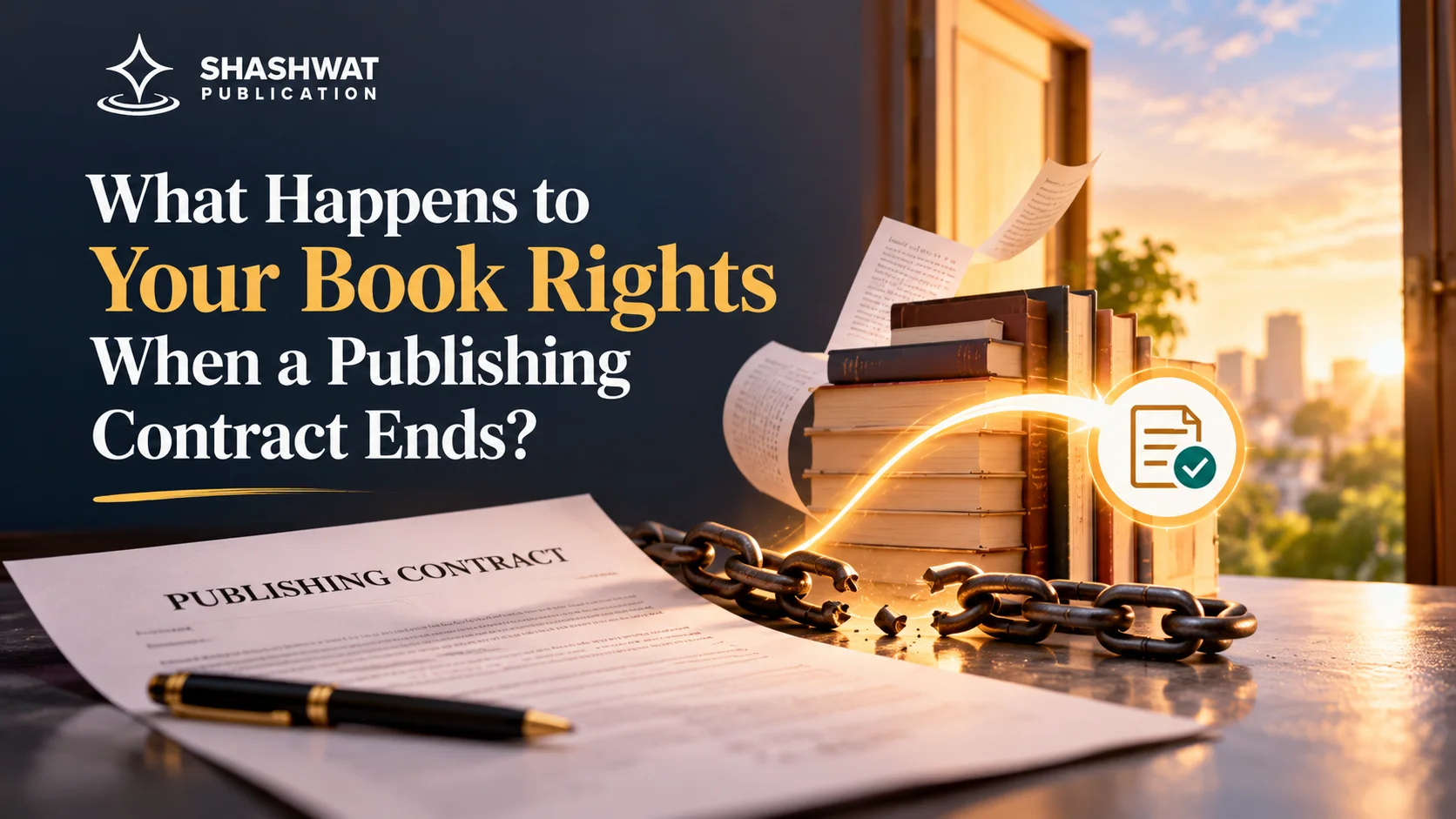
A publishing contract is an important agreement between an author and a publisher. It defines how a book can be published, distributed, marketed, and monetised, along with the rights and responsibilities of both parties. However, publishing agreements do not always last forever. A contract may expire after a specified period, end by mutual agreement, or be terminated under the conditions stated in the agreement.
When a publishing contract ends, one important question arises: what happens to your book rights?
The answer depends on the contract's wording, the type of rights granted, the applicable law, and the circumstances in which the agreement ends. Some rights may return to the author, while other permissions or obligations may continue under specific terms.
Understanding these details before signing a contract—and reviewing them again before it ends—can help authors protect their work and make informed decisions about its future.
Book rights refer to the permissions and legal rights associated with using, reproducing, publishing, distributing, or adapting a written work. A publishing contract may grant a publisher permission to use certain rights while allowing the author to retain others.
The agreement should clearly explain which rights are being granted, for how long, in which territories, and in what formats.
Copyright generally protects an author's original literary work. Under Indian law, the author is generally the first copyright owner, subject to statutory exceptions and the terms of any valid assignment or other applicable arrangement.
An author may grant or assign some or all relevant rights, depending on the agreement. Therefore, do not assume that signing a publishing contract always means either retaining every right or giving away every right.
A publisher may receive permission to produce, distribute, or sell a book in specified formats or territories. For example, an agreement might cover printed editions, digital editions, or particular geographic markets.
The contract determines the scope of those permissions and what happens when they expire or are terminated.
Translation rights concern producing a version of a book in another language. Adaptation rights may cover transforming the work into another form, subject to the rights actually granted.
These rights may be included in a publishing agreement or handled separately. Check whether they are exclusive, limited by territory, or subject to a separate term.
There is no single outcome for every book. The contract's expiry clause and rights provisions determine what happens next.
Some contracts state that specified rights return to the author when the agreement expires, is terminated, or meets defined conditions. This is commonly described as rights reversion.
For example, a contract may grant publishing rights for a defined term. Once that term ends, the author may regain the ability to arrange a new edition or enter into another publishing agreement, provided the contract's conditions have been satisfied.
However, rights do not necessarily revert automatically in every situation. The agreement may require written notice, a formal request, repayment of certain amounts, or completion of other steps.
If the publisher's licence ends, the publisher may no longer be entitled to produce or distribute new copies under the expired rights. The exact position depends on the contract and applicable law.
Some agreements contain sell-off periods that allow existing stock to be sold for a limited time. Others specify how unsold copies must be handled, whether they may be purchased by the author, or whether they must be destroyed.
Check the agreement for provisions covering existing inventory, reprints, digital listings, and the date on which permission to distribute ends.
A book may be available in digital form even after its print edition is no longer actively produced. If digital rights were granted separately or are subject to different conditions, those provisions need to be reviewed individually.
When the contract ends, clarify whether the publisher must remove digital editions, stop distributing new copies, or complete a transition process. Also check whether any permitted sell-off or transition period applies.
Do not assume that ending print rights automatically ends digital rights, or vice versa.
Ending a contract does not necessarily erase every obligation created while it was active. The agreement may contain provisions concerning unpaid royalties, final accounting, confidentiality, indemnities, outstanding costs, or disputes.
Review any clauses that expressly survive expiry or termination. If the contract is unclear about an important financial or legal obligation, obtain professional advice before taking action.
This is one of the most important questions for authors to understand.
Copyright ownership and publishing permission are related but different concepts. An author may own copyright while granting a publisher specific rights to publish a work. In another arrangement, copyright itself may have been assigned, wholly or partially, for a defined period or scope.
Under Sections 18 and 19 of India's Copyright Act, 1957, copyright can be assigned wholly or partially, and a written assignment must identify the work and specify the rights, duration, and territorial extent. The law also addresses consideration and the circumstances in which an assignment may lapse. <Cite refs={["turn482109search1","turn482109search24"]}/>
This means that the end of a publishing agreement should not be treated as an automatic answer to every copyright question.
To understand your position, establish:
Whether the agreement grants a licence or assigns copyright.
Which specific rights are covered.
Whether the grant is exclusive or non-exclusive.
The duration and territorial scope of the grant.
What the contract says about expiry, termination, and reversion.
Whether any rights were assigned separately in another agreement.
For a real contract, the complete wording matters. A legal professional familiar with copyright and publishing agreements can help interpret the clauses that apply to your situation.
Royalties earned during the contract period may remain payable even after the agreement expires. The contract should explain how sales are reported, how royalties are calculated, and when final payments are due.
Review the final statement to confirm the reporting period, number of copies sold, applicable royalty rates, and any permitted deductions or adjustments.
If the agreement provides for periodic statements after expiry, note the dates and requirements. Keep copies of previous statements so you can compare the final accounting with earlier reports.
An outstanding royalty balance does not necessarily disappear when a contract ends. The payment terms and any relevant legal rules will determine what remains payable.
If the final payment is delayed or the figures appear incorrect, request a written explanation and preserve relevant records, including sales statements and correspondence.
The contract may address copies sold during a sell-off period or transactions completed before the rights ended but reported later. It may also distinguish between physical inventory and ongoing digital distribution.
Confirm which sales remain eligible for royalties and whether any final reporting period applies. Do not rely on verbal assumptions when the agreement provides written terms.
You may be able to publish the same book again after a contract ends, but first confirm that the relevant rights are available to you.
If the necessary rights have reverted or were never granted exclusively, you may be able to arrange another edition, subject to the contract and applicable law.
Before making a new publishing arrangement, review the following:
Obtain written confirmation of the rights that have reverted, if required.
Confirm that the previous publisher's distribution permissions have ended or are properly limited.
Check whether any sell-off period remains active.
Review any restrictions on revised editions, illustrations, translations, or supplementary material.
Confirm who owns or controls cover artwork, illustrations, photographs, and other separately protected elements.
Check whether the new edition needs updated production files or new bibliographic information.
You may also wish to explore the book publication process to understand the practical steps involved in preparing a book for publication.
A contract ending can raise questions about the materials associated with the previous edition. These should be considered separately from the underlying copyright in the manuscript.
An ISBN identifies a particular book edition or product configuration. It should not be treated as proof of copyright ownership or as a substitute for a rights agreement.
If you plan to release a new edition, confirm the applicable ISBN requirements and ensure the bibliographic details are accurate. You can also review the book's title page, copyright page, edition statement, and publisher information before preparing new files.
The author may not automatically own every element created for a previous edition. Ownership and reuse permissions for cover designs, illustrations, photographs, and commissioned artwork depend on the relevant agreements and applicable law.
Check whether you have permission to reuse those materials. If not, you may need to obtain written permission or commission replacement artwork.
Ask what files you are entitled to receive under the contract. These may include the final manuscript, edited text, interior layout, cover files, or other production materials.
Do not assume that paying for a service automatically gives you ownership of every source file or design element. Verify the agreed deliverables and any restrictions on reuse.
Planning ahead makes the transition easier and reduces the risk of confusion.
Locate the contract's term, renewal, termination, and rights-reversion provisions. Identify the end date and check whether notice is required.
If the agreement renews automatically, confirm the deadline and method for giving notice.
Prepare a list of the rights covered by the agreement, including print, digital, translation, audio, territory, and adaptation rights where applicable.
Record which rights are assigned, licensed, excluded, or governed by separate agreements. This makes it easier to identify what needs clarification.
If the contract requires notice or written confirmation, follow the specified procedure. Ask for confirmation of the expiry date, the status of each granted right, final royalty accounting, and the handling of remaining stock or digital editions.
Keep copies of all notices and responses.
Organise the signed agreement, amendments, royalty statements, correspondence, manuscript files, artwork permissions, and production materials.
Having these records available will help you assess the position and prepare for the next stage of publication.
Before entering into another agreement, clarify any unresolved royalty payments, stock arrangements, permissions, or continuing obligations.
If a dispute arises or the contract contains an unclear rights assignment, seek legal advice before making commitments to another publisher.
First, review the contract carefully. The publisher may be relying on a renewal clause, a condition that has not yet been met, or a provision that allows certain activities to continue after expiry.
Ask for the publisher's position in writing and identify the specific clause on which it relies. Keep copies of relevant documents and avoid making assumptions based on informal conversations.
If the disagreement remains unresolved, a qualified legal professional can help assess the agreement, applicable law, and available remedies. The correct next step will depend on the wording of the contract and the facts of the dispute.
A contract ending can be an opportunity to review your book's future, but it is important to separate rights management from publishing preparation.
If you are considering a new edition, explore self-book publishing to understand another route to publication. You can also review the book publishing packages page when comparing available publishing options and deliverables.
For authors preparing a novel for a new edition, the novel publishing page may also be relevant.
Before selecting a new arrangement, compare the rights granted, publication timeline, distribution scope, costs, royalty terms, and responsibilities. Review every proposed agreement carefully so you understand which rights you are granting and for how long.
You can find further information about the publishing services offered by Shashwat Publication and evaluate which options fit your manuscript and publishing goals.
When a publishing contract ends, the future of your book depends on the rights granted, the contract's expiry and termination clauses, and the applicable law. Some rights may revert to the author, while other permissions, royalty obligations, or stock arrangements may continue under specific conditions.
Do not assume that copyright automatically returns in every situation or that all existing editions must disappear immediately. Review the signed agreement, obtain written confirmation where needed, and resolve outstanding financial and rights matters before making a new publishing commitment.
Most importantly, keep your publishing records organised and seek professional legal advice when the ownership or scope of your rights is uncertain. Understanding these details can help you make more confident decisions about the next chapter of your book's journey.
+91 99930 01841 | +91 99936 08164 | ssupport@shashwatpublication.com
2nd Floor, HN 46, Balaji Residency, Seept Road, Bilaspur, C.G 495001

Can’t find what you are looking for? Drop an email to support@shashwatpublication.com
The outcome depends on the contract. Certain publishing rights may revert to the author, while other obligations or permissions may continue for a defined period. Review the expiry, termination, and rights-reversion clauses.
Not necessarily. Copyright ownership depends on the original ownership position, the rights granted or assigned, the contract terms, and applicable law. The end of a publishing agreement does not automatically settle every copyright question.
You may be able to if the necessary rights are available to you and the previous agreement no longer restricts the proposed publication. Confirm rights reversion, any remaining sell-off period, and other relevant obligations first.
You may remain entitled to royalties on qualifying sales made during the contract period or under an agreed sell-off arrangement. The contract determines reporting, payment, and final accounting requirements.
Some contracts allow a limited sell-off period for existing stock. Others specify different arrangements. Check the agreement for the duration, permitted activities, and royalty treatment.
Not always. Print and digital rights may be covered by different provisions or terms. Review the agreement to determine when each permission ends and what steps are required.
Only if you have the necessary rights or permission to reuse it. Cover artwork, illustrations, photographs, and other creative elements may be governed by separate agreements.
Review the contract, request a written explanation, and keep relevant records. If the dispute cannot be resolved, consult a qualified legal professional to assess the agreement and available options.
No. An ISBN is an identifier for a book edition or product configuration. Copyright ownership and publishing rights are separate legal matters.
Review it well before the expiry date, especially if it contains automatic renewal or advance-notice requirements. Early preparation gives you time to clarify rights, resolve outstanding payments, and plan the book's next edition.


Dear Team, I would like to express my sincere appreciation for the seamless book publishing experience. As this is my debut publication, I will certainly be recommending Shashwat Publication.
I write this to express my deep sense of appreciation and gratitude to Shashwat Publication for publishing my first book in a time bound and professional manner. The first call from Ms Swati and her subsequent interactions, followed by dealing with ... Read More
Very Good publications
Publishing Experience with Shashwat Publications My experience with Shashwat Publications has been a fulfilling and memorable journey. From the initial stages of manuscript preparation to the final publication of my book, The Dental Prescriber: Fro... Read More
About Publishing Experience with Us As a first-time author with Shashwat Publications, I look forward to a professional, collaborative, and enriching publishing experience. I appreciate the opportunity to present this work to students and educators... Read More
I am satisfied with the work, it was not too long time taken by the publishers. Also the price is appropriate for publishing the book. I recommend other authors too, must have experience once with this publication. Worthy experiences. Thanks :)

B-75, Krishna Vihar, Koni, Bilaspur, C.G 495001
support@shashwatpublication.com
Timing
Important Pages
All rights are reserved by Aadeera Corporation Private Limited
Terms & Condition Apply