06-10-2026
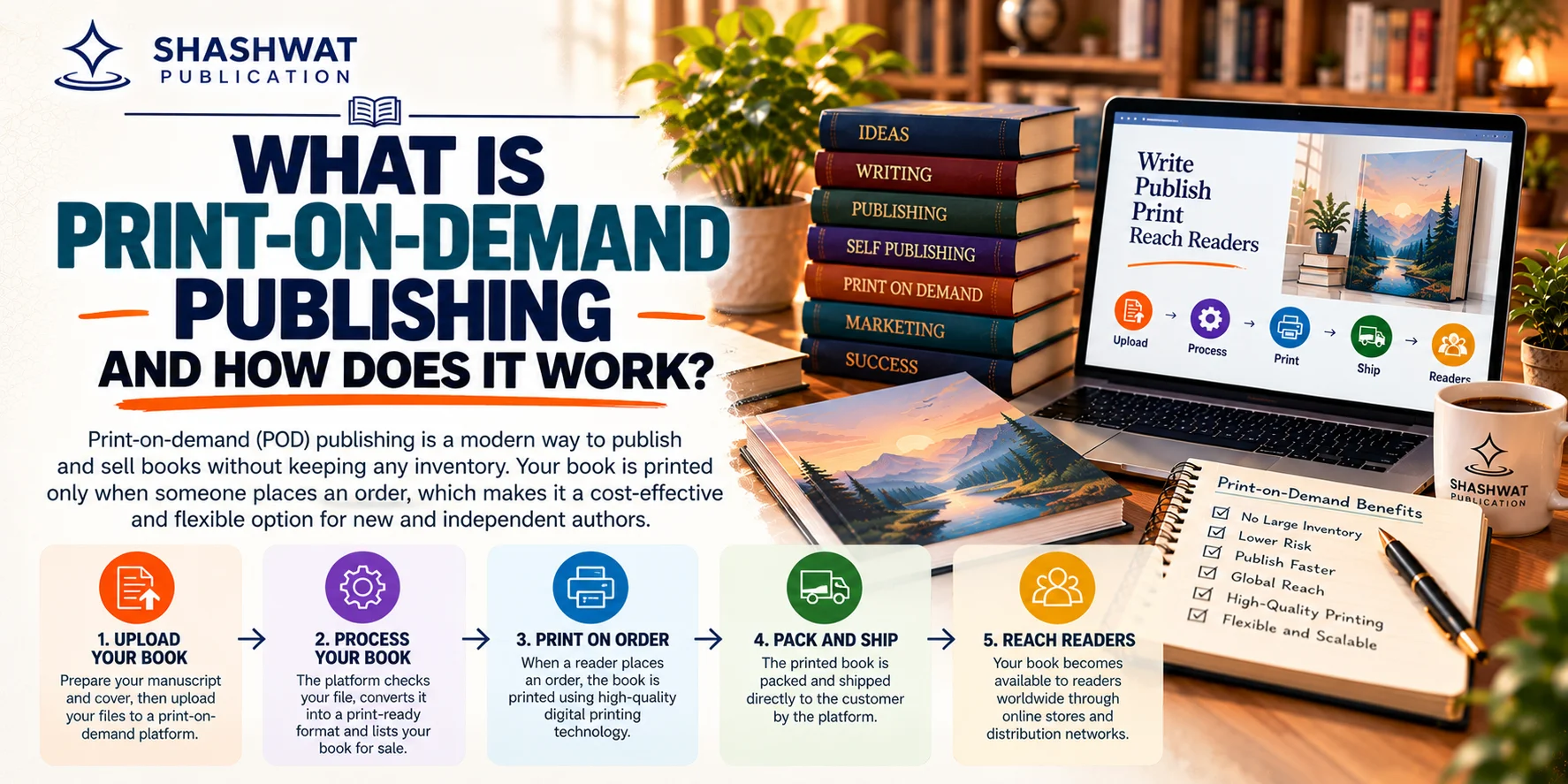
Print-on-demand publishing, commonly known as POD publishing, is a book production method in which physical copies are printed when they are needed, usually after an order is received. Instead of printing hundreds or thousands of copies in advance, authors can make their books available without maintaining a large inventory.
This approach has made book publishing more flexible for independent authors, first-time writers, poets, researchers, and small publishing businesses.
In traditional bulk printing, an author or publisher typically pays to produce a predetermined quantity of books. These copies must then be stored, managed, and distributed. With print-on-demand, production can be linked to actual demand, helping reduce the need for upfront inventory.
For example, an author who publishes a 200-page novel may not know how many readers will purchase it during the first few months. Rather than printing 500 copies immediately, the author can explore a print-on-demand arrangement in which individual copies are produced as orders arrive.
Authors considering this approach can explore self-publishing services in India to understand the publishing support available for preparing and distributing a book.
Print-on-demand publishing follows a series of steps, from manuscript preparation to printing and order fulfilment. The exact workflow depends on the publishing arrangement and distribution channels selected by the author.
The first step is to complete the manuscript. Before a book is prepared for printing, its content should be reviewed for grammar, spelling, consistency, readability, and structural issues.
Authors should also check chapter order, headings, page breaks, references, and any illustrations included in the manuscript.
A properly edited manuscript reduces the likelihood of making costly changes after the book has been prepared for production.
The cover is an important part of a book's presentation. It should communicate the genre, appeal to the intended readership, and display the title and author's name clearly.
For print-on-demand books, the complete cover may need to include the front cover, back cover, and spine. The spine width depends on factors such as the final page count, paper specifications, and printing requirements.
A professional cover design should follow the printer's specifications so that the finished book looks consistent and production-ready.
Interior formatting prepares the manuscript for physical printing.
This stage includes:
Selecting the book size.
Setting page margins.
Choosing readable fonts.
Formatting chapter headings.
Arranging page numbers.
Positioning images and tables.
Preparing the front matter and back matter.
Checking page breaks and alignment.
The final interior file is generally prepared according to the selected printing specifications.
Authors who need assistance with the overall publishing process can explore book publication services.
After editing, cover design, and formatting, the files are checked for production requirements.
This can include verifying page dimensions, image resolution, font embedding, bleed settings where necessary, cover dimensions, and the final page count.
A proof copy may be requested to check the physical appearance of the book before wider distribution begins.
Proofreading the digital file and checking a printed proof are both useful because certain layout issues are easier to identify on physical pages.
The book's publication details are prepared according to the chosen publishing arrangement.
These details may include the title, author name, description, book category, cover, ISBN where applicable, format, and selling price.
Distribution arrangements determine where the book may be listed or ordered. Availability depends on the publishing service, selected channels, geographical coverage, and applicable terms.
Authors should confirm which distribution services are included rather than assuming that print-on-demand automatically makes a book available everywhere.
Once the book is available for sale through a supported channel, a reader can place an order.
The order is processed according to the distribution and fulfilment arrangement. Depending on the service, the order information may be passed to a printing and fulfilment provider.
The author generally does not need to keep a large stock of books at home when the arrangement supports direct order-based production.
The physical copy is printed, bound, checked according to the provider's quality process, and prepared for dispatch.
Delivery time can depend on production workload, shipping distance, stock of materials, and the fulfilment arrangement.
Print-on-demand does not necessarily mean instant printing or immediate delivery. Authors should confirm the expected production and shipping timelines.
When a book sells, the amount payable to the author depends on the agreed royalty structure.
The calculation may take into account the selling price, printing cost, distribution charges, retailer deductions, taxes, and other contractual terms.
Authors should review how earnings are calculated, when payments are made, and whether any other deductions apply.
Both print-on-demand and bulk printing can produce professional books. The main difference is when the copies are printed and how much inventory is produced upfront.
|
Factor |
Print-on-Demand |
Bulk Printing |
|
Printing quantity |
Usually based on individual or smaller orders |
A larger quantity is printed in advance |
|
Initial inventory |
Generally low |
Usually higher |
|
Upfront investment |
Can be lower because fewer copies are printed initially |
Can be higher because a larger print run is paid for upfront |
|
Cost per copy |
May be higher per copy |
May be lower at larger quantities |
|
Storage |
Limited inventory may be needed |
Storage may be required |
|
Unsold stock risk |
Lower inventory exposure |
Greater risk if demand is overestimated |
|
Reprints |
Additional copies can be produced when needed |
Another print run may be required when stock runs low |
|
Best suited for |
New authors and uncertain demand |
Planned events and predictable high-volume demand |
The right option depends on expected sales, budget, storage capacity, book specifications, and distribution requirements.
For a broader understanding of production choices, read how to print a book in India.
Print-on-demand offers several advantages, particularly for authors who are publishing a book for the first time or testing demand for a new title.
One of the biggest advantages is that authors may not need to pay for a large number of copies before knowing whether readers will buy the book.
This can make it easier to launch a title without committing substantial funds to physical stock.
However, editing, design, formatting, setup, and other publishing services may still involve costs.
A large print run can require space to store cartons of books. Unsold copies may remain in storage for months or years.
With print-on-demand, authors can reduce their dependence on storage because copies are produced according to demand.
This can be especially useful for writers who do not have a dedicated storage space.
Predicting book sales is difficult, especially for a first-time author.
If an author prints too many copies and demand is lower than expected, the remaining stock can become a financial burden.
Print-on-demand reduces this risk by limiting the number of copies produced in advance. It does not eliminate all financial risk because publishing and service costs may still apply.
Authors may need additional copies when a book begins attracting more readers.
Under a suitable print-on-demand arrangement, further copies can be produced without requiring the author to plan a large new print run.
This makes production more flexible when demand changes over time.
New authors often have limited information about their potential readership.
Print-on-demand allows them to explore publication without immediately committing to hundreds of physical copies.
It can be a practical choice for novels, poetry collections, biographies, academic titles, and other books where early demand is uncertain.
Some books serve a specialised audience rather than a large general readership.
Examples include research publications, specialised educational material, regional-language books, and professional reference titles.
When demand is limited or irregular, printing copies as required can be more practical than maintaining a large inventory.
Authors may be able to order additional copies as required, depending on their publishing arrangement.
This can help with personal orders, selected events, author readings, academic activities, and promotional requirements.
The availability of these options should be confirmed with the publishing service before publication.
Although print-on-demand offers flexibility, it is not the ideal choice for every publishing project.
Printing a single copy can cost more per unit than printing hundreds of copies together.
Bulk printing can spread setup costs across a larger number of books, potentially reducing the per-copy production cost.
Authors expecting strong and predictable demand should compare the total cost of different printing quantities before making a decision.
The author may not directly control every aspect of the printing and fulfilment process.
Paper availability, printing equipment, binding specifications, production queues, and shipping arrangements can affect the final result.
It is important to confirm the available specifications and quality-control process before publishing.
A book may need to be printed after an order is placed. This adds a production stage before dispatch.
Authors selling books for a fixed-date event should plan ahead and confirm delivery timelines rather than relying on last-minute orders.
The final appearance of a book depends on paper, ink, cover material, binding, file quality, and the production process.
A well-prepared manuscript can still produce disappointing results if the files are incorrect or the selected specifications do not suit the book.
Where possible, authors should review a physical proof before approving the final production files.
Print-on-demand is a production method, not a guarantee of retail placement or sales.
A book still needs appropriate distribution arrangements, accurate metadata, pricing, and visibility.
Authors should understand which sales channels are supported and whether additional distribution services are required.
Printing a book only when it is ordered does not automatically attract readers.
Authors may still need a marketing plan involving relevant content, reader outreach, author branding, book launches, and promotional activities.
Explore book marketing and promotion services to understand how marketing can support a book after publication.
There is no single fixed cost for print-on-demand publishing in India. The total expense depends on the book's specifications, publishing services, and the arrangement used to print and distribute copies.
Important cost factors include:
Manuscript editing and proofreading.
Cover design.
Interior formatting.
Page count.
Book dimensions.
Paper quality.
Colour or black-and-white printing.
Binding type.
Number of copies ordered.
Distribution charges.
Packaging and shipping.
Marketing and promotional services.
Suppose an author sells a paperback for ₹299. The amount the author receives is not necessarily ₹299 because printing, distribution, retailer deductions, taxes, and other applicable charges may reduce the amount payable.
For illustration only, consider the following hypothetical calculation:
| Item | Example Amount |
| Selling price | ₹299 |
| Printing cost | ₹90 |
| Distribution and other deductions | ₹60 |
| Remaining amount before other applicable costs | ₹149 |
In this example, ₹149 remains after the two assumed cost categories. It is not a guaranteed royalty or profit. The actual amount will depend on the contract and the real costs involved.
Authors should request a transparent cost breakdown and understand the royalty calculation before agreeing to publish.
For a more detailed discussion of publishing expenses, read how much it costs to publish a book in India.
Print-on-demand can be financially practical, but profitability depends on the book's pricing, production costs, sales volume, marketing, and royalty arrangement.
Its primary financial advantage is often the reduction in inventory commitments rather than the lowest possible cost per printed copy.
A book may sell only a few copies each month and still benefit from not having hundreds of unsold copies in storage. On the other hand, an author expecting high-volume sales may find bulk printing more economical.
Before deciding, consider:
The total publishing setup cost.
The printing cost per copy.
The expected selling price.
Distribution and retailer deductions.
Shipping and taxes where applicable.
The author's royalty or earnings per sale.
Realistic sales expectations.
Marketing expenses.
Avoid making a decision based only on an advertised royalty percentage. The amount that matters is the actual payment calculated under the agreed terms.
Print-on-demand can support different genres and publishing needs.
Writers can publish novels without necessarily ordering a large quantity of copies upfront. This is useful when demand is uncertain or the author wants to keep inventory manageable.
Poets may have a specialised readership and may prefer flexible printing quantities. POD can help make a poetry collection available without requiring a large initial print run.
Learn more about poetry book publishing.
Specialised academic titles may serve a smaller audience. Printing copies as needed can be useful when demand is irregular.
Authors should ensure that charts, tables, references, diagrams, and other technical content are formatted correctly for print.
Personal histories, biographies, and memoirs may appeal to a specific readership. POD can be suitable when authors want to make the book available without storing large quantities.
Some educational books are needed throughout the year, while others have seasonal demand. Print-on-demand can provide flexibility when order quantities are difficult to predict.
The final choice should depend on the book's format, expected readership, production requirements, and distribution plan.
Authors considering print-on-demand need to think about more than the printing process. A book must also be edited, designed, formatted, prepared for publication, and supported by suitable distribution arrangements.
Shashwat Publication provides self-publishing services for authors who need assistance with different stages of the publishing journey.
Its self-publishing information describes services such as:
Editing and proofreading.
Cover design.
Interior formatting.
ISBN and copyright-related support.
Print and digital publishing options.
Print-on-demand.
Distribution assistance.
Marketing and promotion.
The services available to an author depend on the selected publishing package and agreement. Authors should confirm the current terms, production specifications, distribution coverage, and costs before proceeding.
You can explore self-publishing in India to learn more about the publishing process and available services.
Before signing a publishing agreement, ask the following questions to understand exactly what you are paying for.
Confirm whether editing, proofreading, cover design, interior formatting, ISBN assistance, and distribution are included or charged separately.
Ask about book size, paper options, binding, colour printing, cover finish, and quality-control procedures.
Check whether you can order additional copies for personal use, book launches, events, or direct sales.
Ask for a written explanation of the selling price, printing charges, distribution deductions, payment schedule, and royalty calculation.
Confirm the supported sales and distribution channels. Do not assume that print-on-demand automatically guarantees availability in every bookstore or country.
Ask whether a physical proof is available and whether changes can be made before the book is approved for production.
Clarify the process and cost for correcting errors, changing the cover, revising the manuscript, or updating publication details.
Read the publishing agreement carefully. Understand copyright ownership, licensing permissions, exclusivity, termination terms, and the conditions under which your book can be republished.
Before making your book available, make sure you have completed the following steps.
Finalise the manuscript.
Complete editing and proofreading.
Approve the book cover.
Check the interior formatting.
Confirm the print specifications.
Review a proof copy where available.
Verify the title and author information.
Confirm ISBN requirements.
Understand distribution arrangements.
Review the book's selling price.
Confirm printing costs and royalty terms.
Prepare a marketing plan.
Keep a copy of the publishing agreement.
Following this checklist can help reduce avoidable mistakes and make the publishing process easier to manage.
Print-on-demand publishing is a flexible way to produce physical books according to demand rather than committing to a large print run upfront. It can help authors reduce inventory requirements, minimise storage needs, and make books available even when sales volumes are uncertain.
However, POD is not automatically the cheapest option per copy, and it does not guarantee sales or distribution everywhere. Authors should compare production costs, publishing services, quality, royalty terms, and distribution arrangements before choosing their publishing approach.
For writers who want professional assistance throughout the publishing journey, Shashwat Publication offers self-publishing services that include book preparation and print-on-demand options. Understanding the available services and agreement terms can help authors make an informed decision about publishing their work.
+91 99930 01841 | +91 99936 08164 | ssupport@shashwatpublication.com
2nd Floor, HN 46, Balaji Residency, Seept Road, Bilaspur, C.G 495001

Can’t find what you are looking for? Drop an email to support@shashwatpublication.com
Print-on-demand publishing is a production method in which physical books are printed when orders are received or when copies are otherwise required. It reduces the need to print and store a large quantity of books upfront.
The author prepares the manuscript, finalises the cover and interior formatting, and prepares the required publishing files. Once the book is available through a supported distribution arrangement, copies can be printed when orders arrive and then dispatched to readers.
Yes. It can be suitable for new authors because it reduces the need to invest in a large inventory before knowing how many copies readers may purchase. Editing, design, setup, and other publishing costs may still apply.
Print-on-demand can reduce upfront inventory investment and storage requirements, but its cost per copy may be higher. Bulk printing can offer lower per-copy costs when larger quantities are needed.
Yes. Print-on-demand can be used to produce paperback books, subject to the specifications offered by the selected printing and publishing service.
Not necessarily. Printing and distribution are separate functions, although some publishing services combine them. Authors should confirm which distribution channels are included in their agreement.
ISBN requirements depend on the edition, format, and intended distribution. Authors should check the applicable requirements and confirm whether ISBN assistance is included in their publishing arrangement.
It can be profitable depending on the selling price, printing cost, distribution deductions, sales volume, marketing expenses, and royalty terms. Authors should calculate their expected earnings using actual costs rather than assuming every sale will generate a fixed profit.
Yes. Print-on-demand can be suitable for poetry collections, academic publications, research books, novels, biographies, and other genres, particularly when demand is uncertain or specialised.
Shashwat Publication's self-publishing information describes print-on-demand among its services. Authors should contact the company to confirm the current availability, package inclusions, production specifications, and applicable charges.
Updates may be possible, depending on the publishing arrangement. Changes to the manuscript, cover, or publication details may require revised files, review, and additional charges.
Compare printing quality, available formats, total costs, distribution coverage, royalty calculations, author-copy options, update policies, and customer support. Review the publishing agreement carefully before making your final decision


Very Good publications
Publishing Experience with Shashwat Publications My experience with Shashwat Publications has been a fulfilling and memorable journey. From the initial stages of manuscript preparation to the final publication of my book, The Dental Prescriber: Fro... Read More
About Publishing Experience with Us As a first-time author with Shashwat Publications, I look forward to a professional, collaborative, and enriching publishing experience. I appreciate the opportunity to present this work to students and educators... Read More
I am satisfied with the work, it was not too long time taken by the publishers. Also the price is appropriate for publishing the book. I recommend other authors too, must have experience once with this publication. Worthy experiences. Thanks :)
शाश्वत पब्लिकेशन एक मार्गदर्शक है दिशादर्शक है और आपकी मंजिल तक पहुचाने का बहुत शांतीदायी रास... Read More
It was really a very smooth and wonderful interaction with Shashwat Publication while writing my book. They were very much approachable and helpful in each step. All information was given to me with complete clarity. Whatever corrections were requir... Read More

B-75, Krishna Vihar, Koni, Bilaspur, C.G 495001
support@shashwatpublication.com
Timing
Important Pages
All rights are reserved by Aadeera Corporation Private Limited
Terms & Condition Apply