08-10-2026
A book copyright page is a page near the beginning of a book that contains important legal, ownership and publication information. It commonly appears on the reverse side of the title page and is also known as the copyright notice page or title verso page.
This page helps readers, libraries, booksellers and other professionals identify the book, understand its publication details and find information about the rights associated with its content.
A typical copyright page may include the copyright notice, author's name, publication year, publisher details, ISBN, edition information, printing details and relevant disclaimers.
For example, a novel may include a copyright notice, a statement restricting unauthorised reproduction, its ISBN and publisher information. An academic book may also contain information about research sources, permissions, contributors or a disclaimer explaining that the author's views do not necessarily represent an institution's views.
Although the copyright page is often short, it plays an important role in presenting a book professionally.
Authors preparing a manuscript for publication can explore book publication services to understand the support available for preparing a book for release.
A copyright page serves several practical purposes. It provides publication information, identifies the claimed copyright owner and communicates relevant rights and restrictions.
A copyright notice can identify the person or entity claiming copyright in the book and the year associated with the notice.
This is especially useful when an author wants to make ownership information clear to readers and other parties who may wish to reproduce or use the work.
The name on the copyright notice should accurately reflect the relevant ownership arrangement. An author should not automatically assume that the publisher owns the copyright simply because the publisher produced the book.
The copyright page can record the publisher's name, publication year, edition and other details.
This information helps distinguish one edition from another and supports accurate identification of the book.
An ISBN, or International Standard Book Number, is a unique identifier assigned to an eligible book publication or edition.
For printed books, the ISBN is commonly displayed on the copyright page or at the foot of the title page when there is insufficient space. It may also appear as a barcode on the back cover.
ISBN placement and assignment requirements should be checked for the specific publication format. <Cite refs={["turn581059search24","turn581059search5"]}/>
A rights statement can explain that the work may not be reproduced, distributed or adapted without appropriate permission, subject to applicable law.
This can help readers understand that purchasing a copy of a book does not automatically grant permission to reproduce or commercially reuse its contents.
A well-organised copyright page helps make a book look complete and professionally prepared.
It also gives readers and institutions a convenient place to find essential publication information without searching through the rest of the book.
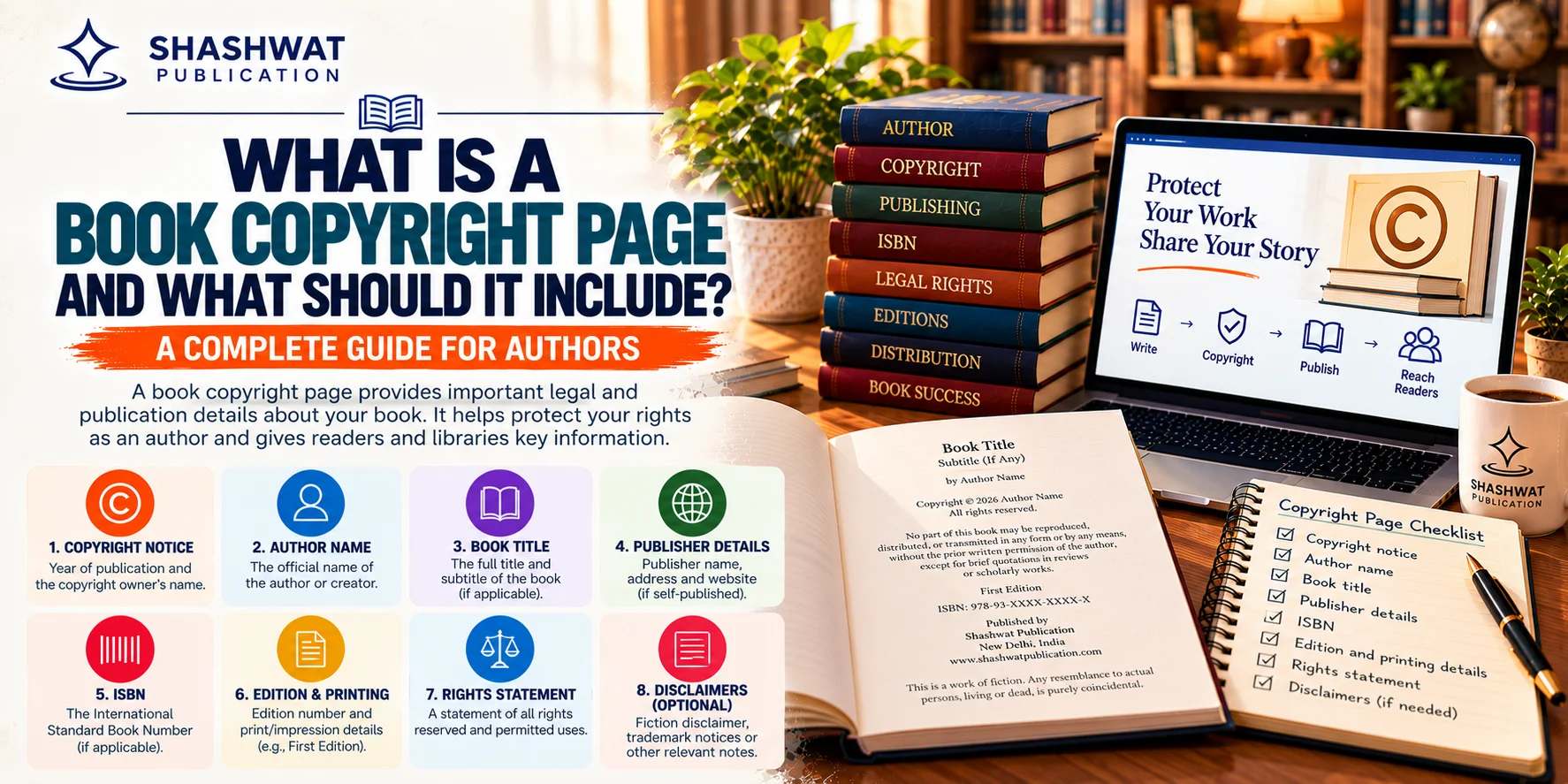
The exact contents vary depending on the genre, format, publisher and legal requirements. However, the following elements are commonly considered when preparing a copyright page.
The copyright notice generally includes the copyright symbol, year and name of the copyright owner.
Example:
Copyright © 2026 by [Author Name]
All rights reserved.
Replace the placeholder with the correct name and year. Do not use a year simply because the manuscript was completed in that year; the appropriate year should reflect the relevant publication and copyright circumstances.
The copyright notice should also accurately identify the person or entity that owns the relevant rights.
A rights statement explains how the content may be used and whether permission is required for certain activities.
A common example is:
“No part of this book may be reproduced, stored in a retrieval system, or transmitted in any form or by any means without prior written permission from the copyright owner, except as permitted by applicable law.”
This is sample wording, not a guarantee of legal protection in every situation. The statement should be adapted to the book and the rights arrangement.
A rights statement should not be treated as a substitute for understanding the applicable copyright law.
The copyright page should identify the author or the relevant copyright owner accurately.
If a book has multiple authors, editors, translators or contributors, the appropriate credits may need to be included.
For books written under a pen name, the author should decide how the name will appear in the publication while ensuring that the copyright ownership information remains accurate.
The page may include the publisher's name and relevant publication details.
For a self-published book, the author may publish under their own name or an appropriately established publishing imprint, depending on the arrangement.
Do not include a publisher's name without authorisation or imply that an organisation has published the book when it has not.
The ISBN identifies the relevant book edition or format for bibliographic and distribution purposes.
Include the assigned ISBN exactly as provided. Check that the number corresponds to the correct title, edition and format.
Do not invent an ISBN or copy the number from another book.
An edition statement helps distinguish a revised or updated edition from an earlier version.
Examples include:
First Edition
Second Edition
Revised Edition
Updated Edition
Only include an edition statement that accurately describes the book.
A reprint that contains no substantive changes should not automatically be described as a revised edition.
The copyright page may include the year of publication and, where relevant, printing information.
For example:
First published in 2026.
If a book is subsequently reprinted or revised, the publication details should be updated as appropriate.
The wording should reflect the actual publication history rather than imply that a book was released in a year when it was not.
Depending on the publishing arrangement, the page may contain the publisher's address or the printer's details.
These details should be accurate and included where required or appropriate.
The publisher and printer are not necessarily the same entity. The printer produces the physical copies, while the publisher manages the publication under the applicable arrangement.
Some books benefit from a disclaimer that explains the intended use of the content or limits the scope of certain statements.
For example, a general educational book may state that it is intended for informational purposes and is not a substitute for individual professional advice.
A novel may not require such a disclaimer, while a specialised professional or technical publication may need one tailored to its subject.
A disclaimer should be relevant, accurate and proportionate. It cannot automatically eliminate legal responsibility.
If a book contains photographs, illustrations, charts, quotations or other material created by third parties, relevant acknowledgements or permission details may be needed.
The precise placement of these credits depends on the material, the applicable licence and the agreement with the rights holder.
Do not assume that mentioning the creator's name automatically gives permission to reproduce their work.
A book may contain brand names, product names or other trademarks. A trademark statement may be appropriate in certain publications, depending on the content and legal circumstances.
It is not a mandatory element of every copyright page. Include it only when there is a genuine reason to do so.
Some publications include bibliographic or library cataloguing information to support identification and classification.
The appropriate information depends on the publication and any applicable cataloguing process. Authors should not invent cataloguing numbers or claim that cataloguing approval has been granted when it has not.
The following example illustrates how a basic copyright page may be arranged for a fictional book. Replace all placeholders with accurate information before publication.
<box border radius="lg" padding={4} gap={3}> <text textAlign="center" weight="medium">COPYRIGHT PAGE — SAMPLE</text> <divider /> <text>Copyright © 2026 by [Author Name]</text> <text>All rights reserved.</text> <text>No part of this book may be reproduced, distributed, or transmitted in any form without prior written permission from the copyright owner, except as permitted by applicable law.</text> <text>**Title:** [Book Title]</text> <text>**Author:** [Author Name]</text> <text>**Publisher:** [Publisher Name]</text> <text>**ISBN:** [Assigned ISBN]</text> <text>**Edition:** First Edition</text> <text>**Publication Year:** 2026</text> <text>**Cover Design:** [Name, if applicable]</text> <text>**Editing:** [Name, if applicable]</text> <text>**Printing:** [Printer Name, if applicable]</text> <text>**Disclaimer:** The views and opinions expressed in this book are those of the author, unless otherwise stated.</text> <divider /> <caption>This is an illustrative template. Include only details that apply to your book, and adapt the rights statement and disclaimer to the actual publishing arrangement.</caption> </box>
Not every book needs all these fields. For example, cover design credits, editing credits, printing information and a disclaimer may be optional depending on the book and the publishing arrangement.
The most important consideration is accuracy. The copyright page should not contain invented ISBN details, false publisher information or unsupported claims about rights.
In a typical printed book, the copyright page appears near the beginning, usually on the reverse side of the title page.
A common front-matter sequence is:
Half-title page, if used
Title page
Copyright page
Dedication, if included
Table of contents
Preface or introduction, where applicable
Main content
The exact sequence can vary by genre, format and publishing style.
For an eBook, the copyright information is generally placed among the opening pages or screens, where readers can readily find it.
The important point is to keep the information accessible and ensure that it corresponds to the correct edition.
A copyright page is a common publishing convention, but the exact legal requirements depend on the country, publication type and circumstances.
In India, original literary works can receive copyright protection under the applicable copyright law. The official Indian intellectual property guidance explains that copyright protects the expression of an idea rather than the idea itself, and that copyright generally arises automatically when an original work is created. Registration is not mandatory, although it can serve as evidence of ownership. <Cite refs={["turn581059search6","turn581059search1"]}/>
Therefore, authors should distinguish between three separate matters:
Copyright protection: The legal rights that may arise in an original work.
Copyright page: The publication page that communicates ownership and bibliographic information.
Copyright registration: A separate administrative process for registering a claim where appropriate.
Including a copyright notice on a book does not itself establish that a formal registration has been completed.
For complex ownership arrangements, co-authored works, licensed content or disputes, consider obtaining advice from a qualified legal professional.
A copyright page and an ISBN serve different purposes.
| Feature | Copyright Page | ISBN |
| Main purpose | Presents copyright and publication information | Identifies a specific book publication or edition |
| Contents | May include rights notice, author, publisher and edition | A unique identification number |
| Ownership information | Can identify the claimed copyright owner | Does not establish copyright ownership |
| Format | A page or section of a publication | A numerical identifier |
| Placement | Usually near the beginning of a book | Often on the copyright page and/or back cover, as appropriate |
An ISBN is not a copyright registration number. Likewise, including an ISBN does not prove that the person assigning or using it owns the copyright.
Both can be useful for different reasons when preparing a book for publication.
The basic elements are similar across many genres, but certain publications may require additional information.
A novel's copyright page commonly includes the copyright notice, rights statement, publisher details, ISBN, edition and publication year.
A fictional-work disclaimer may be included if appropriate, but the wording should accurately reflect the work and should not be treated as a blanket legal safeguard.
Poetry collections may include the same core publication details as novels.
If the book includes illustrations, photographs, previously published poems or third-party material, the author should check whether acknowledgements or permissions are required.
Academic books may require contributor credits, acknowledgements, research-related disclaimers, permissions and other publication information.
Authors should ensure that quotations, figures, tables and reproduced material are used in accordance with the applicable rights and permissions.
Children's books may include illustrations, translations or contributions from several creators.
The author and publisher should confirm the appropriate credits and rights arrangements for all included content.
An eBook should contain appropriate copyright and publication information in a format suitable for digital reading.
The relevant ISBN, if assigned, should correspond to the digital edition. The requirements for identifying and displaying an eBook should be checked for the intended format and distribution arrangement.
A copyright page should be simple and accurate. The following mistakes can create confusion or lead to avoidable problems.
Do not automatically list the publisher as the copyright owner. Confirm who owns the relevant rights under the actual agreement.
Check the assigned ISBN against the correct title and format before finalising the files.
A sample can provide a useful structure, but copying another author's ownership statement, publisher details or ISBN is inappropriate.
Prepare a page that accurately reflects your own publication.
A rights statement should not imply that all uses are prohibited regardless of applicable legal exceptions.
Use wording appropriate to the publication and relevant jurisdiction.
If the book contains third-party photographs, illustrations, charts or substantial quotations, confirm the relevant permission requirements and include appropriate credits where required.
Ensure that the publication year and edition details accurately reflect the book's history.
A copyright notice is not the same as a formal copyright registration record.
Do not claim that a work has been registered unless the relevant registration has actually been completed.
Preparing a book for publication involves more than writing and editing the manuscript. Authors also need to review formatting, front matter, publication details, cover design and other production requirements.
Shashwat Publication offers book publishing services for authors preparing different types of books.
Depending on the selected services and publishing agreement, support may include manuscript editing, proofreading, cover design, interior formatting, ISBN-related assistance, printing and distribution.
Authors should confirm the exact service inclusions and the responsibilities assigned to the author and publisher before publication.
If you are preparing a manuscript for release, explore self-publishing in India to learn more about the publishing process and available support.
Before approving your book's interior files, check the following:
Copyright year is accurate.
Copyright owner is correctly identified.
Rights statement has been reviewed.
Author name and book title are correct.
Publisher information is accurate.
ISBN matches the correct edition and format.
Edition and publication details are correct.
Credits and permissions have been checked.
Any disclaimer is relevant and accurate.
Printing details are included where appropriate.
Copyright page is placed correctly.
The final formatted page has been proofread.
This checklist helps ensure that the copyright page is complete, consistent and suitable for the intended publication.
A book copyright page provides important information about ownership, publication, identification and the permitted use of a book's content. Although its format is usually simple, the information it contains should be accurate and consistent with the book's actual rights and publication arrangements.
Most authors should begin with the copyright notice, author and publisher details, ISBN where applicable, edition and publication information, and a suitable rights statement. Additional elements, such as credits, disclaimers and cataloguing information, can be included when relevant.
A copyright page does not replace copyright registration or legal advice, and it should not contain claims that cannot be supported.
If you are preparing your first book, review the copyright page carefully alongside the cover, interior formatting and other front-matter pages. Professional publishing support can help you organise these details and prepare a polished book for publication.
+91 99930 01841 | +91 99936 08164 | ssupport@shashwatpublication.com
2nd Floor, HN 46, Balaji Residency, Seept Road, Bilaspur, C.G 495001

Can’t find what you are looking for? Drop an email to support@shashwatpublication.com
A copyright page is a page near the beginning of a book that presents copyright, ownership and publication information. It commonly includes the copyright notice, author and publisher details, ISBN, edition and publication year.
A copyright page commonly includes a copyright notice, copyright owner's name, rights statement, book title, author name, publisher information, ISBN where applicable, edition and publication year. Credits, disclaimers and printing details may also be included when relevant.
The exact legal requirements depend on the jurisdiction and publication. A copyright page is a standard publishing convention, but including one is not the same as obtaining formal copyright registration.
A copyright page communicates ownership and relevant usage restrictions, but it does not prevent every instance of copying. Copyright protection depends on applicable law and the circumstances of the work. The notice itself is not a substitute for legal enforcement.
In a typical printed book, the copyright page appears near the beginning, usually on the reverse side of the title page. In an eBook, copyright information is generally included among the opening pages or screens.
For a printed book, the ISBN is commonly included on the copyright page or at the foot of the title page if there is insufficient room. The relevant ISBN should match the book's edition and format.
No. An ISBN identifies a book publication or edition, while copyright registration is a separate administrative process. An ISBN does not establish copyright ownership.
Yes. Authors can prepare their own copyright page using accurate ownership, publication and identification details. For complicated rights arrangements or legal concerns, professional legal advice may be appropriate.
A disclaimer may be appropriate for certain educational, professional, technical or fictional publications. It should be relevant to the book's content and should not be treated as a guarantee against legal responsibility.
Shashwat Publication offers book publishing services that may include editing, proofreading, cover design, interior formatting and ISBN-related assistance, depending on the selected services and agreement. Authors should confirm the current package details directly.


Very Good publications
Publishing Experience with Shashwat Publications My experience with Shashwat Publications has been a fulfilling and memorable journey. From the initial stages of manuscript preparation to the final publication of my book, The Dental Prescriber: Fro... Read More
About Publishing Experience with Us As a first-time author with Shashwat Publications, I look forward to a professional, collaborative, and enriching publishing experience. I appreciate the opportunity to present this work to students and educators... Read More
I am satisfied with the work, it was not too long time taken by the publishers. Also the price is appropriate for publishing the book. I recommend other authors too, must have experience once with this publication. Worthy experiences. Thanks :)
शाश्वत पब्लिकेशन एक मार्गदर्शक है दिशादर्शक है और आपकी मंजिल तक पहुचाने का बहुत शांतीदायी रास... Read More
It was really a very smooth and wonderful interaction with Shashwat Publication while writing my book. They were very much approachable and helpful in each step. All information was given to me with complete clarity. Whatever corrections were requir... Read More

B-75, Krishna Vihar, Koni, Bilaspur, C.G 495001
support@shashwatpublication.com
Timing
Important Pages
All rights are reserved by Aadeera Corporation Private Limited
Terms & Condition Apply