10-10-2026
An author bio, or author biography, is a short introduction that tells readers who you are, what you write and why your background may be relevant to your book.
It commonly appears on a book's back cover, inside flap, author page, website, online book listing or promotional material. Depending on the purpose, it may include your profession, education, writing experience, achievements, interests and previous publications.
A good author bio does more than list personal details. It helps readers understand the person behind the book and creates a connection between the author and the intended audience.
For example, an author writing a personal finance book may highlight relevant professional experience, while a novelist may focus on storytelling interests, literary achievements and the themes explored in their work.
The goal is not to make yourself sound impressive at any cost. It is to present accurate, relevant information in a clear and engaging way.
Authors preparing their books for publication can explore book publication services to understand the different stages involved in preparing a book for readers.
An author bio can contribute to the way readers discover and understand a book. It is also useful when an author introduces themselves to publishers, event organisers, interviewers and professional contacts.
Readers often want to know something about the person who wrote a book.
A relevant author bio can help establish context by highlighting the author's experience, knowledge, interests or writing background.
For example, a researcher writing about a specialised academic subject may mention relevant research experience. A first-time fiction writer may explain their interest in storytelling without claiming previous publishing achievements.
A professional bio helps you communicate your identity as a writer.
It can explain what you write, which subjects interest you and what readers can expect from your work.
Over time, a consistent author biography can support your presence across books, websites, interviews and promotional activities.
If your book covers a specialised topic, your background may help readers understand your perspective.
Relevant details may include professional experience, qualifications, research interests, teaching experience or practical knowledge.
Only include credentials that are accurate and relevant to the book.
An author bio can include a small personal detail that helps readers connect with you.
For example, a nature writer may mention an interest in wildlife observation, while a novelist may describe a lifelong fascination with storytelling.
Such details can make a bio more memorable without turning it into a lengthy personal history.
A professional bio can be reused across appropriate marketing materials, including your author website, book launch announcements, interviews and event introductions.
A consistent biography helps maintain a recognisable author identity while allowing you to adjust its length for different platforms.
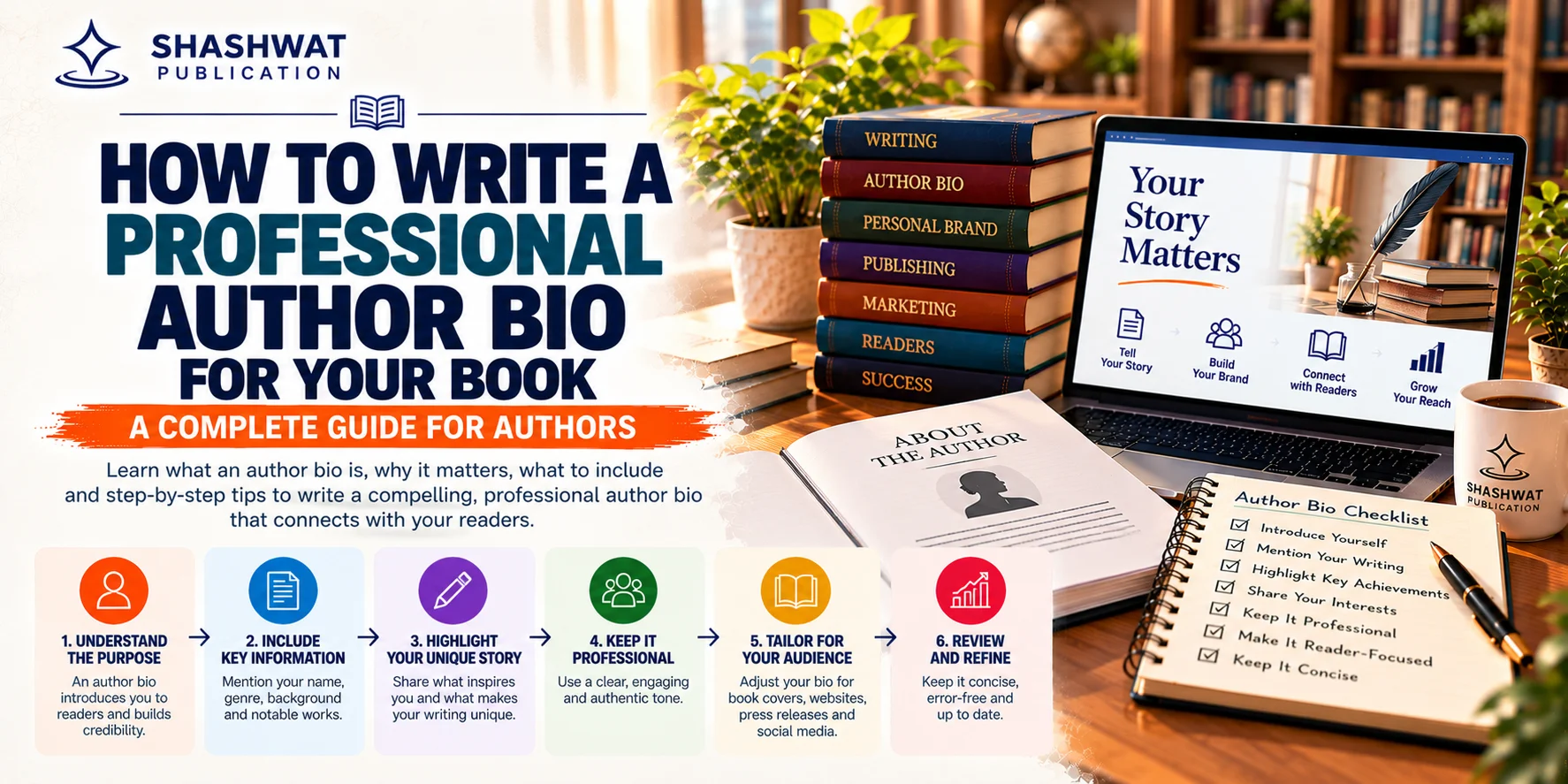
There is no single format that works for every author. However, most professional biographies include a few common elements.
Begin with the name you use professionally as an author.
If you write under a pen name, use that name where appropriate for your author-facing biography.
Keep your name consistent across your book cover, author page and promotional materials.
Briefly explain what you do or what experience informs your writing.
Depending on your background, this could include your profession, education, research interests, creative work or personal experience relevant to the book.
You do not need to include your entire employment history.
Tell readers what you write.
You might focus on fiction, poetry, self-help, academic research, biographies, business, education or another subject area.
This helps readers understand your writing interests and makes your bio more specific.
Include meaningful achievements when they are relevant.
Examples include:
Previous books or publications
Literary awards
Academic qualifications
Professional certifications
Research contributions
Relevant teaching or industry experience
Significant writing projects
If you are a new author without formal achievements, do not worry. A clear introduction to your interests and book is enough to create a useful biography.
Where appropriate, explain how your background or interests relate to the subject of your book.
For example, a book about gardening may be written by someone with years of practical gardening experience. A memoir may be introduced through the author's personal connection to the events described.
Keep this explanation concise and avoid revealing unnecessary personal information.
One relevant personal detail can make your bio feel more human.
You might mention a favourite writing environment, an interest that inspires your stories or a subject you enjoy exploring.
Personal details are optional. They should support the tone of the book rather than distract from it.
For a longer author biography, you may include your official website or a professional contact method.
This can help readers discover more about your work.
For a short back-cover bio, contact information may be unnecessary. Follow the design and publishing requirements for the specific placement.
The ideal length depends on where the biography will appear.
|
Type of Author Bio |
Suggested Length |
Main Purpose |
|
Short author bio |
30–50 words |
Back cover or compact book listing |
|
Standard author bio |
75–120 words |
Book interior or author profile |
|
Detailed author bio |
150–250 words |
Author website or professional profile |
|
Speaker or event bio |
50–100 words |
Introductions for events and interviews |
|
Academic author bio |
75–150 words |
Relevant qualifications and research experience |
These are practical guidelines, not strict rules. The publisher, book design or event organiser may specify a different length.
A short bio should focus on the most important information. A longer version can provide more background, but it should still remain relevant and easy to read.
Follow these steps to create a biography that introduces you clearly and professionally.
Before writing, consider who will read the bio.
Readers of an academic book may be interested in qualifications and research experience. Readers of a novel may be more interested in your storytelling interests and literary background.
The intended audience should influence which details you include.
A back-cover biography has a different purpose from a professional author profile.
For a back cover, the objective is to introduce the author in a few sentences. For a website, you can provide more detail about your background, writing journey and publications.
Choose the purpose before drafting the bio.
Write down the facts you may want to include:
Name
Profession
Education, where relevant
Writing interests
Relevant experience
Previous publications
Achievements
Personal interests
Website or professional contact
Select only the details that support your author identity.
Most book biographies are written in the third person.
For example:
“Priya Sharma is a writer who explores themes of family, identity and personal growth.”
This format allows publishers, event organisers and other professionals to reuse the biography easily.
First-person bios can also work on personal websites or social profiles when a conversational style is appropriate.
Begin with your name and a meaningful description of your work.
Avoid vague openings such as “I am a person who loves many things.”
Instead, introduce your profession, genre or writing focus directly.
Use the next one or two sentences to explain your relevant experience, writing interests or achievements.
Choose details that strengthen the introduction rather than repeating it.
You can conclude with a personal interest, a brief statement about your writing or a reference to your website.
A call to action is optional. Do not force a promotional ending into a short book bio.
Read the bio aloud and remove unnecessary words.
Check spelling, grammar, sentence flow and factual accuracy. Ensure that the biography fits the space available in the book or on the intended platform.
The following examples use fictional names and illustrative details. Replace them with accurate information about your own background and writing.
Example:
“Ananya Verma is an emerging writer who enjoys exploring human relationships, everyday experiences and personal growth. Her writing reflects an interest in the choices that shape people's lives. This book marks an important step in her journey as an author.”
Why it works: It introduces the writer and their interests without inventing awards or previous publications.
Example:
“Rohan Mehta writes fiction inspired by human emotions, complex relationships and unexpected turning points. His stories explore the choices people make when faced with difficult circumstances. When he is not writing, he enjoys reading novels and developing ideas for new stories.”
Why it works: It communicates the author's literary interests and gives readers a sense of the themes in the work.
Example:
“Neha Kapoor writes about personal development, everyday habits and practical approaches to personal growth. Her work focuses on presenting ideas in a clear and accessible way. Through her writing, she aims to help readers reflect on their goals and make more informed decisions.”
Why it works: It explains the subject area and the author's approach without making unsupported claims about results.
Example:
“Dr. Amit Sharma is an academic researcher whose work focuses on educational practices and student learning. His interests include research-based approaches to teaching, curriculum development and learning assessment. He writes to make relevant academic ideas accessible to students, educators and researchers.”
Why it works: It highlights subject expertise and the intended audience. Use academic titles and credentials only when they are accurate.
Example:
“Meera Joshi is a poet whose writing explores memory, nature, love and the quiet moments of everyday life. Her poems draw inspiration from personal observations and the emotional connections people share. Through her work, she seeks to express complex feelings in simple, thoughtful language.”
Why it works: It focuses on themes, creative interests and writing style.
Example:
“Kavita Rao writes stories for young readers, combining imaginative settings with themes of friendship, curiosity and kindness. She enjoys creating characters who encourage children to explore the world around them. Her writing aims to make reading an engaging and enjoyable experience.”
Why it works: It establishes the intended audience and the author's creative focus.
Example:
“Vikram Malhotra writes about entrepreneurship, business planning and professional development. His interests include practical approaches to problem-solving, decision-making and sustainable business growth. His work is intended for readers who want to understand business concepts through clear explanations and actionable ideas.”
Why it works: It communicates the subject area and audience without overstating professional credentials.
Use these templates as a starting point. Replace the placeholders with accurate details and remove any sections that do not apply.
“[Author Name] is a [writer/professional/author] who writes about [subject or genre]. Their work explores [key themes or interests]. [Author Name] is interested in creating work that [relevant purpose or reader benefit].”
“[Author Name] is a [profession or description] with an interest in [subject or genre]. Their work focuses on [main themes or topics]. With a background in [relevant experience, education or interest], [Author Name] brings a [distinctive perspective or approach] to their writing. When not writing, they enjoy [relevant personal interest].”
“[Author Name] is a [verified academic or professional role] whose work focuses on [research area]. Their interests include [relevant topics]. Through their writing, they aim to contribute to discussions on [subject or field] and make relevant ideas accessible to [intended audience].”
“[Author Name] writes [genre] exploring themes of [theme one], [theme two] and [theme three]. Their stories are inspired by [relevant interests or influences]. [Author Name] enjoys developing characters and stories that encourage readers to reflect on [relevant topic].”
“[Author Name] is a [writer/professional/author] specialising in [subject or genre]. Their work includes [relevant books, publications or projects]. With an interest in [specific area], they write for [target audience]. To learn more about their work, visit [website].”
Both formats can work, but the best choice depends on where the bio will appear.
A third-person bio uses the author's name and pronouns such as “he,” “she” or “they.”
Example:
“Arjun Singh is a writer interested in history, culture and storytelling. His work explores the relationship between past events and contemporary life.”
Third-person writing is commonly suitable for book covers, author pages, press materials and event introductions because it reads like a formal introduction.
A first-person bio uses “I” and “my.”
Example:
“I am a writer interested in history, culture and storytelling. My work explores the relationship between past events and contemporary life.”
First-person writing can feel more conversational and may work well on a personal website or informal author profile.
Recommendation: Use third person for your book's author bio unless your publisher or chosen format specifies otherwise. You can maintain a separate first-person version for your personal website or social profiles.
A professional biography should be informative, authentic and concise. Avoid these common problems.
Readers do not need your entire life story in a short author bio.
Prioritise the information most relevant to your book and intended audience.
Unrelated personal information can distract from your author identity.
Include hobbies and personal experiences only when they add context or personality.
Do not claim awards, qualifications, professional experience or publishing success that you cannot substantiate.
Accuracy is more important than impressive-sounding language.
Phrases such as “the greatest author of the generation” may sound exaggerated unless supported by a meaningful context.
Use specific, factual language instead.
Your author bio should introduce you, not simply summarise the book.
You can mention your book's subject, but the biography should provide information about your background, interests or writing identity.
Spelling mistakes and inconsistent formatting can make a biography appear unfinished.
Proofread the final version and ensure that the author's name, titles and other details are correct.
A short book-cover bio may not provide enough information for a speaker profile or professional website.
Maintain a few versions of different lengths and adapt them to the intended use.
An online author bio can also support your digital presence when it is clear, accurate and consistent.
Use the same professional author name across your website, book listings and relevant profiles.
Consistency helps readers identify your work.
If you write academic books, poetry or business guides, describe your subject area in natural language.
Avoid forcing keywords into every sentence.
If you have an official author website, include it where appropriate. Your website can provide a central location for book information, biography, publications and contact details.
Update the bio when you publish new books, complete relevant qualifications or achieve significant professional milestones.
Do not add outdated information or leave placeholders in a published biography.
Where the format allows, a professional author photograph can complement the bio. Choose a clear image that suits the book's tone and the intended audience.
An image is optional, and its inclusion should follow the relevant design requirements.
A professional author bio is one part of preparing a book for publication. The complete process may also involve manuscript editing, cover design, interior formatting and preparing the publication's opening and closing pages.
Shashwat Publication offers book publishing services for authors working on different genres and publication projects.
Depending on the selected services and agreement, authors may receive assistance with editing, proofreading, cover design, interior formatting, ISBN-related support, printing and distribution.
Shashwat Publication's existing book-design guidance also identifies the author bio as an element that may appear in a book's design, alongside other reader-facing information. <Cite refs={["turn626563search1"]}/>
Authors can explore book publishing packages to understand the available publishing options and confirm which services are included in a particular package.
Before publication, check that the final author bio is accurate, approved and appropriate for the book's design.
Use this checklist to review your biography before submitting it for publication.
My name is spelled correctly.
The bio identifies my writing genre or subject.
My background and qualifications are accurate.
My achievements are relevant and verifiable.
The bio matches the intended audience.
The length suits the available space.
The writing style is consistent.
The grammar and spelling have been checked.
Any website or contact information is correct.
No unnecessary personal information is included.
The biography does not repeat the entire book description.
The final version is approved for publication.
Writing a professional author bio is an important step in presenting yourself and your book to readers. A well-written biography introduces your background, highlights relevant expertise and communicates your writing interests without overwhelming readers with unnecessary details.
Start with your name and writing focus, include a few meaningful facts, and end with a relevant personal detail or professional reference where appropriate. Adjust the length and tone according to whether the bio will appear on a book cover, inside the book, on your website or in promotional materials.
You do not need a long list of awards or previous publications to write a strong bio. First-time authors can create an effective introduction by being clear, authentic and accurate.
Before your book goes to print, review your author bio alongside the cover, book description and other publication details. A consistent presentation can help you establish a professional identity and prepare readers to discover your work.
+91 99930 01841 | +91 99936 08164 | ssupport@shashwatpublication.com
2nd Floor, HN 46, Balaji Residency, Seept Road, Bilaspur, C.G 495001

Can’t find what you are looking for? Drop an email to support@shashwatpublication.com
An author bio is a short biography that introduces the person who wrote the book. It may include the author's background, writing interests, relevant experience, achievements and personal interests.
Start with your name and writing focus. Add relevant background, experience or achievements, explain your connection to the subject where appropriate, and finish with a brief personal detail or website. Keep the information accurate and concise.
A short author bio may be around 30–50 words, while a standard book biography may be approximately 75–120 words. Website biographies can be longer depending on their purpose and the author's background.
Third person is commonly used for book covers, author pages and formal introductions. First person can be suitable for personal websites or informal profiles. Choose the style that best matches the intended use.
A first-time author can include their name, writing interests, relevant background, the themes they explore and a brief personal detail. Previous publications or awards are not necessary if the author does not have them.
Include qualifications when they are relevant to the book or help readers understand your expertise. Always ensure that qualifications, titles and professional claims are accurate.
A brief personal interest can make a bio more relatable, especially when it connects to your writing. However, personal details are optional and should not distract from your author identity.
An author bio may appear on the back cover, inside flap, inside the book, or in other appropriate publication materials. The placement depends on the book design and publishing requirements.
You can maintain a consistent core biography, but it is often useful to adjust the details for each book's genre, audience and format. A short back-cover bio may need to be more concise than a website biography.
Shashwat Publication offers publishing services that may include editing, proofreading, cover design, interior formatting, ISBN-related assistance and other production support, depending on the selected package and agreement. Authors should confirm the current service inclusions before proceeding.


Dear Team, I would like to express my sincere appreciation for the seamless book publishing experience. As this is my debut publication, I will certainly be recommending Shashwat Publication.
I write this to express my deep sense of appreciation and gratitude to Shashwat Publication for publishing my first book in a time bound and professional manner. The first call from Ms Swati and her subsequent interactions, followed by dealing with ... Read More
Very Good publications
Publishing Experience with Shashwat Publications My experience with Shashwat Publications has been a fulfilling and memorable journey. From the initial stages of manuscript preparation to the final publication of my book, The Dental Prescriber: Fro... Read More
About Publishing Experience with Us As a first-time author with Shashwat Publications, I look forward to a professional, collaborative, and enriching publishing experience. I appreciate the opportunity to present this work to students and educators... Read More
I am satisfied with the work, it was not too long time taken by the publishers. Also the price is appropriate for publishing the book. I recommend other authors too, must have experience once with this publication. Worthy experiences. Thanks :)

B-75, Krishna Vihar, Koni, Bilaspur, C.G 495001
support@shashwatpublication.com
Timing
Important Pages
All rights are reserved by Aadeera Corporation Private Limited
Terms & Condition Apply