21-09-2026
Finishing a manuscript is a major achievement for any writer, but completing the book is only the beginning of the publishing journey. The next challenge is finding the right publisher and submitting your manuscript professionally.
If you are wondering how to submit a manuscript to a publisher in India, it is important to understand that publishers may have different submission requirements. Some publishers accept complete manuscripts, while others may ask for a book proposal, synopsis, sample chapters, author information, or a query letter before requesting the full manuscript.
A well-prepared submission can make it easier for a publisher to understand your book, its intended audience, and its potential.
Whether you have written a novel, poetry collection, self-help book, academic book, children's book, business book, or non-fiction title, this guide explains the complete process of submitting a manuscript to a publisher in India.
A manuscript is the written version of a book before it is formally published.
Depending on the type of book, a manuscript may include:
Complete chapters
Introduction
Conclusion
References
Bibliography
Tables or figures
Appendices
Illustrations
Supporting material
For a novel, the manuscript usually contains the complete story.
For a non-fiction or academic book, a publisher may sometimes evaluate a proposal and sample chapters before requesting the complete manuscript.
The exact requirements depend on the publisher and type of book.
Yes, some publishers accept direct manuscript submissions from authors.
However, there is no universal submission process followed by every Indian publisher.
Some publishers may ask for:
Complete manuscript
Book proposal
Synopsis
Sample chapters
Author biography
Target audience
Genre
Word count
Previous publishing experience
Contact details
Others may have their own online submission form or email-based process.
Therefore, always check the publisher's official submission guidelines before sending your manuscript.
Shashwat Publication's existing author resources also emphasize that publishing routes and requirements can vary depending on the publishing model and the publisher being approached.
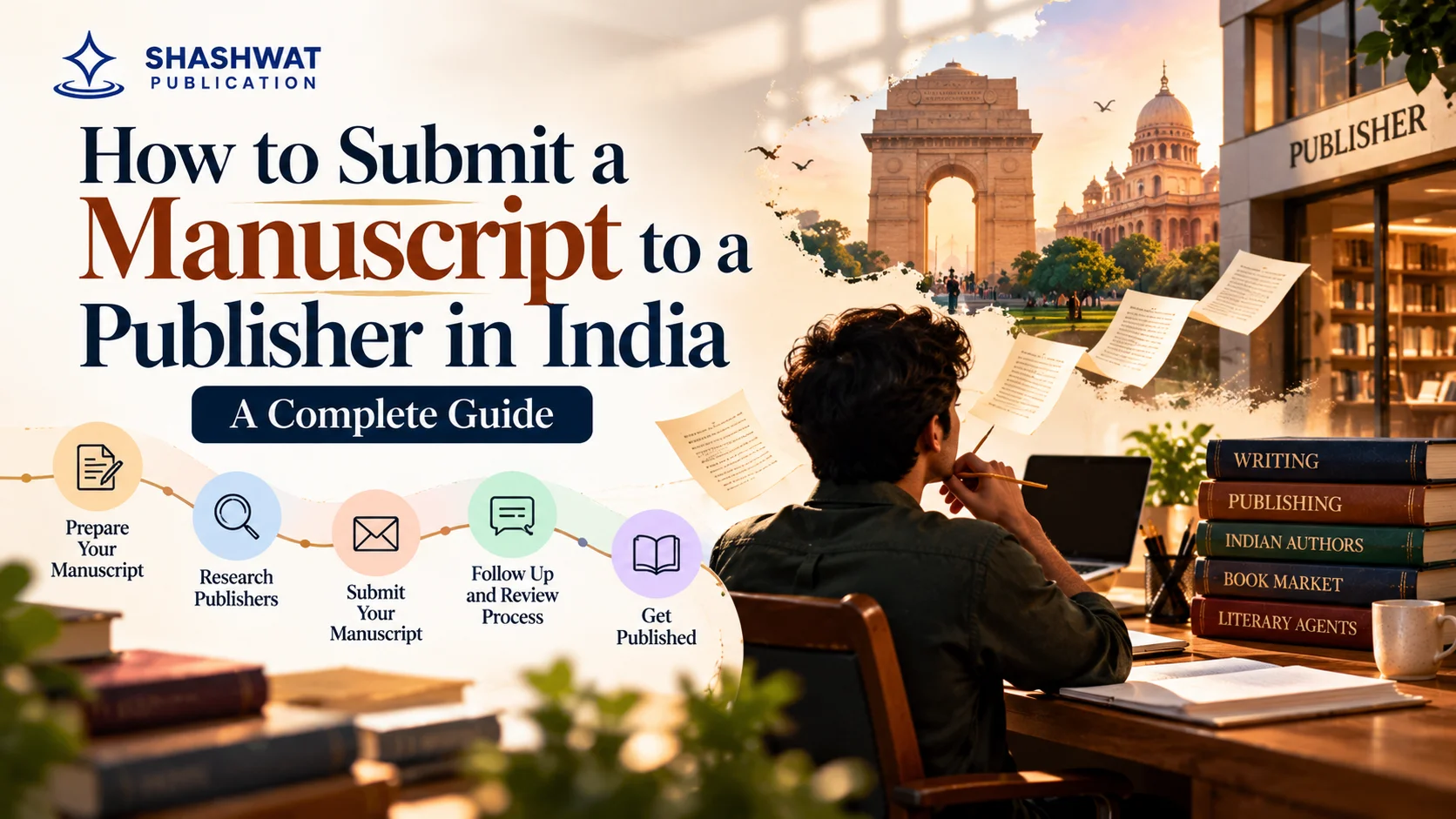
Before approaching publishers, make sure your manuscript is complete enough for the submission route you are choosing.
For a completed book, check that:
All chapters are written
The conclusion is complete
Major revisions are finished
The structure is consistent
The manuscript has been proofread
References are properly organized where applicable
Do not submit a manuscript that is still an early draft unless the publisher specifically requests a partial manuscript or proposal.
For example, if you are submitting a novel, publishers may expect a complete manuscript or a defined sample depending on their submission process.
Completing the first draft does not mean the manuscript is ready to submit.
Read the book again and look for:
Repetition
Weak sections
Grammar issues
Inconsistent terminology
Poor chapter transitions
Unnecessary paragraphs
Structural problems
Factual errors
You can also ask beta readers or experienced writers to review the manuscript.
A fresh perspective can help identify problems that are difficult to notice when you have been working on the same book for months.
Professional editing can significantly improve the quality of a manuscript before submission.
Depending on the book, editing can involve:
Focuses on:
Structure
Chapter organization
Story development
Argument flow
Pacing
Overall readability
Focuses on:
Grammar
Sentence structure
Language
Consistency
Punctuation
The final stage focuses on:
Spelling
Typographical errors
Formatting inconsistencies
Minor mistakes
A publisher may perform its own editorial assessment later, but submitting a polished manuscript demonstrates professionalism.
You can also explore book publication services if you want professional assistance with manuscript preparation and the publishing process.
Do not send the same manuscript randomly to every publisher you find online.
Research publishers that are relevant to your book.
For example:
Fiction publishers for novels
Poetry publishers for poetry collections
Academic publishers for research books
Children's publishers for children's literature
Business publishers for professional books
Educational publishers for textbooks
Look at the publisher's existing catalogue.
Ask yourself:
Does the publisher publish books in my genre?
Does it accept submissions from new authors?
Does it publish my type of book?
Does it distribute books in my target market?
Does its publishing model suit my goals?
Choosing a relevant publisher can make your submission more targeted.
This is one of the most important steps.
Before sending anything, visit the publisher's official website and look for its manuscript submission instructions.
The guidelines may specify:
Accepted file format
Maximum word count
Required documents
Email subject
Sample chapter requirements
Synopsis length
Proposal format
Author biography
Submission method
Follow these instructions exactly.
If a publisher asks for a synopsis and three sample chapters, do not send a 300-page manuscript without checking whether complete manuscripts are accepted.
Similarly, if a publisher specifically asks for a Word document, avoid sending a different format unless permitted.
A book proposal introduces your project to the publisher.
A proposal can include:
Provide the proposed title and subtitle if applicable.
Explain what the book is about in a concise and compelling way.
Clearly identify the category.
Examples include:
Fiction
Romance
Thriller
Poetry
Self-help
Biography
Business
Academic
Education
Children's literature
Explain who is most likely to read the book.
For example:
The book is intended for college students, young professionals and readers interested in personal finance.
Mention the approximate word count or page estimate.
Provide a brief explanation of each chapter.
Explain your professional background, expertise, achievements, previous publications and relevant experience.
Mention similar books and explain how your book is different.
A strong proposal helps the publisher understand both the manuscript and its potential market.
A query letter is a short professional introduction to your book and yourself.
It should not be a long explanation of your entire writing journey.
A basic query can include:
Introduction
Book title
Genre
Word count
Short book pitch
Target audience
Author credentials
Relevant publishing information
Submission request
Keep the message professional and concise.
Subject: Manuscript Submission – [Book Title] – [Genre]
Dear [Publisher/Editorial Team],
I am submitting my manuscript, [Book Title], a [genre] of approximately [word count] words.
[Briefly explain the book in 2–3 sentences.]
The book is intended for [target audience].
I have attached/provided [requested documents] according to your submission guidelines.
Thank you for considering my manuscript.
Regards,
[Author Name]
The exact format should always be adjusted according to the publisher's requirements.
If the publisher requests sample chapters, choose them carefully.
For fiction, the opening chapters are often important because they introduce:
Main characters
Setting
Conflict
Writing style
Story direction
For non-fiction, choose chapters that demonstrate:
Your expertise
Writing quality
Unique perspective
Practical value
Do not select a chapter simply because it is your personal favourite.
Choose the material that best represents the quality and potential of the book.
Your manuscript should be easy for an editor to read.
Unless the publisher provides different instructions, use a clean and simple format.
Pay attention to:
Consistent font
Clear chapter headings
Proper paragraph spacing
Page numbers
Standard margins
Consistent line spacing
Clear file naming
Avoid excessive design elements.
A manuscript submission is not the final printed book, so it does not need elaborate colours, decorative fonts or complicated layouts.
Your author bio gives the publisher context about you.
Include relevant information such as:
Professional background
Education where relevant
Industry experience
Writing experience
Previous publications
Awards
Subject expertise
Online presence
Keep the bio relevant to the book.
For example, if you are submitting a medical book, your professional qualifications and healthcare experience may be more relevant than unrelated personal achievements.
Once everything is ready, submit your manuscript through the publisher's specified channel.
Possible submission methods include:
Online submission form
Publisher portal
Literary agent
Direct manuscript submission
Before sending the email, check:
Correct publisher
Correct email address
Correct subject line
Correct attachments
Correct file format
Correct proposal
Correct synopsis
Author contact details
A final checklist can prevent simple submission mistakes.
If you are submitting to multiple publishers, maintain a submission tracker.
Record:
This prevents confusion when you are approaching several publishers.
Do not expect an immediate response.
Publishing companies may receive many manuscripts and proposals.
The evaluation period can vary depending on:
Publisher
Genre
Submission volume
Editorial process
Type of publishing model
If the publisher provides an estimated response time, wait until that period has passed before following up.
If the stated response period has passed, you can send a polite follow-up.
Keep it short.
Mention:
Your name
Book title
Date of submission
Original submission method
Request for an update
Avoid sending repeated emails every few days.
Professional communication is important throughout the publishing process.
Rejection is a normal part of the publishing journey.
A rejection does not necessarily mean that your book has no value.
It may happen because:
The publisher does not publish your genre
The manuscript does not fit its current catalogue
The publisher already has a similar title
The project does not fit its current business strategy
The manuscript needs further development
The publisher is not accepting submissions
The proposal does not match its current requirements
Use rejection as an opportunity to improve your submission.
If the publisher provides specific feedback, review it carefully.
There is no guaranteed formula for manuscript acceptance, but authors can improve their submissions by focusing on quality and relevance.
Do not submit blindly.
Research publishers that already work with your genre.
Ignoring instructions can make your submission look careless.
Grammar, structure and presentation matter.
Make the concept easy to understand.
The publisher should quickly understand what your book is about.
Explain who will buy and read the book.
Relevant experience can strengthen your proposal.
Editors and publishing teams need to understand the submission quickly.
Submitting a manuscript to a traditional publisher is only one publishing route.
Authors can also consider self-publishing or assisted publishing.
The publisher evaluates your manuscript and may offer a publishing agreement if the project fits its requirements.
Potential advantages include:
Publisher-led production
Editorial support
Distribution network
Established publishing brand
However, acceptance can be competitive.
Self-publishing allows authors to take greater control over:
Publishing timeline
Book design
Pricing
Distribution
Marketing
The author may also invest in professional services.
An author can work with a publishing company that provides professional support while allowing the author greater involvement in the project.
You can learn more about the self publishing process in India before deciding which model is suitable for your book.
Depending on the publisher's guidelines, your submission package may include:
Complete manuscript
Book proposal
Synopsis
Sample chapters
Author biography
Book details
Target audience information
Contact information
Previous publication details
Do not send unnecessary documents unless requested.
The publisher's submission guidelines should always take priority.
Unless requested, submit a properly completed manuscript.
Different publishers have different requirements.
Check the requested file format before submitting.
A synopsis should clearly communicate the book's central idea or story.
Use a simple and professional email identity where possible.
Avoid sending the same generic message to dozens of publishers.
Give the publisher reasonable time to respond.
Think about your long-term goals, including distribution, marketing, audience and author development.
The submission process can vary by genre.
For a novel, prepare:
Completed manuscript
Synopsis
Query letter
Author bio
Genre
Word count
Sample chapters if requested
For poetry, publishers may evaluate:
Selection of poems
Overall theme
Writing style
Manuscript structure
Author background
You can also explore poetry book publishing if you are considering professional publishing support for a poetry collection.
Academic submissions may require:
Book proposal
Chapter outline
Sample chapter
Author credentials
Research background
References
Target academic audience
For scholars and researchers, academic book publishing is a separate publishing area with specific requirements.
A children's book submission may require:
Manuscript
Age category
Illustrations or illustration notes
Story concept
Target reading level
Always follow the specific requirements of the publisher.
Getting an offer is exciting, but do not accept immediately without reviewing the terms.
Check:
Copyright ownership
Publishing rights
Royalty structure
Contract duration
Distribution
Marketing
Editing
Printing
Additional charges
Termination clauses
Rights reversion
You can also read our guide on book publishing contracts before signing an agreement.
Your manuscript is the foundation of your book.
A professional submission demonstrates that you have taken your project seriously.
Good preparation can help you:
Present your idea clearly
Avoid technical mistakes
Improve readability
Communicate your target audience
Make your proposal more professional
Give publishers the information they need for evaluation
Shashwat Publication provides publishing-related support including editing, book design, formatting, printing and distribution services, depending on the author's requirements. You can explore book publishing packages to understand the types of services that may be available.
Knowing how to submit a manuscript to a publisher in India can make the publishing journey more organized and professional.
The process starts long before you press the send button. You need a completed and polished manuscript, a clear proposal, a concise synopsis, relevant sample chapters, a professional author bio and a carefully researched list of publishers.
Most importantly, follow the submission guidelines of every publisher you approach. A publisher that accepts direct submissions may have completely different requirements from another publishing house or literary agency.
If your manuscript is rejected, do not assume that your writing career is over. Review the feedback where available, improve your manuscript and continue approaching publishers that are a genuine fit for your book.
And if traditional submission is not the right route for your goals, self-publishing and professional publishing support can provide alternative ways to bring your book to readers.
The key is to choose the publishing route that matches your book, budget, timeline and long-term goals.
+91 99930 01841 | +91 99936 08164 | ssupport@shashwatpublication.com
2nd Floor, HN 46, Balaji Residency, Seept Road, Bilaspur, C.G 495001

Can’t find what you are looking for? Drop an email to support@shashwatpublication.com
Yes, some Indian publishers accept direct manuscript submissions. However, submission requirements vary, so authors should always check the publisher's official guidelines before sending a manuscript.
Depending on the publisher, you may need to submit a complete manuscript, book proposal, synopsis, sample chapters, author biography, genre, word count and contact information. Always follow the publisher's specific submission requirements.
Not always. Some publishers request a book proposal, while others may ask for the complete manuscript or sample chapters. Check the submission guidelines of the publisher you are approaching.
A book proposal can include the book title, overview, genre, target audience, word count, chapter outline, author biography, competitive titles and sample chapters. The exact requirements depend on the publisher.
No. You should first check each publisher's submission guidelines. Some publishers accept complete manuscripts, while others may initially request a proposal, synopsis or sample chapters.
Yes. First-time authors can submit manuscripts to publishers that accept submissions from new authors. A polished manuscript and professional submission package can help present the project effectively.
Response times vary by publisher, genre and submission volume. If a publisher provides a specific response period, wait until that period has passed before sending a follow-up.
Review any feedback provided, identify areas for improvement, revise your manuscript if necessary and research other publishers that are suitable for your genre and book.
This depends on the publisher's submission policy. Some publishers may allow simultaneous submissions, while others may require exclusive consideration. Always check the relevant guidelines before submitting to multiple publishers.
Not necessarily. Some publishers accept direct submissions from authors, while others may prefer or require submissions through literary agents. The requirement depends on the publisher.
Yes. Self-publishing is an alternative route that can give authors greater control over publishing, pricing, distribution and marketing. The right approach depends on the author's goals and resources.
Yes. Shashwat Publication provides publishing-related support for authors, including services such as editing, formatting, design, printing and distribution, depending on the publishing requirements and selected services.


Dear Team, I would like to express my sincere appreciation for the seamless book publishing experience. As this is my debut publication, I will certainly be recommending Shashwat Publication.
I write this to express my deep sense of appreciation and gratitude to Shashwat Publication for publishing my first book in a time bound and professional manner. The first call from Ms Swati and her subsequent interactions, followed by dealing with ... Read More
Very Good publications
Publishing Experience with Shashwat Publications My experience with Shashwat Publications has been a fulfilling and memorable journey. From the initial stages of manuscript preparation to the final publication of my book, The Dental Prescriber: Fro... Read More
About Publishing Experience with Us As a first-time author with Shashwat Publications, I look forward to a professional, collaborative, and enriching publishing experience. I appreciate the opportunity to present this work to students and educators... Read More
I am satisfied with the work, it was not too long time taken by the publishers. Also the price is appropriate for publishing the book. I recommend other authors too, must have experience once with this publication. Worthy experiences. Thanks :)

B-75, Krishna Vihar, Koni, Bilaspur, C.G 495001
support@shashwatpublication.com
Timing
Important Pages
All rights are reserved by Aadeera Corporation Private Limited
Terms & Condition Apply