03-09-2026
Academic publishing in India has evolved rapidly over the last decade. With the growth of higher education institutions, research programs, online learning platforms, and government focus on quality education, the demand for academic books has increased significantly. Today, professors, researchers, PhD scholars, educators, and industry experts are actively looking for reliable ways to publish academic books in India.
Whether you are writing a research-based textbook, edited volume, thesis-based publication, professional handbook, reference book, or curriculum-focused study material, understanding the academic publishing process is essential.
Many authors struggle with questions such as:
How to publish an academic book in India?
Which publisher is best for academic publishing?
What are the steps involved in publishing a research book?
How much does academic book publishing cost?
How can authors get ISBN for academic books?
What makes a book acceptable for universities and colleges?
This detailed guide answers these questions and explains the complete process of academic book publication in India, from manuscript preparation to editing, ISBN registration, printing, distribution, copyright protection, and marketing strategies.
If you are planning to publish your first academic book or looking for a professional academic publisher, this guide will help you make informed decisions. Throughout the article, we will also discuss how publishers like Shashwat Publication support authors in academic book publishing through professional editing, ISBN support, formatting, printing, and distribution services.
Academic book publishing refers to the process of publishing books intended for educational, research, professional, or scholarly purposes. Unlike commercial fiction or entertainment books, academic books focus on structured knowledge, verified research, educational value, and curriculum relevance.
Academic publishing in India includes:
University textbooks
Research books
Thesis publications
Edited books
Conference proceedings
Technical handbooks
Scholarly monographs
Professional reference books
Educational guides
Study materials for competitive exams
The Indian education ecosystem is expanding due to increasing numbers of universities and colleges, growth in online education, research-focused academic policies, NEP, demand for quality educational resources, and the rise of independent researchers and educators.
As a result, opportunities for academic authors continue to grow.
Publishing an academic book is not only about sharing knowledge. It can also contribute to professional growth and academic credibility.
Publishing a research-based or educational book can strengthen your credibility in your field. Professors and scholars with published books may be recognized as subject matter experts.
Academic publications can contribute to:
Faculty promotions
Research recognition
University applications
Professional reputation
Consultancy opportunities
Speaking engagements
A published academic book allows your research to reach students, scholars, libraries, institutions, and readers beyond your immediate academic environment.
Quality educational books provide valuable resources for students, researchers, teachers, and future generations.
Unlike temporary online content, academic books can remain useful for years and become references for future research.
Before starting the publication process, authors should identify the category of academic book they want to publish.
Textbooks are designed around educational curricula and may cover subjects such as:
Engineering
Commerce
Medical studies
Law
Management
Science
Research monographs focus on specialized research topics and are generally written by researchers, scholars, or PhD scholars.
Edited books contain chapters written by multiple contributors under the guidance of an editor.
Many scholars convert their PhD thesis into published academic books after restructuring and adapting the content for book readers.
Industry experts can publish practical reference books designed for professionals, students, and researchers.
Conference proceedings compile research papers presented during academic conferences or seminars.
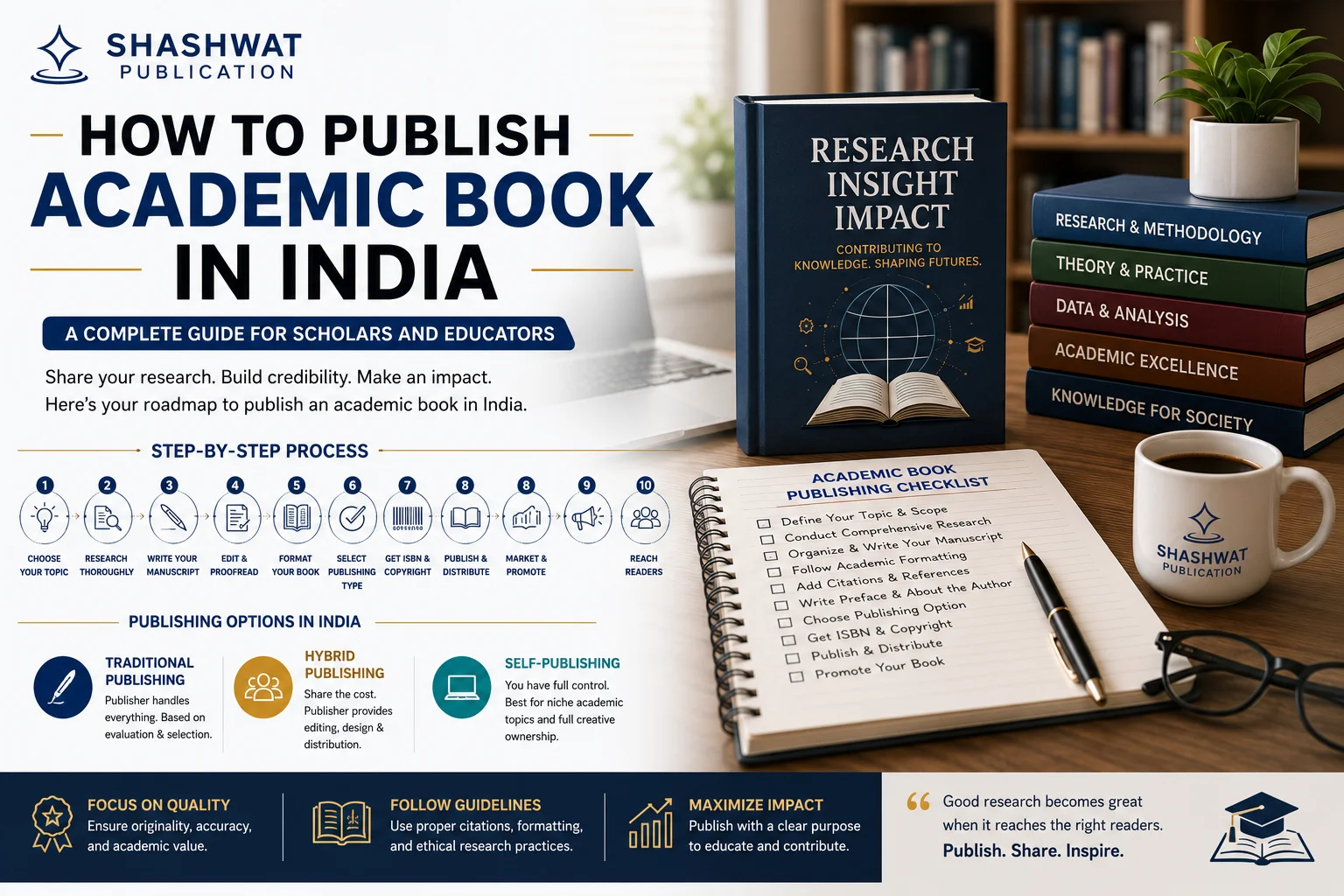
Now let us understand the complete process involved in academic book publishing.
The first and most important step is selecting the right topic.
Solve a real academic problem
Add value to existing literature
Match current educational needs
Be relevant to students or researchers
Have long-term academic demand
Research similar books available in the market
Identify gaps in existing content
Understand your target readers
Review university syllabi
Analyze current research trends
Academic books require evidence-based writing.
Authors should collect:
Research papers
Journals
Government reports
Case studies
Statistical data
Industry references
Peer-reviewed articles
Proper citations and references are extremely important in academic publishing.
Ensure that your work:
Avoids plagiarism
Includes updated information
Uses authentic sources
Follows academic ethics
A professional manuscript improves the quality and usability of an academic book.
Your manuscript may include:
Title page
Copyright page
Acknowledgement
Preface
Table of contents
Chapters
References
Bibliography
Index, if required
Use simple and clear language
Maintain consistent formatting
Include diagrams and tables where needed
Avoid grammatical errors
Use proper citation style
Structure chapters logically
Write reader-friendly content
Many first-time authors underestimate the importance of formatting and structure. A poorly formatted manuscript can reduce the professional presentation of otherwise valuable research.
Choosing the right publisher is crucial.
A professional academic publisher can help with:
Editing
Formatting
Cover design
ISBN allocation
Printing
Distribution
Copyright guidance
Marketing support
When selecting a publisher, evaluate:
Experience in academic publishing
Distribution network
Author support services
Transparency in pricing
Publishing timelines
Quality of printing
Online availability
Many Indian authors consider publishers such as Shashwat Publication when looking for professional support for educational and research books.
You can also explore academic research publishing services to understand the type of support available for academic and research-oriented publications.
Authors often get confused between traditional publishing and self-publishing.
In traditional publishing:
The publisher reviews the manuscript
The publisher generally invests in printing and production
A royalty model may be followed
The publisher manages or controls distribution
Professional credibility
Potential institutional acceptance
Established distribution
Professional editorial support
Longer approval process
Competitive selection
Less creative control
In self-publishing:
The author retains greater control
Publication can be faster
Authors have more control over content
Pricing and updates can be more flexible
Faster publishing
Greater ownership and control
Potentially better margins
Flexible editing and publishing decisions
Marketing responsibility
Need for professional support
Initial investment may be required
Today, some academic authors also consider supported or hybrid publishing models where professional publishing services are combined with greater author involvement.
ISBN stands for International Standard Book Number.
An ISBN can help:
Give a book a unique identity
Support library cataloging
Improve distribution
Enable online listing
Support professional book identification
Professional publishers can assist authors with ISBN-related requirements. Authors should understand how ISBN is handled under their specific publishing arrangement.
Copyright protects the intellectual property associated with an author's original work.
When publishing an academic book, authors should understand:
Copyright ownership
Licensing rights
Distribution permissions
Translation rights
Royalty terms
Authors should always clarify copyright terms with their publisher before signing an agreement.
You can also explore Shashwat Publication's publishing services for information about publishing support and related author services.
Editing is one of the most important stages in academic publishing.
Even experienced scholars can benefit from professional editing because academic writing needs to maintain:
Clarity
Accuracy
Consistency
Academic tone
Error-free language
Developmental editing focuses on:
Structure
Flow
Chapter organization
Academic depth
Copy editing focuses on:
Grammar
Punctuation
Sentence structure
Formatting consistency
Proofreading is the final review before printing or publication. It helps identify:
Typographical mistakes
Layout errors
Minor inconsistencies
Skipping professional editing and proofreading can negatively affect the quality and presentation of an academic book.
Formatting plays a major role in readability and professional presentation.
Academic books may require:
Consistent fonts
Proper margins
Citation styles
Chapter hierarchy
Numbered headings
Figure captions
Table formatting
APA
MLA
Chicago
Harvard
IEEE
Vancouver
The appropriate citation style depends on the academic discipline.
Professional formatting improves reader experience, institutional presentation, printing quality, and online readability.
Many people believe academic books do not need attractive covers. This is incorrect.
A professional cover can:
Create a strong first impression
Increase credibility
Improve online visibility
Support author and book branding
An academic cover should:
Look professional
Reflect the subject area
Use appropriate typography
Avoid excessive design clutter
Match the expectations of the target audience
Experienced publishers understand how to balance academic seriousness with modern design standards.
Authors can choose between different printing methods.
Offset printing can be suitable for:
Large quantity printing
Institutional distribution
Bulk orders where per-copy cost is important
Print-on-demand can be suitable for:
Limited inventory
New authors
Low-risk publishing
Continuous availability
Print-on-demand is useful for authors who want to reduce storage requirements and avoid maintaining large inventories.
For production requirements, authors can explore book publication services for publishing and production support.
Publishing a research book requires additional academic rigor.
Original research
Proper references
Methodology clarity
Data authenticity
Research ethics compliance
Convert your thesis into a reader-friendly format
Remove repetitive academic language
Add updated research
Simplify complex explanations
Include practical implications
Research books should focus on readability along with academic quality.
The timeline depends on multiple factors.
| Process | Estimated Time |
|---|---|
| Manuscript Writing | 3–12 Months |
| Editing | 2–6 Weeks |
| Formatting | 1–3 Weeks |
| Cover Design | 1–2 Weeks |
| ISBN & Copyright | 1–2 Weeks |
| Printing | 1–4 Weeks |
| Distribution Setup | 1–2 Weeks |
Overall, the process may take anywhere between two months and one year, depending on the manuscript, publisher workflow, editing requirements, production, and distribution.
But with shashwat publicaiton you can do it in 14 dyas. Publish your book within 14 Days if your Manuscript is Ready to Publish. Contact Us For More Information. You can also checkout our publishing packages and self register your book by yourself.
One of the most common questions authors ask is about publishing costs.
The cost depends on:
Number of pages
Editing requirements
Printing quantity
Cover design quality
Distribution services
Marketing support
Manuscript editing
Formatting
Cover design
ISBN support
Printing
Shipping
Marketing
Self-publishing generally involves an initial investment, while giving authors greater control over the publishing process. Authors should always discuss complete pricing and included services transparently before starting publication.
Publishing a book is only the first step. Distribution determines reach and visibility.
Academic books can be distributed through:
Amazon
Flipkart
Publisher websites
Educational marketplaces
Books may also reach:
Universities
Libraries
Colleges
Research institutes
Academic conferences
Some publishers support global distribution through international platforms.
Strong distribution can help authors increase readership and make their work accessible to a wider academic audience.
Digital publishing has transformed academic publishing in India.
Many students and researchers prefer eBooks because they are:
Accessible instantly
Portable
Searchable
Affordable
Environment-friendly
Academic publishers may provide:
PDF editions
ePub formats
Kindle versions
Digital library integration
Digital availability can increase the reach and accessibility of academic content.
Many authors assume publishers handle all marketing automatically. In reality, author involvement can be extremely important.
Authors can reach out to:
Professors
Academic departments
Libraries
Research scholars
Useful platforms may include:
ResearchGate
YouTube
Book launches and conference participation can help improve visibility among relevant academic audiences.
Authors can build their professional identity through:
Blogs
Webinars
Research articles
Interviews
Authors can share book information with:
Educational institutions
Students
Academic communities
Professional publishers may also provide promotional support depending on the publishing package and agreement.
Many academic authors face delays or publishing challenges because of avoidable mistakes.
Books without sufficient relevance or demand may struggle to attract readers.
Grammar, clarity, and structural problems can reduce professional credibility.
Inconsistent formatting can affect readability and professional presentation.
Copied content can create serious academic, ethical, and legal problems.
Even high-quality academic books need visibility to reach the appropriate audience.
Academic publishing should be viewed as a long-term professional and intellectual investment.
Many scholars want to transform their thesis into a publishable book. However, thesis writing and book writing are different.
Theses often contain highly technical or formal language. A book should make the research easier to understand while maintaining academic value.
A book should focus more on the research insights, arguments, findings, and practical implications rather than reproducing an extensive thesis literature review.
Readers generally benefit from a more engaging and logically structured chapter flow.
Real-world examples can make complex research easier to understand.
Include relevant developments and updated research before publication.
A well-converted thesis can become a valuable academic resource for students, researchers, and professionals.
Professional publishing support can improve both the quality and reach of an academic book.
Expert editing
Better formatting
Professional design
Publishing support
ISBN assistance
Distribution support
Marketing guidance
Long-term availability
Working with a professional publishing company can simplify the academic publishing process for both first-time and experienced authors.
Academic publishing can contribute to professional development.
Promotion opportunities
Academic profile development
Research visibility
Institutional recognition
Citation opportunities
International exposure
Potential collaboration opportunities
Greater research visibility
Stronger academic profile
Scholarship support
Higher education applications
Development of subject expertise
Academic books can strengthen an author's long-term intellectual reputation when they are well researched, professionally produced, and effectively distributed.
The academic publishing landscape continues to evolve with developments in education and digital technology.
Major trends include:
Digital learning growth
AI-assisted research tools
Online academic libraries
International collaborations
Open-access publishing
Increased research activity
Authors who focus on producing high-quality academic content can benefit from the growing demand for accessible educational and research resources.
Your publishing partner can significantly affect the overall publishing experience and reach of your academic book.
A reliable publisher should provide:
High-quality production
Professional credibility
Timely publishing
Distribution support
Transparent communication
Shashwat Publication is one option authors can explore when looking for professional support for educational and academic publishing in India.
The right publishing partner should not only help publish your book but also provide clarity around editing, production, distribution, rights, and other important aspects of the publishing process.
Publishing an academic book in India is an important milestone for educators, researchers, scholars, and professionals. The process may seem complicated initially, but with proper planning and the right publishing support, authors can successfully transform their research and expertise into professionally published books.
From selecting the right topic to manuscript preparation, editing, ISBN registration, printing, distribution, and marketing, every stage contributes to the overall success of an academic publication.
Authors should focus on:
As India's education and research ecosystem continues to expand, opportunities for academic authors are increasing. Working with experienced publishing professionals can simplify the journey and help authors publish high-quality academic books with professional standards.
If you are planning to publish an academic book in India, now is a good time to begin your publishing journey.
+91 99930 01841 | +91 99936 08164 | ssupport@shashwatpublication.com
2nd Floor, HN 46, Balaji Residency, Seept Road, Bilaspur, C.G 495001

Can’t find what you are looking for? Drop an email to support@shashwatpublication.com
You can publish an academic book in India by preparing a professional manuscript, selecting a reliable publisher, completing editing and formatting, obtaining ISBN-related support, and distributing the book through suitable online and offline channels.
The cost depends on editing, formatting, printing quantity, cover design, distribution requirements, and other publishing services. Academic publishing costs vary based on the complexity of the project and the services included.
An ISBN is important for identifying a book and supporting activities such as cataloging, online listing, and distribution. Authors should confirm the ISBN requirements applicable to their particular publishing arrangement.
Yes. Authors can self-publish research books in India and may use professional publishing support for editing, formatting, printing, distribution, and other requirements.
The timeline can range from a few weeks to several months depending on manuscript quality, editing requirements, formatting, printing, distribution, and the publisher's workflow.
You can convert your thesis into a book by simplifying academic language, reducing unnecessary repetition, improving readability, restructuring chapters, adding updated research, and adapting the content for academic book readers.
The best academic publisher depends on your subject area, publishing goals, distribution requirements, budget, and desired support. Authors should compare publishers based on their services, transparency, publishing process, and distribution capabilities.
Academic publishing can improve professional credibility, research visibility, career opportunities, academic recognition, and the long-term impact of an author's research.
Yes. Academic books can be published in digital formats such as eBooks and other electronic editions, making research and educational content accessible to a wider audience.
You can market an academic book through university outreach, academic conferences, social media promotion, author branding, online marketplaces, email outreach, and institutional networking. A consistent marketing strategy can help improve the visibility of the book.


Very Good publications
Publishing Experience with Shashwat Publications My experience with Shashwat Publications has been a fulfilling and memorable journey. From the initial stages of manuscript preparation to the final publication of my book, The Dental Prescriber: Fro... Read More
About Publishing Experience with Us As a first-time author with Shashwat Publications, I look forward to a professional, collaborative, and enriching publishing experience. I appreciate the opportunity to present this work to students and educators... Read More
I am satisfied with the work, it was not too long time taken by the publishers. Also the price is appropriate for publishing the book. I recommend other authors too, must have experience once with this publication. Worthy experiences. Thanks :)
शाश्वत पब्लिकेशन एक मार्गदर्शक है दिशादर्शक है और आपकी मंजिल तक पहुचाने का बहुत शांतीदायी रास... Read More
It was really a very smooth and wonderful interaction with Shashwat Publication while writing my book. They were very much approachable and helpful in each step. All information was given to me with complete clarity. Whatever corrections were requir... Read More

B-75, Krishna Vihar, Koni, Bilaspur, C.G 495001
support@shashwatpublication.com
Timing
Important Pages
All rights are reserved by Aadeera Corporation Private Limited
Terms & Condition Apply