05-09-2026
Poetry is one of the most personal and powerful forms of writing. For many writers, publishing a poetry book is a lifelong dream—a way to share emotions, experiences, and creativity with the world. But while writing poems may come naturally, understanding how to publish a poetry book can feel overwhelming.
Whether you are an aspiring poet or someone with years of verses tucked away in journals, this guide will walk you through every step of turning your poetry into a professionally published book. From manuscript preparation to choosing the right publishing path, you’ll learn practical strategies that can help your collection reach readers successfully.
With trusted publishing support from brands like Shashwat Publication
, many poets can access professional assistance for editing, formatting, cover design, printing, distribution, and other stages of the publishing process.
A poetry book is more than a collection of poems—it is your artistic identity presented to the world. Publishing your poetry can help you establish yourself as a writer, reach new readers, and preserve your creative work for the future.
A professionally published poetry collection can help establish your credibility as a writer and open opportunities for literary events, interviews, readings, collaborations, and other creative projects.
Publishing gives your poetry the opportunity to connect with readers through bookstores, online platforms, digital marketplaces, literary communities, and social media.
Poetry often captures personal experiences, emotions, thoughts, and observations. Publishing your collection creates a lasting form of your creative work that can be shared with future generations.
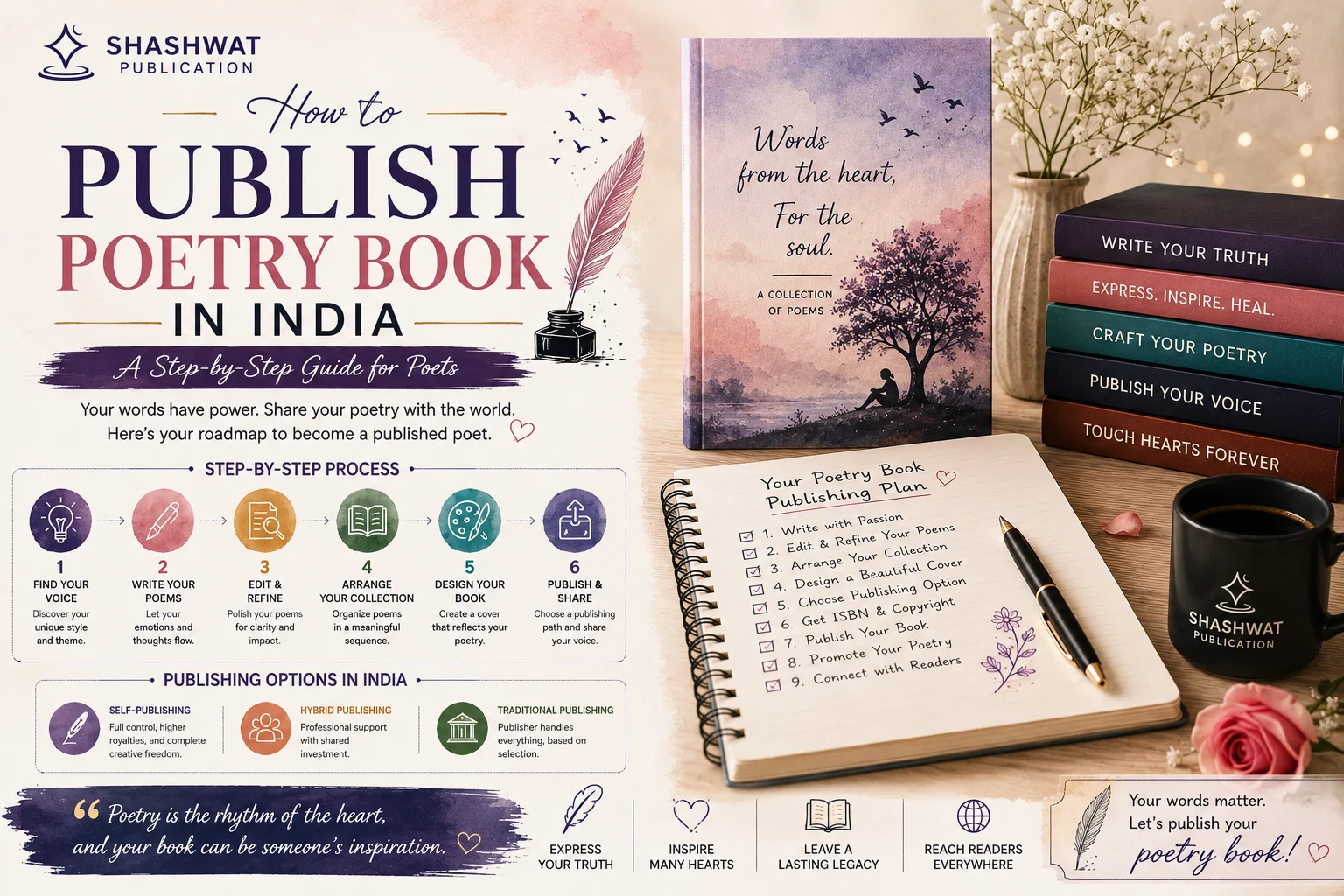
Before publishing, your poetry collection should feel cohesive and polished. A strong manuscript is the foundation of a successful poetry book.
Avoid including every poem you have ever written. Instead, curate pieces that align with a clear theme, emotional journey, literary style, or overall concept.
You can divide your poems into categories based on subjects such as love, relationships, nature, life experiences, spirituality, society, or personal growth.
Arrange your poems in a way that creates a natural reading flow. Many poetry books follow an emotional progression, storytelling arc, chronological structure, or thematic organization.
The order of poems matters because readers experience the collection as a complete work rather than as unrelated individual poems.
Even the strongest poems can benefit from revision. Review:
Grammar and punctuation
Line breaks and formatting
Consistency in tone
Repetitive themes
Weak or unnecessary poems
Word choice
Overall rhythm and readability
Professional editing can help identify issues that an author may overlook after working on the same manuscript for a long period.
If you want professional assistance, you can explore poetry book publishing services, where editing, formatting, design, printing, distribution, and other publishing requirements can be handled as part of the publishing process.
Choosing the right publishing model is essential when learning how to publish a poetry collection successfully.
The two common options are traditional publishing and self-publishing. Each has its own advantages and considerations.
Traditional publishing involves submitting your manuscript to publishers or literary agents for consideration. If accepted, the publisher generally manages various aspects of production and distribution.
Pros:
Professional publishing support
Established distribution networks
Editorial and design assistance
Potential industry credibility
Cons:
Highly competitive
Longer timelines
Less creative control
Manuscript may not be accepted
Traditional publishing can be suitable for poets who are willing to go through a competitive selection process and prefer working within an established publishing system.
Self-publishing gives poets greater control over their book's content, design, pricing, publishing timeline, and marketing strategy.
Pros:
Faster publishing process
Greater creative freedom
More control over pricing
Flexible publishing decisions
Potential for higher royalty rates
Cons:
Upfront costs may be required
Author involvement is important
Marketing responsibility can be higher
Professional services may need to be arranged
Many emerging poets choose self-publishing because it provides greater flexibility while still allowing them to work with professional publishing service providers.
Readers often form their first impression of a book from its presentation. Poetry is especially dependent on visual presentation because line breaks, spacing, typography, and page layout can influence how a poem is experienced.
Your poetry book cover should visually represent the essence of your writing.
Depending on the collection, a cover can be:
Minimalistic
Emotional
Artistic
Modern
Elegant
Concept-driven
The design should match the theme and audience of the poetry collection without becoming unnecessarily complicated.
Interior formatting is especially important for poetry because poems often depend on precise line breaks, spacing, indentation, and page placement.
A poorly formatted poetry book can affect readability and may change the visual structure intended by the poet.
Important formatting elements include:
Font selection
Line spacing
Page margins
Poem alignment
Chapter or section headings
Page numbering
Blank pages where required
Consistent typography
ISBN helps identify a published book for distribution and cataloging, while copyright relates to protection of original creative work.
Authors should understand the rights, ISBN arrangements, and publishing terms applicable to their chosen publishing model.
Professional publishing companies can assist authors with ISBN-related requirements and other publication formalities.
If you are self-publishing, selecting the appropriate publishing platform or publishing partner is an important decision.
Amazon KDP is commonly used for publishing print-on-demand books and eBooks. It can provide authors with access to a large online marketplace.
IngramSpark is another publishing and distribution platform that can help authors make books available through broader distribution networks.
Authors who do not want to manage every technical step themselves can work with a professional publishing company.
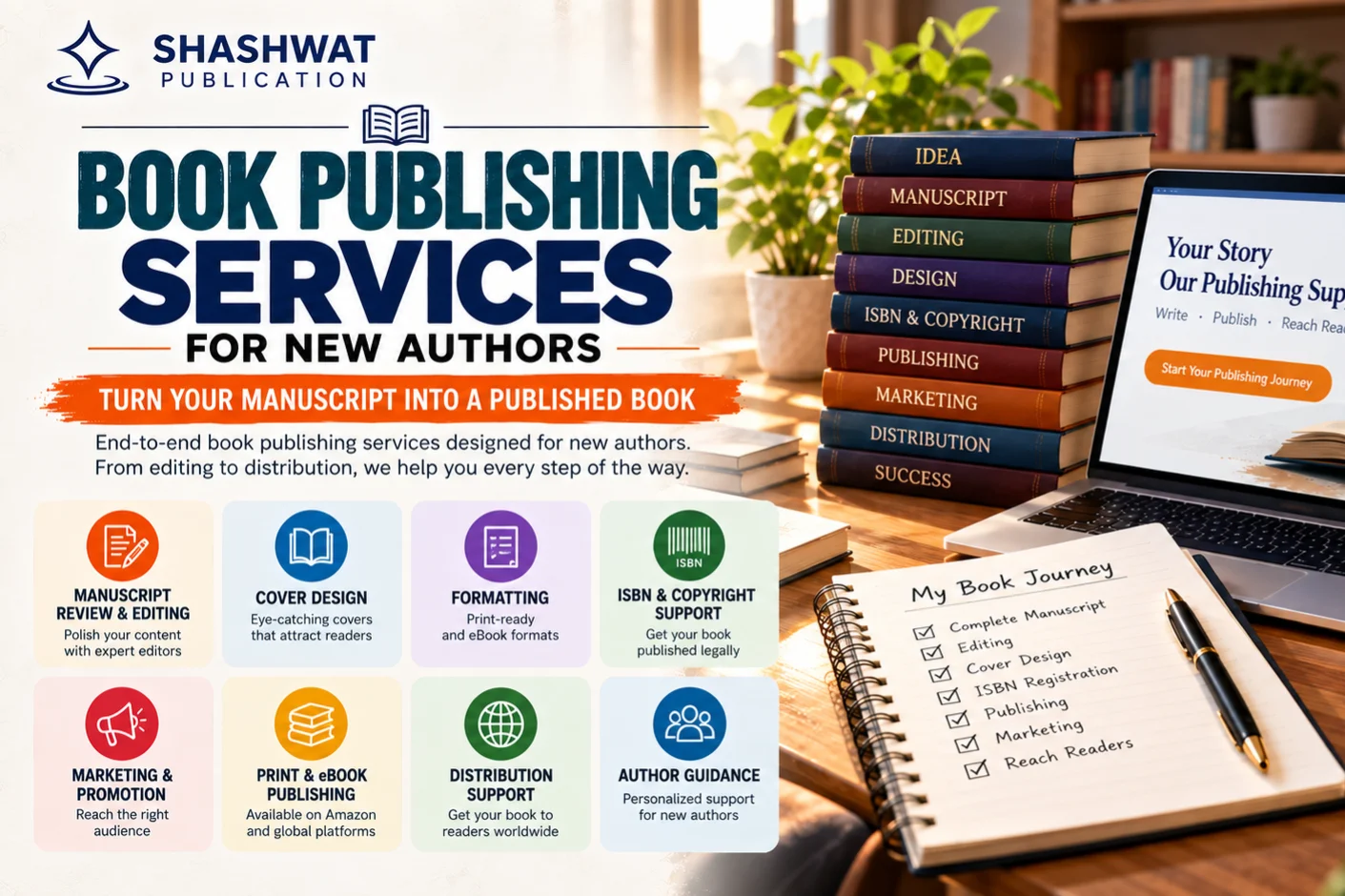
Shashwat Publication provides book publication services covering areas such as editing, cover design, formatting, printing, eBook conversion, distribution, and marketing support.
For poets specifically, its poetry book publishing service focuses on helping poets publish their collections with professional support.
Once the manuscript and design are ready, the book needs to be prepared for final publication.
This stage may include:
Final proofreading
Interior formatting
Cover design
ISBN assignment
Copyright-related formalities
Print file preparation
eBook conversion
Final author approval
Before approving the final version, carefully review every page.
Pay special attention to:
Poem titles
Spelling
Line breaks
Page numbers
Chapter or section order
Table of contents
Author name
Cover details
A final review can help catch mistakes before the book becomes publicly available.
After final approval, your poetry collection can move into printing and distribution.
Print-on-demand can be useful for first-time poets because books are printed when orders are received. This can reduce the need to maintain large physical inventories.
Your poetry book can potentially be made available through platforms such as:
Amazon
Flipkart
Online bookstores
Publisher websites
Digital reading platforms
Shashwat Publication states that it supports distribution through major online platforms and offers print and digital publishing options.
Depending on the publishing arrangement, books may also reach:
Local bookstores
Literary events
Book fairs
Libraries
Author events
Institutional networks
A combination of online and offline distribution can help a poetry collection reach different types of readers.
Publishing is only half the journey. Marketing determines how easily readers discover your poetry.
A good marketing strategy should ideally begin before the book is published.
Poets can use:
Instagram poetry pages
Author websites
Facebook communities
Goodreads
YouTube
Literary communities
Social media is particularly useful for poetry because individual poems, quotes, short videos, readings, and visual content can be shared easily.
Instead of promoting only the book cover, share selected lines or short excerpts from your collection.
This gives potential readers an idea of your writing style and can encourage them to explore the complete book.
Virtual or physical book launches can create awareness around your collection.
You can organize:
Poetry readings
Book launch events
Live sessions
Online readings
Literary meetups
Reader reviews can help establish trust and give potential buyers more confidence when considering your book.
Encourage genuine readers to share their honest experiences after reading your collection.
Creating useful online content around topics such as publish poetry book, poetry book publishing guide, self publish poetry book, and how to publish a poetry book can help attract people interested in poetry publishing.
Publishing your first poetry book can be exciting, but rushing the process can create avoidable problems.
Do not publish simply because the manuscript is complete. Give yourself enough time to review, revise, edit, and organize the collection.
Poetry may be creative, but that does not mean proofreading and editing are unnecessary. Grammar, spelling, punctuation, formatting, and consistency still matter.
A poor cover can make it difficult for your book to stand out among other poetry collections.
The cover should reflect the tone and subject of your work while maintaining a professional appearance.
Poetry depends heavily on visual presentation. Incorrect line breaks, spacing, or alignment can affect the intended reading experience.
Even exceptional poetry needs visibility. Publishing the book and waiting for readers to discover it may not be enough.
Create a realistic promotional strategy that includes social media, author branding, reviews, events, and reader outreach.
For poets seeking professional support throughout the publishing process, Shashwat Publication offers poetry-focused publishing services.
The publishing process can include support with:
Manuscript editing
Book formatting
Cover design
ISBN assistance
Printing
eBook conversion
Distribution
Marketing support
Shashwat Publication's dedicated poetry publishing page states that it provides customized publishing solutions and support from manuscript preparation through distribution.
The company also has a dedicated collection of poetry books, allowing readers to explore published poetry titles across different languages and themes.
For authors who want broader publishing assistance beyond poetry, Shashwat Publication's book publishing services can also be explored.
Understanding how to publish a poetry book involves more than simply writing poems. It requires thoughtful manuscript preparation, editing, professional design, appropriate publishing decisions, distribution, and marketing.
Start by curating your strongest poems and creating a collection with a clear identity. Then focus on professional editing, formatting, cover design, ISBN and publishing requirements.
Whether you choose traditional publishing, self-publishing, or professional publishing support, take the time to understand your options before making a decision.
For poets who want professional assistance, working with an experienced publishing partner can simplify the technical side of the process and allow you to focus more on your writing.
Your words deserve more than a notebook—they deserve a bookshelf.
+91 99930 01841 | +91 99936 08164 | ssupport@shashwatpublication.com
2nd Floor, HN 46, Balaji Residency, Seept Road, Bilaspur, C.G 495001

Can’t find what you are looking for? Drop an email to support@shashwatpublication.com
Start by organizing your best poems into a cohesive collection, revise and edit the manuscript, prepare the cover and interior design, complete publishing requirements, and choose between traditional publishing or self-publishing. You can also work with a professional poetry publishing service for assistance with the process.
Yes, self-publishing can be a suitable option for poets who want greater creative control and flexibility over their book. It allows authors to make decisions about design, pricing, publishing timelines, and marketing while using professional services when needed.
The cost depends on factors such as manuscript editing, proofreading, cover design, interior formatting, printing, distribution, eBook conversion, and marketing. Different publishing projects require different levels of investment, so authors should compare the services included in a publishing package.
Yes. Amazon KDP is commonly used by authors to publish poetry books in print and digital formats. Authors can also work with professional publishing companies that help prepare and distribute books through major online platforms.
Poetry books can find readers when they have strong writing, professional presentation, a clear target audience, and consistent marketing. Social media, poetry communities, literary events, reviews, and author branding can all help increase visibility.
Authors should understand copyright protection and the rights associated with their original work before publication. Copyright and ISBN serve different purposes, so it is important to clarify the relevant requirements and terms under your publishing arrangement.
There is no fixed number of poems required for a poetry collection. The appropriate length depends on the individual poems, their themes, formatting, and the overall concept of the book. A shorter collection can work well if the poems create a strong and cohesive reading experience.
Yes. Shashwat Publication's poetry publishing service is designed to support poets through stages such as manuscript preparation, editing, formatting, cover design, printing, distribution, and other publishing requirements.
A poetry manuscript should have clear and consistent formatting, with particular attention to line breaks, spacing, poem titles, typography, and page structure. The final format should make it easy for the publisher or designer to understand how the poems should appear in the finished book.
The timeline depends on the publishing method, manuscript readiness, editing requirements, design, final approvals, printing, and distribution. A professionally supported project may move faster when the manuscript is ready, while traditional publishing can take considerably longer because of its submission and selection process.


Very Good publications
Publishing Experience with Shashwat Publications My experience with Shashwat Publications has been a fulfilling and memorable journey. From the initial stages of manuscript preparation to the final publication of my book, The Dental Prescriber: Fro... Read More
About Publishing Experience with Us As a first-time author with Shashwat Publications, I look forward to a professional, collaborative, and enriching publishing experience. I appreciate the opportunity to present this work to students and educators... Read More
I am satisfied with the work, it was not too long time taken by the publishers. Also the price is appropriate for publishing the book. I recommend other authors too, must have experience once with this publication. Worthy experiences. Thanks :)
शाश्वत पब्लिकेशन एक मार्गदर्शक है दिशादर्शक है और आपकी मंजिल तक पहुचाने का बहुत शांतीदायी रास... Read More
It was really a very smooth and wonderful interaction with Shashwat Publication while writing my book. They were very much approachable and helpful in each step. All information was given to me with complete clarity. Whatever corrections were requir... Read More

B-75, Krishna Vihar, Koni, Bilaspur, C.G 495001
support@shashwatpublication.com
Timing
Important Pages
All rights are reserved by Aadeera Corporation Private Limited
Terms & Condition Apply