03-10-2026
Learn how to use AI throughout the book publishing process in 2026, including research, writing, editing, proofreading, cover concepts, formatting, publishing, and book marketing.
Artificial intelligence has changed the way authors approach writing and publishing. In 2026, writers can use AI tools to brainstorm book ideas, organize chapters, improve drafts, identify writing issues, create marketing content, and support several other stages of the publishing process.
But publishing a book using AI does not mean asking an AI tool to generate an entire book and publishing the output without review.
A successful AI-assisted book still needs human creativity, original thinking, fact-checking, editing, copyright awareness, professional formatting, and a proper publishing strategy.
Whether you are writing a novel, self-help book, business book, poetry collection, educational guide, or non-fiction title, AI can become a useful part of your publishing workflow.
This guide explains how authors can use AI responsibly to move from an initial idea to a professionally published book in 2026.
Yes. AI can assist with many stages of the book creation and publishing process.
For example, an author can use AI to help with:
Brainstorming book ideas
Research planning
Chapter outlines
Writing prompts
Draft improvement
Grammar and language correction
Summarization
Content organization
Reader persona development
Marketing ideas
Social media content
Book descriptions
Advertising copy
Author newsletters
However, AI should generally be treated as an assistant rather than a replacement for the author.
The author should remain responsible for the manuscript's accuracy, originality, voice, structure, and final quality.
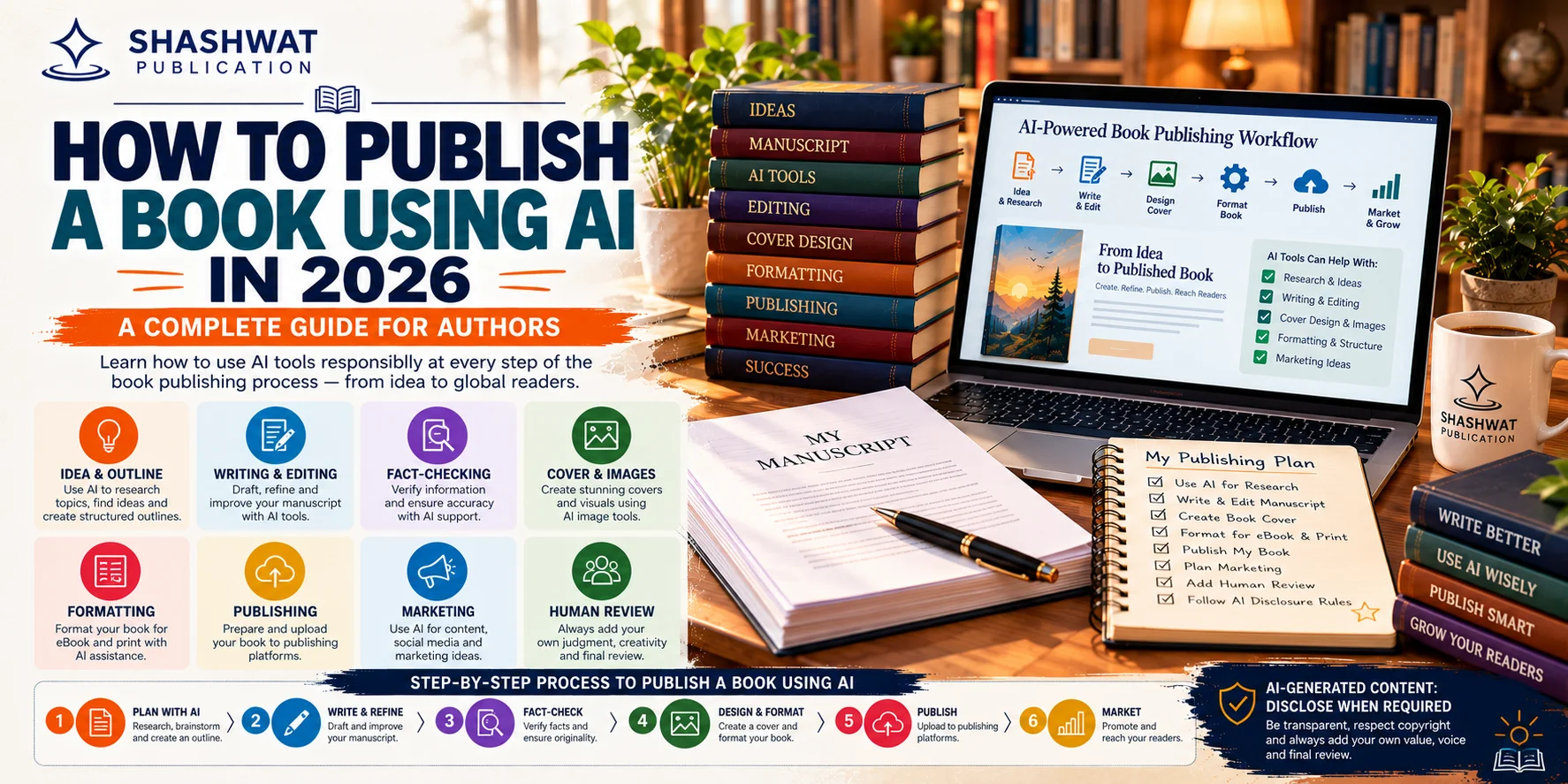
AI-assisted publishing means using artificial intelligence tools to support one or more stages of creating and publishing a book.
It can involve three broad areas:
AI can help authors brainstorm, outline, rewrite, summarize, and refine content.
AI can help with design concepts, formatting workflows, metadata, descriptions, and other production-related tasks.
AI can help generate promotional ideas, social media posts, email drafts, advertisements, and audience-specific content.
The important distinction is that AI-assisted publishing still involves human review and decision-making.
Before using AI, decide what you actually want to write.
Your topic should ideally have:
A clearly defined audience
A specific purpose
A useful or interesting angle
Sufficient scope for a complete book
A clear reason for readers to choose it
You can use AI during the brainstorming stage.
For example, instead of asking:
"Give me a book idea."
You can provide more useful context:
"Suggest 20 non-fiction book ideas for Indian entrepreneurs who want to learn digital marketing. Focus on practical problems that beginners face."
The more specific your instructions are, the more useful the brainstorming process can become.
AI can help organize your research process, but it should not automatically be treated as a source of truth.
For research-heavy books, verify important information using reliable sources such as:
Government publications
Academic papers
Books
Official statistics
Industry reports
Reputable publications
Primary sources
This is particularly important for:
Medical topics
Financial topics
Legal subjects
Academic books
Historical claims
Scientific information
Statistics
AI can sometimes produce incorrect or outdated information.
Therefore, use AI to assist research, not to replace source verification.
Once the topic is finalized, AI can help create a preliminary structure.
For example:
Book Topic: Digital Marketing for Small Businesses
Possible structure:
Introduction to Digital Marketing
Understanding Your Audience
Website Fundamentals
SEO
Social Media Marketing
Content Marketing
Email Marketing
Paid Advertising
Analytics
Creating a Marketing Plan
The author should then review the outline and change it according to the book's purpose and audience.
AI-generated outlines should be treated as starting points rather than final structures.
AI can help you develop chapter ideas by suggesting:
Subtopics
Examples
Questions readers may have
Case-study ideas
Explanations
Chapter summaries
Exercises
Discussion points
However, avoid producing every chapter with the same generic AI prompt.
This can result in repetitive writing and a predictable tone.
Instead, provide your own:
Ideas
Experiences
Research
Examples
Opinions
Arguments
Stories
Your personal knowledge is what gives the book its identity.
One of the biggest problems with poorly produced AI books is that they can sound generic.
Readers may notice repetitive phrases, predictable structures, excessive headings, and unnatural explanations.
To maintain your author voice:
Write important ideas yourself
Add personal experiences
Include original examples
Use your preferred tone
Revise AI-assisted passages
Remove repetitive language
Add your own opinions and insights
AI should help you communicate your ideas more effectively—not make the entire book sound like everyone else's.
AI can be useful during the editing stage.
You can use it to identify:
Grammar problems
Repeated words
Awkward sentences
Inconsistent terminology
Long sentences
Unclear explanations
Structural repetition
For example, you can ask AI to identify sentences that are difficult to understand without rewriting the entire chapter.
This gives the author more control over the final manuscript.
However, AI editing should not automatically replace professional human editing, particularly for books intended for commercial publication.
Professional editorial review can identify problems involving context, structure, tone, logic, audience expectations, and consistency that automated tools may miss.
This is one of the most important steps when publishing a book using AI.
AI can generate information that sounds convincing but may be inaccurate.
Before publication, verify:
Names
Dates
Statistics
Historical facts
Quotes
Scientific claims
Legal information
Financial information
References
URLs
Citations
For academic and research books, every important factual claim should be supported by appropriate sources.
Shashwat Publication's current academic publishing guidance similarly emphasizes authentic sources, proper citations, updated information, research ethics, and avoiding plagiarism in academic manuscripts.
AI-assisted writing does not eliminate the need to check originality.
Before publication:
Review your manuscript
Check quotations
Verify references
Properly attribute external material
Use plagiarism-detection tools where appropriate
Rewrite material that is too close to existing sources
Keep records of your research
The author should be able to explain the origin of important ideas, quotations, statistics, and research used in the book.
Copyright treatment of AI-generated material can depend on the applicable law and the nature of human contribution.
Because laws and policies can evolve, authors should not assume that everything generated by an AI tool automatically receives the same copyright protection as fully human-created work.
A safer approach is to ensure substantial human involvement in:
Creative decisions
Original writing
Editing
Selection
Arrangement
Research
Revision
Final manuscript development
If your book contains AI-generated images, text, translations, or other material, check the relevant tool's terms and applicable legal requirements before commercial publication.
For important legal questions, consider professional legal advice.
AI can help generate title ideas based on:
Genre
Audience
Topic
Tone
Market positioning
Keywords
For example, if you are writing a book about productivity, AI can generate multiple title directions:
Productivity for Busy Professionals
The Modern Productivity Guide
Work Smarter Every Day
The Focus Framework
The author should then evaluate the options for originality, clarity, brand fit, and potential confusion with existing books.
Do not select a title simply because an AI tool says it is the best one.
AI can help transform your manuscript into a concise book description.
A strong book description should explain:
What the book is about
Who it is for
What readers can learn or experience
Why the book is different
What makes the reader want to continue
You can create multiple versions and then edit the strongest one manually.
The final description should sound like your book—not like generic AI-generated promotional copy.
AI image-generation tools can help authors explore cover concepts quickly.
For example, an author can generate several visual directions based on:
Genre
Mood
Setting
Colour preferences
Target audience
Main theme
For a thriller, the concept may focus on suspense and mystery.
For a children's book, the visual language may be colourful and character-driven.
For an academic book, a cleaner and more professional design may be appropriate.
However, the final cover should be reviewed carefully for:
Typography
Title readability
Author name
Genre expectations
Image quality
Print requirements
Copyright or licensing considerations
A professional designer can still be valuable, especially for commercial books.
After editing and cover design, the manuscript needs professional formatting.
This may include:
Page size
Margins
Fonts
Chapter headings
Page numbering
Front matter
Back matter
Tables
Images
Footnotes
References
Different formats may require different files.
For example:
Paperback
Hardcover
eBook
EPUB
AI can assist with some formatting workflows, but final files should be professionally checked before publication.
Shashwat Publication's current publishing guidance identifies formatting as an important stage before printing and distribution.
AI does not determine which publishing model is right for you.
Authors can consider:
You submit your manuscript to a traditional publisher.
If accepted, the publisher typically manages major production and distribution activities according to the publishing agreement.
You control the publishing process and arrange the required services yourself.
A publishing company helps you with services such as:
Editing
Cover design
Formatting
ISBN
Printing
Distribution
Marketing
Hybrid arrangements combine characteristics of different publishing models, but the exact terms vary significantly between companies.
The right option depends on your:
Budget
Control requirements
Timeline
Publishing goals
Marketing capacity
Need for professional assistance
Shashwat Publication's current 2026 publishing guidance also identifies traditional, self-publishing, hybrid, and assisted publishing as options authors can evaluate.
Once the manuscript and book files are ready, you need to understand the applicable publishing requirements.
This can include:
ISBN
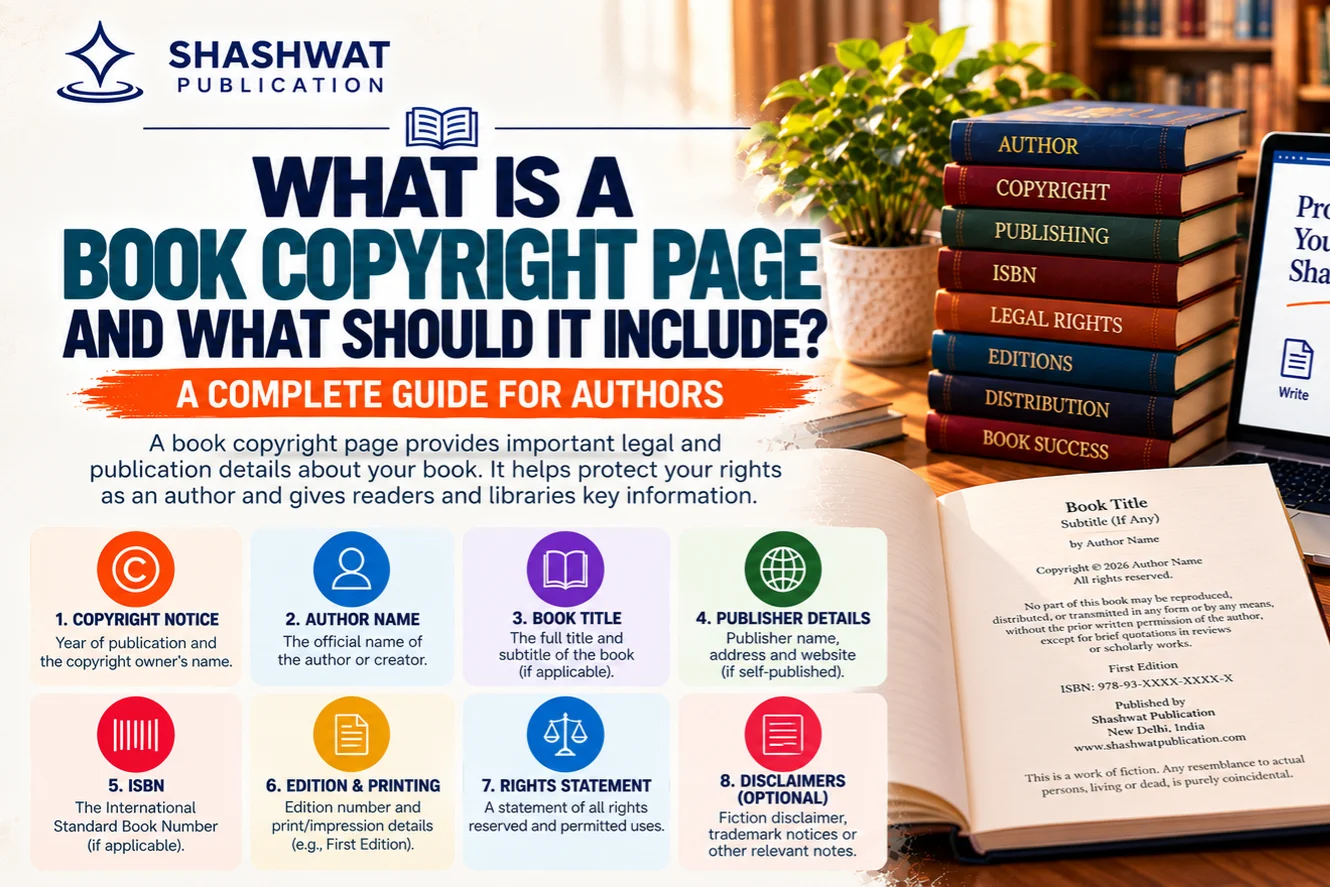
Copyright page
Publisher information
Author information
Edition information
Book metadata
Barcode
Pricing information
The exact requirements depend on your publishing model and format.
Do not assume that AI can handle legal or publishing registration automatically. Verify the requirements through the appropriate official sources or your publishing partner.
If you want a physical book, you can consider:
Suitable when you need a larger quantity.
Advantages can include:
Lower unit cost at larger quantities
Useful for events
Useful for institutional orders
The downside is inventory.
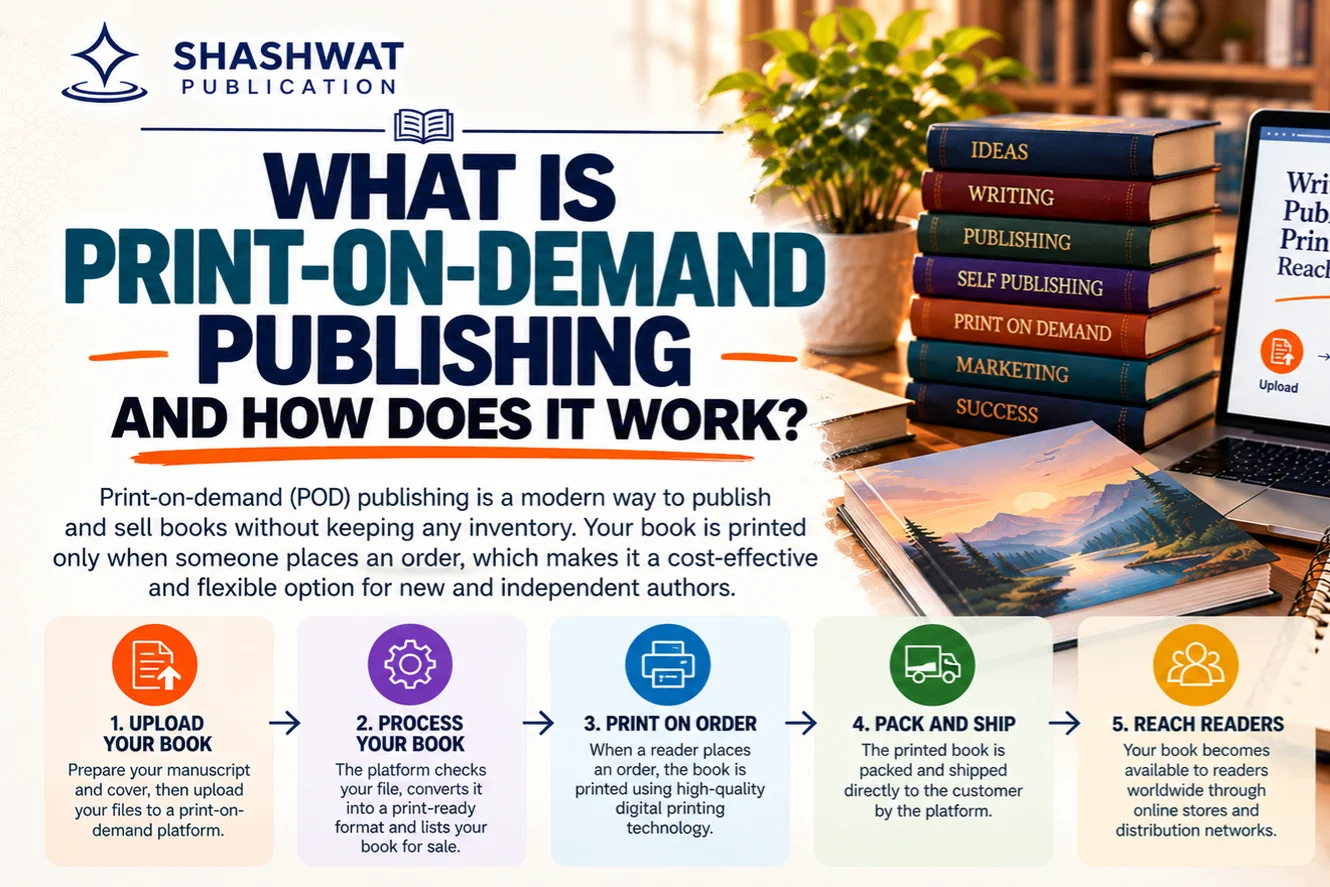
Books are printed when orders are received.
This can be useful for new authors who want to avoid maintaining large quantities of stock.
Shashwat Publication's current publishing information describes print-on-demand as one of the production options available to authors.
An AI-assisted book can also be published digitally.
The process generally involves:
Final manuscript
eBook formatting
Cover preparation
Metadata
Description
Pricing
Distribution
Final quality check
Digital publishing can make it easier to reach readers without the initial cost of physical inventory.
AI can be extremely useful after publication.
It can help create:
Social media posts
Instagram captions
YouTube scripts
Email newsletters
Blog topics
Book launch announcements
Promotional copy
Reader FAQs
Ad variations
Author interview questions
For example, one chapter can become multiple promotional assets.
However, the marketing content should still be reviewed by the author before publishing.
Shashwat Publication's existing marketing guidance emphasizes using a structured combination of online and offline promotion rather than relying on a single promotional activity.
One of the biggest advantages of AI for authors is content repurposing.
Suppose you publish a 10-chapter business book.
AI can help turn the book into:
10 blog topics
20 social media posts
10 short-video ideas
5 email newsletters
10 quote graphics
3 YouTube video scripts
1 book launch campaign
The author can then review and customize each asset.
This allows a single book to become the foundation of a broader author-brand strategy.
Different AI tools can support different tasks.
| Publishing Task | AI Assistance |
| Idea generation | Brainstorming |
| Research planning | Topic organization |
| Outlining | Chapter structure |
| Draft development | Writing assistance |
| Editing | Grammar and clarity |
| Summarization | Chapter summaries |
| Cover concepts | Visual ideation |
| Marketing | Promotional copy |
| Social media | Post ideas |
| Email marketing | Newsletter drafts |
| Reader research | Audience questions |
| Content repurposing | Multi-format content |
The exact tool you use matters less than how responsibly you use it.
AI should not become a shortcut for avoiding essential publishing work.
Do not rely entirely on AI for:
Final fact-checking
Copyright decisions
Legal advice
Academic research verification
Final manuscript approval
Professional editing
Final cover approval
Publishing contracts
Author voice
Original creative decisions
Human judgment remains important throughout the process.
AI-generated text may require substantial revision.
Poor prompts often produce generic content.
AI can produce inaccurate information.
A book should represent the author's ideas and perspective.
Check the applicable tool terms and commercial-use conditions.
AI proofreading is not always enough for a complete book.
AI can help with marketing, but it cannot guarantee readers or revenue.
AI can assist with tasks, but publishing still requires decisions around editing, design, rights, production, distribution, and marketing.
A practical AI-assisted workflow can look like this:
Idea → Research → Outline → Draft → Human Revision → AI-Assisted Editing → Fact-Checking → Professional Editing → Cover Design → Formatting → ISBN/Publishing Requirements → Proof → Distribution → Marketing
This workflow keeps AI in a supporting role while maintaining human responsibility for the final book.
Using AI may reduce some preparation costs, but it does not necessarily make professional publishing free.
You may still need to budget for:
Professional editing
Proofreading
Cover design
Formatting
ISBN/publishing support
Printing
Distribution
Marketing
AI can reduce the amount of time spent on brainstorming, drafting assistance, and content preparation, but professional publishing services can still be valuable.
The cost ultimately depends on the book's length, complexity, format, publishing model, and services selected.
Yes, AI can potentially speed up several parts of the workflow.
For example, it can help an author:
Organize ideas quickly
Build an initial outline
Generate research questions
Identify repetitive writing
Create marketing drafts
Repurpose content
But faster does not automatically mean better.
The goal should be efficient publishing without sacrificing quality.
Even if AI assists with writing, the final book still needs to meet professional publishing standards.
A publishing partner can help with areas such as:
Editing
Cover design
Formatting
ISBN-related support
Printing
Distribution
Marketing
Shashwat Publication's current services describe support across multiple stages of the publishing workflow, including editing, design, formatting, ISBN, printing, distribution, and marketing.
For an author using AI, this can be particularly useful because AI can assist with content creation while professional publishing services can focus on production and market readiness.
It depends on the quality and originality of the final manuscript.
A book created entirely from generic AI prompts may have little differentiation.
An AI-assisted book that combines:
Original author ideas
Human research
Personal experience
Expert knowledge
Careful editing
Fact-checking
Professional design
can be significantly stronger.
The value of a book comes from what it offers readers—not simply from whether AI was involved in producing it.
Before publishing your AI-assisted book, check:
Book topic is clearly defined
Target audience identified
Original ideas included
Research completed
Important facts verified
AI-generated material reviewed
Manuscript professionally edited
Plagiarism/originality checked
Copyright considerations reviewed
Title finalized
Cover finalized
Interior formatting completed
ISBN requirements understood
Print/eBook files checked
Distribution channels selected
Book description finalized
Marketing plan prepared
Final proof approved
Publishing a book using AI in 2026 is possible, but AI should be treated as a publishing assistant—not a replacement for the author.
AI can help with brainstorming, research organization, outlining, drafting assistance, editing, cover concepts, book descriptions, content repurposing, and marketing.
However, the author remains responsible for originality, accuracy, voice, quality, and final decisions.
The strongest approach is a human + AI + professional publishing workflow:
Human creativity + AI assistance + professional editing + quality design + proper publishing + effective distribution and marketing.
If you are planning to publish your first AI-assisted book, start with a strong idea, develop your own perspective, verify your information, edit carefully, and choose a publishing process that matches your goals.
AI can make the journey more efficient. The author's ideas and judgment are what make the finished book worth reading.
+91 99930 01841 | +91 99936 08164 | ssupport@shashwatpublication.com
2nd Floor, HN 46, Balaji Residency, Seept Road, Bilaspur, C.G 495001

Can’t find what you are looking for? Drop an email to support@shashwatpublication.com
Yes, you can use AI as part of the book creation process, but the final manuscript should be carefully reviewed, edited, fact-checked, and developed with meaningful human input.
AI can generate large amounts of text, but relying entirely on AI output can result in generic, repetitive, inaccurate, or poorly differentiated content. Authors should contribute their own ideas, research, experience, and editorial judgment.
AI-assisted publishing can involve copyright, licensing, attribution, and other legal considerations that depend on the jurisdiction and how the content was created. Authors should review applicable laws and the AI tool's terms before commercial publication.
Yes. AI can help identify grammar issues, repetition, unclear sentences, and other writing problems. However, professional human editing can still be valuable for structure, context, tone, consistency, and overall manuscript quality.
AI can help generate visual concepts and artwork, but the final cover should be reviewed for quality, typography, genre suitability, licensing or usage terms, and print requirements.
The answer depends on the AI tool, its terms of service, the image-generation process, and applicable law. Authors should check the relevant commercial-use and licensing terms before using AI-generated images in a published book.
Yes. AI can speed up brainstorming, outlining, drafting assistance, editing support, content repurposing, and marketing preparation. However, professional review and publishing stages still require time.
For a commercially published book, professional editing can still be highly valuable. AI can identify certain language issues, but human editors can evaluate structure, context, tone, consistency, and reader experience.
Yes. AI can help generate social media posts, email drafts, promotional ideas, video scripts, advertising copy, blog topics, and other marketing content. Human review is recommended before publishing promotional material.
Yes. AI-assisted books can be self-published, provided the author handles the applicable publishing, content, copyright, formatting, distribution, and platform requirements.
AI may reduce some preparation costs, but authors may still need to pay for editing, proofreading, cover design, formatting, ISBN or publishing support, printing, distribution, and marketing. The total cost depends on the publishing model and services selected.
Not automatically. Authors should review AI-generated material carefully and ensure that the final work contains meaningful original contribution, proper research, appropriate attribution, and compliance with applicable copyright and platform requirements.


Dear Team, I would like to express my sincere appreciation for the seamless book publishing experience. As this is my debut publication, I will certainly be recommending Shashwat Publication.
I write this to express my deep sense of appreciation and gratitude to Shashwat Publication for publishing my first book in a time bound and professional manner. The first call from Ms Swati and her subsequent interactions, followed by dealing with ... Read More
Very Good publications
Publishing Experience with Shashwat Publications My experience with Shashwat Publications has been a fulfilling and memorable journey. From the initial stages of manuscript preparation to the final publication of my book, The Dental Prescriber: Fro... Read More
About Publishing Experience with Us As a first-time author with Shashwat Publications, I look forward to a professional, collaborative, and enriching publishing experience. I appreciate the opportunity to present this work to students and educators... Read More
I am satisfied with the work, it was not too long time taken by the publishers. Also the price is appropriate for publishing the book. I recommend other authors too, must have experience once with this publication. Worthy experiences. Thanks :)

B-75, Krishna Vihar, Koni, Bilaspur, C.G 495001
support@shashwatpublication.com
Timing
Important Pages
All rights are reserved by Aadeera Corporation Private Limited
Terms & Condition Apply