07-10-2026
Publishing a book is an important achievement, but reaching the right readers is the next challenge. For authors of academic books, reference books, educational guides, research publications and professional titles, libraries, colleges and institutions can be valuable audiences.
Institutional distribution helps make books available to students, faculty members, researchers, librarians and professionals who need reliable information in a particular subject area. Unlike ordinary consumer sales, institutional book distribution often involves identifying relevant organisations, understanding their requirements, submitting book information, and building professional relationships.
However, getting a book into an institutional collection is not automatic. Each library or educational organisation may follow its own acquisition policy, budget, subject requirements and purchasing process.
In this guide, we explain how authors can distribute their books to libraries, colleges and institutions in India, from preparing a professional book proposal to following up with institutional buyers and building long-term visibility.
Institutional book distribution is the process of making books available to organisations that purchase, collect, recommend or use publications for educational, research, professional or reference purposes.
These organisations may include:
Public libraries
College libraries
University libraries
School libraries
Research institutions
Government libraries
Professional training institutes
Educational organisations
Specialised subject libraries
Corporate learning centres
The type of book determines which institutions are most relevant.
For example, an academic research book may be suitable for university departments and research libraries. A school-level educational book may be more relevant to school libraries and teaching organisations. A professional handbook may be useful to specialised institutions and training centres.
The key is to identify institutions whose readers are likely to benefit from the book rather than approaching every organisation with the same proposal.
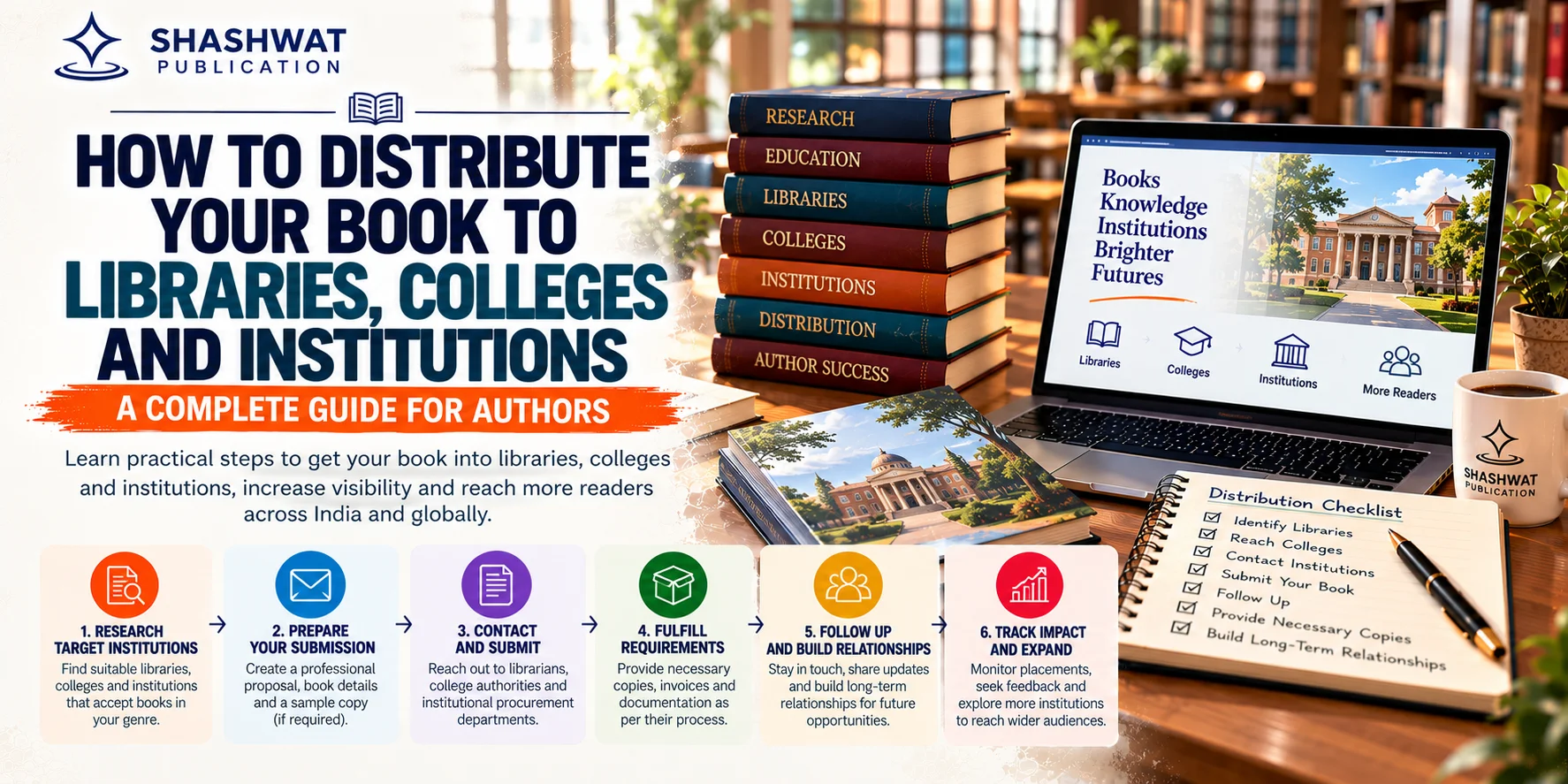
Institutional distribution can create opportunities beyond individual book sales.
Libraries and colleges serve readers with specific educational and research needs. When a book matches those needs, it may become a useful resource for students, teachers, scholars and professionals.
A relevant academic or reference book may attract attention from faculty members, researchers and subject specialists. Institutional availability can help readers discover an author's work.
Research books, textbooks and reference publications can contribute to teaching, independent study and academic research when their content is appropriate for the intended audience.
Some institutions purchase multiple copies of selected books for departments, courses, training programmes or library collections. Such opportunities depend on the institution's requirements and available budget.
A book that remains useful to its intended readership can support an author's professional reputation over time. Relevant publications may also help authors establish relationships with educators and subject specialists.
Institutional distribution should therefore be considered part of a broader book distribution and marketing strategy, rather than a guaranteed source of sales.
Before contacting institutions, identify the category of your book and the readers it serves.
Academic books can be relevant to university libraries, research centres, faculty members and postgraduate students.
Examples include research monographs, subject-specific studies, scholarly books and publications based on original research.
Authors preparing scholarly manuscripts can explore academic research publishing to understand the publishing support available for research-oriented books.
Textbooks and educational publications may be relevant to colleges, schools, teaching departments and training institutions.
The suitability of a textbook depends on the subject, academic level, curriculum relevance and the institution's evaluation process.
Authors should avoid claiming that a book is officially approved for a course unless the relevant approval has actually been obtained.
Reference books are designed to help readers find specific information quickly. They may include dictionaries, subject guides, handbooks, technical references and specialised educational resources.
Explore reference books to understand this category of publication.
Books covering professional skills, industry practices, technical subjects and specialised knowledge may be useful to professional institutes, training centres and corporate libraries.
For these titles, the author's expertise, the accuracy of the content and its practical usefulness can be important considerations.
Libraries also acquire novels, poetry collections, short-story collections, biographies and other literary works.
For literary books, relevance may depend on the library's collection policy, reader interests, language requirements, available budget and acquisition priorities.
The first step is to create a targeted list of institutions that are likely to be interested in your publication.
Sending the same message to hundreds of unrelated organisations is usually less effective than approaching a smaller, carefully researched list.
Start by answering these questions:
Who is the intended reader?
What subject does the book cover?
What educational or professional level does it serve?
Is the book intended for reference, classroom use, research or general reading?
Which departments or organisations would benefit from it?
Your answers will help determine which institutions should be prioritised.
Organise potential institutions into relevant categories.
| Book Category | Potential Institutions |
| Academic research book | University libraries and research centres |
| College textbook | College libraries and relevant departments |
| School educational book | School libraries and educational organisations |
| Technical handbook | Technical institutes and professional training centres |
| Reference book | Public, academic and specialised libraries |
| Poetry or fiction | Public libraries, college libraries and literature departments |
| Professional development book | Training institutes and corporate learning centres |
These are potential audiences, not confirmed buyers. Each institution must be assessed individually.
Visit the official website of each institution and look for its library, acquisitions, collection development or procurement information.
Record details such as:
Library or institution name
Location
Relevant department
Librarian or acquisition contact
Official email address
Book submission procedure
Purchasing or procurement requirements
Follow-up date
This information helps you approach each institution professionally.
Before contacting a librarian or college, ensure that your book is ready to be evaluated.
A well-presented publication makes it easier for an institution to understand its subject, intended audience and potential usefulness.
Check the manuscript for spelling, grammar, accuracy, consistency and readability.
For academic titles, also review references, citations, tables, figures, research methodology and subject-specific terminology.
The cover should clearly communicate the book's subject and title. Academic and reference books should have a professional appearance appropriate to their subject and intended readers.
Make sure that headings, chapter numbering, page numbers, images, tables and references are consistent.
The layout should support comfortable reading and make information easy to locate.
Create a standard information sheet containing:
Full book title
Subtitle, if applicable
Author name
ISBN, where applicable
Publication date
Edition
Language
Page count
Book format
Dimensions
Subject category
Price
Publisher details
Ordering information
Accurate metadata makes it easier for institutions to assess, identify and order the correct edition.
Authors who need professional assistance with publication preparation can review book publication services.
A book proposal is a concise document that explains why an institution may find your book useful.
It should not simply repeat the book description. Instead, it should explain the publication's subject, intended readers and relevance to the institution.
1. Book Overview
Summarise the subject, purpose and main topics covered in the book.
2. Target Audience
Explain whether the book is intended for undergraduate students, postgraduate students, researchers, teachers, professionals or general readers.
3. Academic or Practical Relevance
Describe how the book may support a subject area, research interest, teaching activity or professional learning need.
4. Table of Contents
Include the chapter titles so that the librarian or faculty member can quickly understand the scope of the publication.
5. Author Biography
Provide a short, factual biography highlighting relevant academic qualifications, professional experience, research interests or writing experience.
6. Publication Information
Include the ISBN, edition, publication date, format, page count and price, where available.
7. Ordering Details
Provide a clear method for requesting, purchasing or evaluating the book.
A proposal of approximately one to three pages is often a practical starting point. Some institutions may require a specific form, catalogue record, sample chapter or other documentation.
Always follow the institution's stated submission procedure.
Librarians and acquisition teams often play an important role in selecting resources for institutional collections. Depending on the organisation, faculty members, department heads, procurement teams or committee members may also be involved.
Your communication should explain why the book is relevant to that particular institution.
Look for the official library email address or the contact information for acquisitions and collection development.
For academic titles, it may also be useful to identify the relevant subject department or faculty member.
Avoid sending repeated messages to unrelated departments.
Your email should include:
A clear subject line
A brief introduction
The book title and subject
The intended readership
A short explanation of its relevance
A link to the book's information page, if available
Publication and ordering details
A polite request for the appropriate next step
Keep the message professional and easy to read.
If no response arrives, consider one polite follow-up after approximately seven to ten working days, unless the institution specifies another timeline.
If there is still no response, record the outcome and move to other relevant institutions. Avoid sending repeated unsolicited messages.
For textbooks, academic publications and specialised subject books, faculty members may be able to assess whether a title is relevant to their department.
However, a faculty member's interest does not automatically mean that a college will purchase the book or adopt it for a course.
Match the book's subject with the appropriate academic department.
For example, a research book on a specialised scientific topic may be relevant to a department that teaches or researches that subject. A business handbook may be more suitable for a management or professional education department.
Describe how the book may support:
Additional reading
Research projects
Subject reference
Classroom discussion
Independent study
Professional development
Be specific about the value the book provides.
Some institutions may accept a sample chapter or review copy. Others may require formal documentation or may only consider titles through their acquisition process.
Ask what is appropriate before sending physical copies or making claims about curriculum suitability.
One of the most important aspects of institutional distribution is understanding how an organisation purchases books.
A librarian may be interested in a title but may not have authority to place an order directly.
A library may assess a book based on subject relevance, collection gaps, reader demand, price, format and its available budget.
A department may purchase copies for teaching, research or internal reference. Such purchases may require departmental approval.
Some organisations require quotations, vendor registration, purchase orders, invoices or other documentation.
Requirements vary by institution. Ask for the official procedure before preparing a quotation or shipping books.
If an institution requests multiple copies, confirm the quantity, edition, price, delivery address, payment process and expected delivery date in writing.
Do not reserve substantial inventory or promise delivery until the order details are clear.
Institutions need reliable information to identify and obtain the right book.
A professional book information page should provide the details required for evaluation and ordering.
Ensure that the title, subtitle, author name, edition, ISBN where applicable, publication date and subject classification are accurate.
Inconsistent details across the cover, catalogue information, website and quotation can create confusion.
Explain the book's purpose, intended audience and main topics in straightforward language.
For academic books, include a concise description of the research area, key themes and potential educational relevance.
Where available, provide:
Book price
Format options
Ordering contact
Institutional enquiry details
Applicable delivery information
Availability information
Do not advertise institutional discounts or special purchasing terms unless they are actually offered.
Keep a current record of each edition, including changes to the manuscript, publication details and availability.
This is especially important when libraries need to distinguish between editions or verify bibliographic information.
Institutional outreach does not need to rely entirely on email.
Relevant professional relationships and academic events can help authors introduce their work to readers who understand its subject.
When suitable opportunities are available, academic conferences and subject-specific events can help authors meet researchers, educators and institutional representatives.
Prepare a concise book description and contact details that people can keep for future reference.
Professional conversations with subject specialists can help you understand which institutions may benefit from the book.
Focus on the publication's relevance rather than making unsupported claims about academic recognition or adoption.
Where invited, an author talk, workshop, reading or subject presentation can introduce the book to an interested audience.
Such activities should be planned with the institution's permission and according to its policies.
Maintain a record of professional contacts and previous conversations. Share genuinely relevant updates, such as a new edition or a publication related to their subject area.
A useful professional relationship should be based on relevance and mutual interest rather than frequent promotional messages.
A structured distribution plan makes outreach easier to manage and measure.
Instead of approaching every institution at once, divide your prospects into groups based on relevance and potential demand.
Start with organisations whose subject areas closely match the book.
For example, academic and research titles should generally be prioritised for relevant departments and research libraries before unrelated organisations.
Maintain a spreadsheet with the following columns:
| Field | Purpose |
| Institution Name | Identify the organisation |
| Institution Type | Library, college, university or institute |
| Subject Match | Explain why the book is relevant |
| Contact Person | Record the appropriate contact |
| Email or Contact Details | Track official communication details |
| Date Contacted | Record the first outreach date |
| Response | Track the outcome |
| Next Action | Record the next step |
| Order Status | Track confirmed purchases, if any |
This makes it easier to follow up consistently and avoid contacting the same institution repeatedly without a reason.
Review which institutions responded, requested further information, asked for a sample or placed an order.
Use this information to improve your targeting, proposal and communication. A lack of response may indicate a timing issue, an unsuitable contact or limited relevance; it does not necessarily mean the book is poor quality.
Digital marketing can complement direct institutional outreach by helping librarians, faculty members and researchers discover your book.
A dedicated page should include the book description, author biography, table of contents, publication details and ordering information.
For academic titles, make the subject and intended audience particularly clear.
Authors can create useful articles related to the book's subject. These articles can help demonstrate expertise and give potential readers a better understanding of the publication.
The content should provide genuine information rather than merely repeating sales language.
Use relevant keywords in the book page title, headings, description and other appropriate SEO fields.
Examples of keyword themes include:
Academic books for college libraries
Research books for university libraries
Educational books for institutions
Reference books for academic libraries
Subject-specific books for researchers
These are possible keyword themes, not guaranteed high-volume search terms. Validate them through keyword research before targeting them.
Where appropriate, share publication details through professional networks, author profiles, relevant newsletters and academic communities that permit such content.
Always follow each community's promotional rules and respect recipients' communication preferences.
For additional promotional support, authors can explore book marketing and promotion services.
Authors planning to distribute books to libraries, colleges and institutions need to consider publication quality, accurate book information, printing requirements and the availability of suitable distribution services.
Shashwat Publication provides book publishing services for authors across different genres, including academic and research-oriented books.
Depending on the selected services and agreement, publishing support may include:
Manuscript editing and proofreading
Cover design and interior formatting
ISBN-related assistance
Print and digital publishing options
Printing support
Distribution assistance
Book marketing and promotion
Authors should confirm the current service inclusions, institutional distribution options, costs and applicable terms directly before proceeding.
For books intended for universities, colleges or research institutions, you can also explore academic research publishing to understand the support available for preparing and publishing scholarly work.
Publishing support can help prepare a book professionally, but institutional acquisition decisions remain with the relevant library, department or organisation.
Even a well-written book may struggle to reach institutional readers if the distribution approach is poorly planned.
A specialised academic book may not be relevant to every library or college.
Prioritise organisations that serve the book's intended audience.
A generic email does not explain why the book is relevant to the recipient.
Personalise the message with a clear connection between the book's subject and the institution's collection or department.
Institutions may have specific procedures for book evaluation and purchasing.
Check these requirements before sending proposals, samples or quotations.
Missing ISBN details, unclear pricing, incomplete descriptions or inconsistent edition information can delay evaluation.
Prepare a complete and accurate book information sheet.
Institutional purchases may depend on budgets, approval cycles, collection reviews and procurement procedures.
Allow reasonable time and maintain a professional follow-up schedule.
Do not claim that a book is officially approved, prescribed or recommended by an institution unless there is documented confirmation.
Describe the book's actual content and relevance instead.
A book may need continued visibility after publication.
Relevant articles, professional outreach, author sessions and targeted institutional communication can support discovery over time.
Authors can use the following plan to organise their first month of institutional outreach.
| Period | Main Activity | Expected Output |
| Days 1–5 | Finalise book information and proposal | Complete book information sheet and proposal |
| Days 6–10 | Research libraries, colleges and institutions | Targeted institution list |
| Days 11–15 | Identify appropriate contacts and acquisition procedures | Verified contact and submission records |
| Days 16–20 | Send personalised outreach | Initial institutional enquiries |
| Days 21–25 | Respond to requests and conduct suitable follow-ups | Updated outreach tracker |
| Days 26–30 | Review responses and refine targeting | Improved distribution plan |
This is a suggested workflow, not a promise of institutional acceptance or sales within 30 days. Actual results depend on the book, its audience, institutional requirements and purchasing timelines.
Distributing your book to libraries, colleges and institutions requires more than publishing a title and waiting for orders. Authors need to identify relevant organisations, prepare professional book information, understand acquisition procedures, communicate with the right people and follow up respectfully.
Academic and research books may be suitable for university libraries and subject departments, while educational, reference and literary books may appeal to different institutional audiences. The most effective strategy begins with a clear understanding of who will benefit from the publication.
Professional publishing, accurate metadata, relevant outreach and consistent promotion can make the process easier to manage. However, institutional availability and purchasing decisions depend on each organisation's requirements and policies.
If you are preparing an academic, educational or reference book, explore the publishing services offered by Shashwat Publication and develop an institutional distribution plan that matches your book's subject, readership and long-term goals.
+91 99930 01841 | +91 99936 08164 | ssupport@shashwatpublication.com
2nd Floor, HN 46, Balaji Residency, Seept Road, Bilaspur, C.G 495001

Can’t find what you are looking for? Drop an email to support@shashwatpublication.com
Start by identifying libraries whose collections match your book's subject. Prepare a book information sheet, catalogue details, price and a concise proposal. Contact the appropriate librarian or acquisition department and follow its official submission and purchasing procedures.
Research colleges with relevant courses and departments. Contact the library or acquisition team, explain the book's educational relevance, and provide the publication details requested. Each college decides whether a title meets its collection needs and budget.
Yes. Authors can contact university libraries through their official enquiry or acquisition channels. They should first check whether the library accepts direct submissions, publisher catalogues, sample copies or other forms of book proposals.
Include the title, author name, ISBN where applicable, publication date, edition, format, page count, price, subject category, book description, table of contents and ordering information. Follow any additional requirements specified by the institution.
Some institutions may consider direct purchases, while others may require an approved supplier, formal quotation, purchase order or another procurement process. Authors should confirm the institution's purchasing policy before making arrangements.
Identify universities and departments relevant to your subject. Prepare an academic book proposal, complete publication details and any requested sample material. Contact library acquisition teams and relevant faculty members where appropriate, and follow the institution's evaluation procedure.
An ISBN is useful for identifying a specific book edition and supporting bibliographic records and distribution. Requirements vary according to the publication and institution, so authors should verify the applicable requirements for their intended distribution channels.
You can ask whether an institution accepts donated or review copies. Follow its donation policy and confirm the correct delivery process before sending a book. Acceptance of a copy does not guarantee that it will be added to the collection.
There is no fixed timeline. Evaluation, budget approval, procurement, shipping and collection processing may take different amounts of time depending on the institution and its procedures. Authors should ask about the expected process and follow up respectfully.
Use targeted email outreach, relevant faculty contacts, academic events, professional networks and a complete online book page. Explain how the publication relates to the institution's subject area and avoid making unsupported claims about adoption or approval.
Shashwat Publication offers academic and research publishing services and describes distribution support among its publishing services. Authors should contact the company to confirm the current institutional distribution options, service inclusions and applicable terms.
Choose institutions that match the book's subject, ensure the content is accurate and professionally presented, provide complete publication information and explain its relevance to the intended readers. Adoption remains the institution's decision and cannot be guaranteed.


Very Good publications
Publishing Experience with Shashwat Publications My experience with Shashwat Publications has been a fulfilling and memorable journey. From the initial stages of manuscript preparation to the final publication of my book, The Dental Prescriber: Fro... Read More
About Publishing Experience with Us As a first-time author with Shashwat Publications, I look forward to a professional, collaborative, and enriching publishing experience. I appreciate the opportunity to present this work to students and educators... Read More
I am satisfied with the work, it was not too long time taken by the publishers. Also the price is appropriate for publishing the book. I recommend other authors too, must have experience once with this publication. Worthy experiences. Thanks :)
शाश्वत पब्लिकेशन एक मार्गदर्शक है दिशादर्शक है और आपकी मंजिल तक पहुचाने का बहुत शांतीदायी रास... Read More
It was really a very smooth and wonderful interaction with Shashwat Publication while writing my book. They were very much approachable and helpful in each step. All information was given to me with complete clarity. Whatever corrections were requir... Read More

B-75, Krishna Vihar, Koni, Bilaspur, C.G 495001
support@shashwatpublication.com
Timing
Important Pages
All rights are reserved by Aadeera Corporation Private Limited
Terms & Condition Apply