About Book
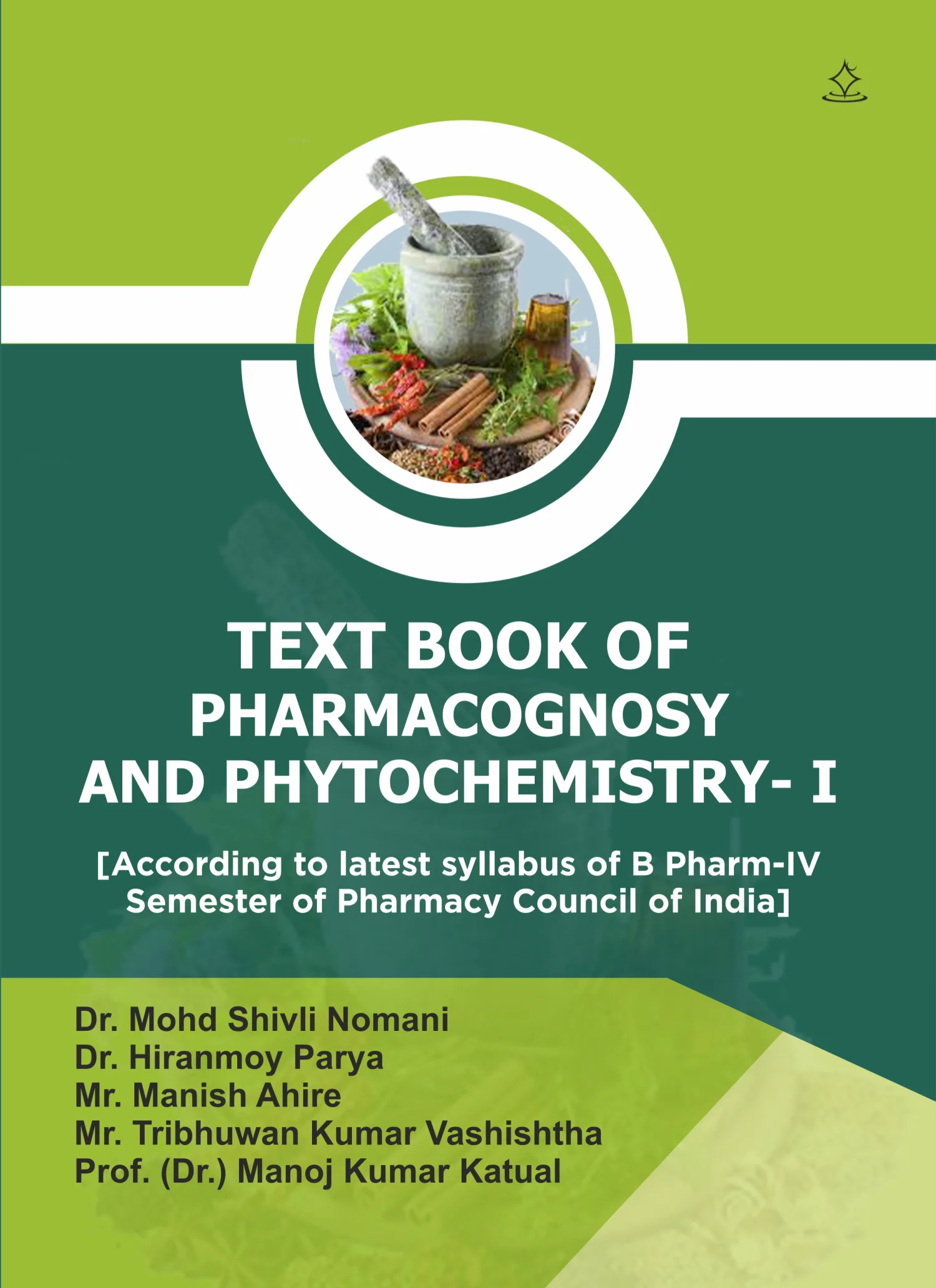
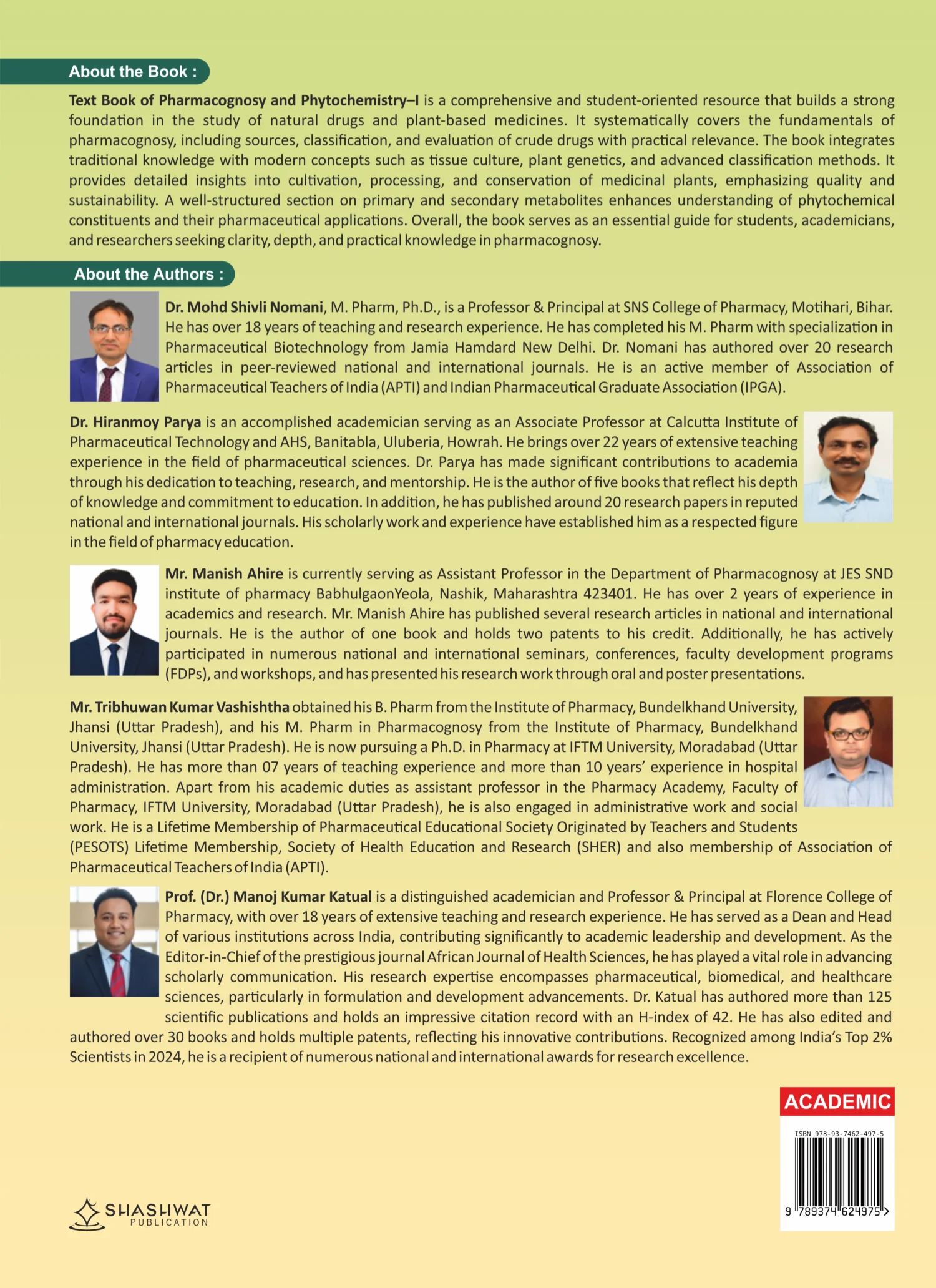
Text Book of Pharmacognosy and Phytochemistry–I is a comprehensive and student-friendly guide designed to build a strong foundation in the study of natural drugs and plant-based medicines. The book begins with a clear introduction to Pharmacognosy, covering its definition, history, scope, and development in a systematic manner. It explains the major sources of drugs including plants, animals, marine organisms, and tissue culture products. A detailed discussion on organized and unorganized drugs such as dried latex, juices, extracts, gums, mucilages, oleoresins, and oleo-gum-resins is included for better conceptual clarity. The text presents an in-depth chapter on the classification of crude drugs through alphabetical, morphological, chemical, and pharmacological approaches. It also highlights advanced methods like chemo-taxonomical and sero-taxonomical classification to connect taxonomy with chemistry and activity.Adulteration of drugs of natural origin is discussed with definition, classification, and suitable examples of crude drugs. The evaluation of crude drugs is explained in a structured way, starting from the basic definition and objectives. Multiple evaluation techniques—organoleptic, microscopic, physical, chemical, and biological—are described with relevant properties. Quantitative microscopy is given special focus to improve practical understanding and examination skills. Important methods such as the Lycopodium spore method, leaf constants, and camera lucida diagrams are also covered. The book further explains cultivation, collection, processing, and storage practices required for maintaining drug quality. It discusses the factors influencing cultivation of medicinal plants and the role of plant hormones in growth and yield improvement. Topics like polyploidy, mutation, and hybridization are included to connect genetics with medicinal plant production. Conservation of medicinal plants is emphasized to promote sustainability and responsible use of resources. A full section on plant tissue culture provides historical development, types of cultures, and nutritional requirements. It explains growth, maintenance, and practical applications of tissue culture in Pharmacognosy. Modern concepts such as edible vaccines are introduced to reflect current advancements in the field. The book also connects Pharmacognosy with various systems of medicine including Ayurveda, Unani, Siddha, Homeopathy, Chinese medicine, and Allopathy.
About Author
Dr. Mohd Shivli Nomani, M. Pharm, Ph.D., is a Professor & Principal at SNS College of Pharmacy, Motihari, Bihar. He has over 18 years of teaching and research experience. He has completed his M. Pharm with specialization in Pharmaceutical Biotechnology from Jamia Hamdard New Delhi. Dr. Nomani has authored over 20 research articles in peer-reviewed national and international journals. He is an active member of Association of Pharmaceutical Teachers of India (APTI) and Indian Pharmaceutical Graduate Association (IPGA).
Dr. Hiranmoy Parya is an accomplished academician serving as an Associate Professor at Calcutta Institute of Pharmaceutical Technology and AHS, Banitabla, Uluberia, Howrah. He brings over 22 years of extensive teaching experience in the field of pharmaceutical sciences. Dr. Parya has made significant contributions to academia through his dedication to teaching, research, and mentorship. He is the author of five books that reflect his depth of knowledge and commitment to education. In addition, he has published around 20 research papers in reputed national and international journals. His scholarly work and experience have established him as a respected figure in the field of pharmacy education.
Mr. Manish Ahire is currently serving as Assistant Professor in the Department of Pharmacognosy at JES SND institute of pharmacy Babhulgaon Yeola, Nashik, Maharashtra 423401. He has over 2 years of experience in academics and research. Mr. Manish Ahire has published several research articles in national and international journals. He is the author of one book and holds two patents to his credit. Additionally, he has actively participated in numerous national and international seminars, conferences, faculty development programs (FDPs), and workshops, and has presented his research work through oral and poster presentations.
Mr. Tribhuwan Kumar Vashishtha obtained his B. Pharm from the Institute of Pharmacy, Bundelkhand University, Jhansi (Uttar Pradesh), and his M. Pharm in Pharmacognosy from the Institute of Pharmacy, Bundelkhand University, Jhansi (Uttar Pradesh). He is now pursuing a Ph.D. in Pharmacy at IFTM University, Moradabad (Uttar Pradesh). He has more than 07 years of teaching experience and more than 10 years’ experience in hospital administration. Apart from his academic duties as assistant professor in the Pharmacy Academy, Faculty of Pharmacy, IFTM University, Moradabad (Uttar Pradesh), he is also engaged in administrative work and social work. He is a Lifetime Membership of Pharmaceutical Educational Society Originated by Teachers and Students (PESOTS) Lifetime Membership, Society of Health Education and Research (SHER) and also membership of Association of Pharmaceutical Teachers of India (APTI).
Prof. (Dr.) Manoj Kumar Katual is a distinguished academician and Professor & Principal at Florence College of Pharmacy, with over 18 years of extensive teaching and research experience. He has served as a Dean and Head of various institutions across India, contributing significantly to academic leadership and development. As the Editor-in-Chief of the prestigious journal African Journal of Health Sciences, he has played a vital role in advancing scholarly communication. His research expertise encompasses pharmaceutical, biomedical, and healthcare sciences, particularly in formulation and development advancements. Dr. Katual has authored more than 125 scientific publications and holds an impressive citation record with an H-index of 42. He has also edited and authored over 30 books and holds multiple patents, reflecting his innovative contributions. Recognized among India’s Top 2% Scientists in 2024, he is a recipient of numerous national and international awards for research excellence.