support@shashwatpublication.com +91 7000072109 B-75, Krishna Vihar, Koni, Bilaspur, C.G 495001
Mon - Sat 10:00 AM to 5:00 PM
Book Image
Book Image
Book Image

ISBN : 978-93-7462-453-1

Category : Academic

Catalogue : Medical And Nursing

ID : SB22416

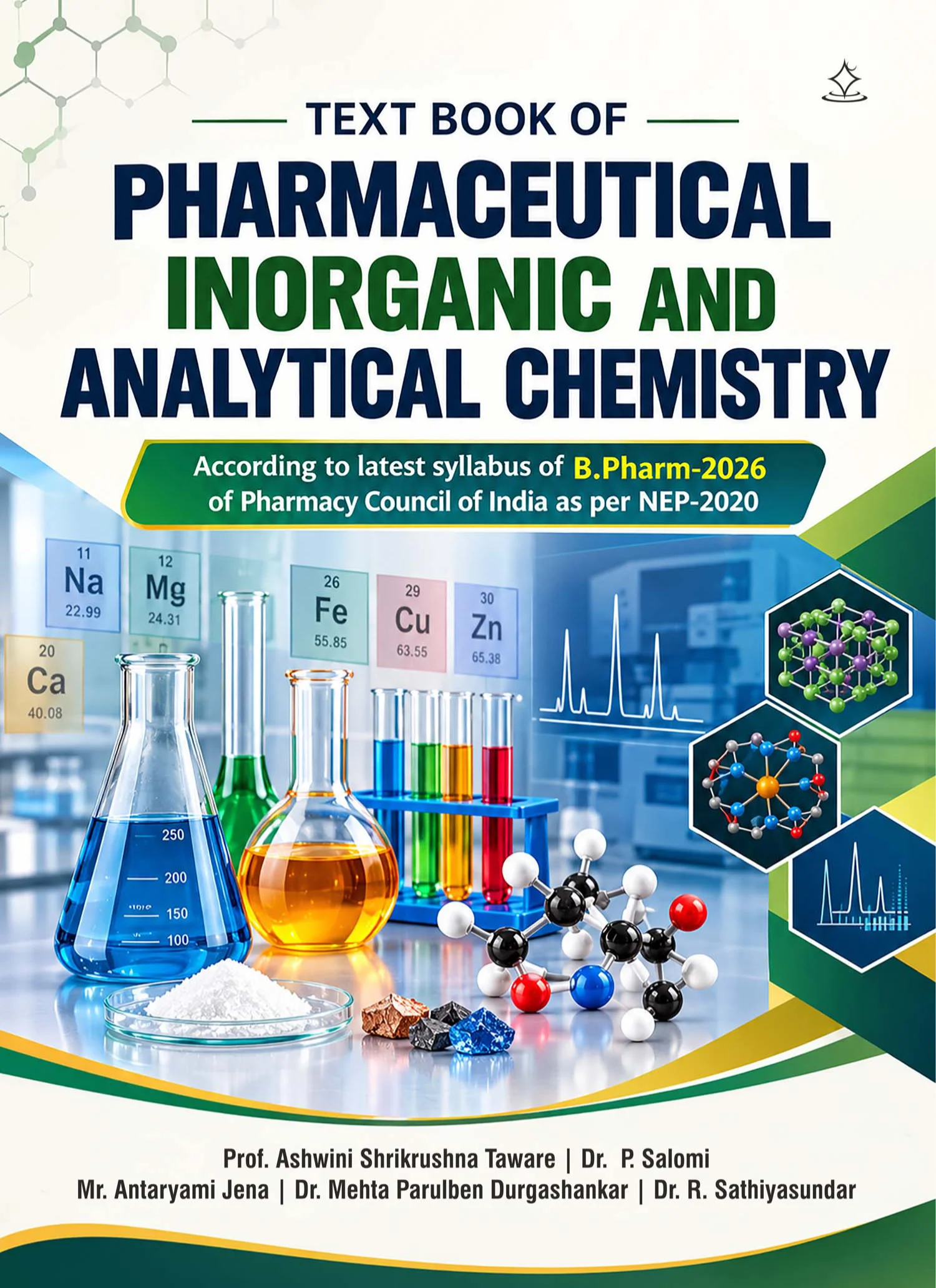
TEXT BOOK OF PHARMACEUTICAL INORGANIC AND ANALYTICAL CHEMISTRY

According to latest syllabus of B.Pharm-2026 of Pharmacy Council of India as per NEP-2020

Prof. Ashwini Shrikrushna Taware, Prof. (Dr.) Salomi Patta, Mr. Antaryami Jena, Dr. Mehta Parulben Durgashankar, Dr. R. Sathiyasundar

Paperback

919.00

e Book

699.00

Pages : 276

Language : English

PAPERBACK Price : 919.00

About Book

The Text Book of Pharmaceutical Inorganic and Analytical Chemistry has been designed to provide students with a strong foundation in the fundamental principles and pharmaceutical applications of inorganic and analytical chemistry. The book begins with an introduction to pharmaceutical analysis and explains different analytical techniques used for the identification and estimation of pharmaceutical substances. Various methods of expressing the strength of solutions are discussed along with the concepts of primary and secondary standards. The important topic of analytical errors is presented with emphasis on their sources, classification, minimization, accuracy, precision, and significant figures. Pharmaceutical impurities are discussed with reference to their sources, types, regulatory importance, and impact on product quality. Limit tests for chloride, sulphate, iron, arsenic, lead, and heavy metals are described systematically. Modified limit tests for chloride and sulphate are also included to provide a better understanding of impurity control. The book explains acid-base chemistry, buffers, pH, and their importance in pharmaceutical formulations. Buffer equations and calculations of pH for buffer solutions are presented in an understandable manner. Isotonicity and its applications in intravenous fluids and ophthalmic preparations are discussed with pharmaceutical relevance. Major extracellular and intracellular electrolytes are covered along with their physiological functions. Important replacement electrolytes such as sodium chloride, potassium chloride, calcium chloride, and oral rehydration salts are also described. Physiological acid-base balance is included to relate chemical concepts with human health. The section on volumetric analysis provides detailed coverage of acid-base titrations, indicators, titrant preparation, standardization, and neutralization curves. Non-aqueous titrations are explained with special emphasis on solvents, acidic and basic titrants, and estimation of weakly acidic and basic substances. Precipitation titrations such as Mohr’s, Volhard’s, modified Volhard’s, and Fajans methods are presented along with gravimetric analysis. Complexometric titrations are discussed with reference to metal ion indicators, masking and demasking agents, EDTA standardization, and pharmaceutical estimations. Redox titrations including permanganometry, cerimetry, iodimetry, iodometry, and potassium iodate titrations are explained systematically. The book also presents important gastrointestinal agents with their chemical properties, preparation, storage, applications, and marketed preparations. Acidifiers, antacids, agents promoting bowel movements, and antimicrobial compounds are discussed in a pharmaceutical context. A dedicated section on radiopharmaceuticals introduces the basics of radioactivity and the pharmaceutical uses of important radioisotopes. Safe handling, storage, disposal, and regulatory requirements related to radiopharmaceuticals are also highlighted. The miscellaneous inorganic compounds section covers expectorants, emetics, haematinics, poisons, antidotes, and astringents. Important compounds are described with respect to their molecular characteristics, preparation, physical and chemical properties, pharmaceutical applications, and storage conditions. The inclusion of marketed preparations helps students connect theoretical concepts with practical pharmacy applications. Overall, the book integrates core analytical principles, inorganic pharmaceutical compounds, quality control concepts, and therapeutic applications in a clear and systematic manner, making it a valuable resource for pharmacy students, teachers, researchers, and pharmaceutical professionals.


About Author

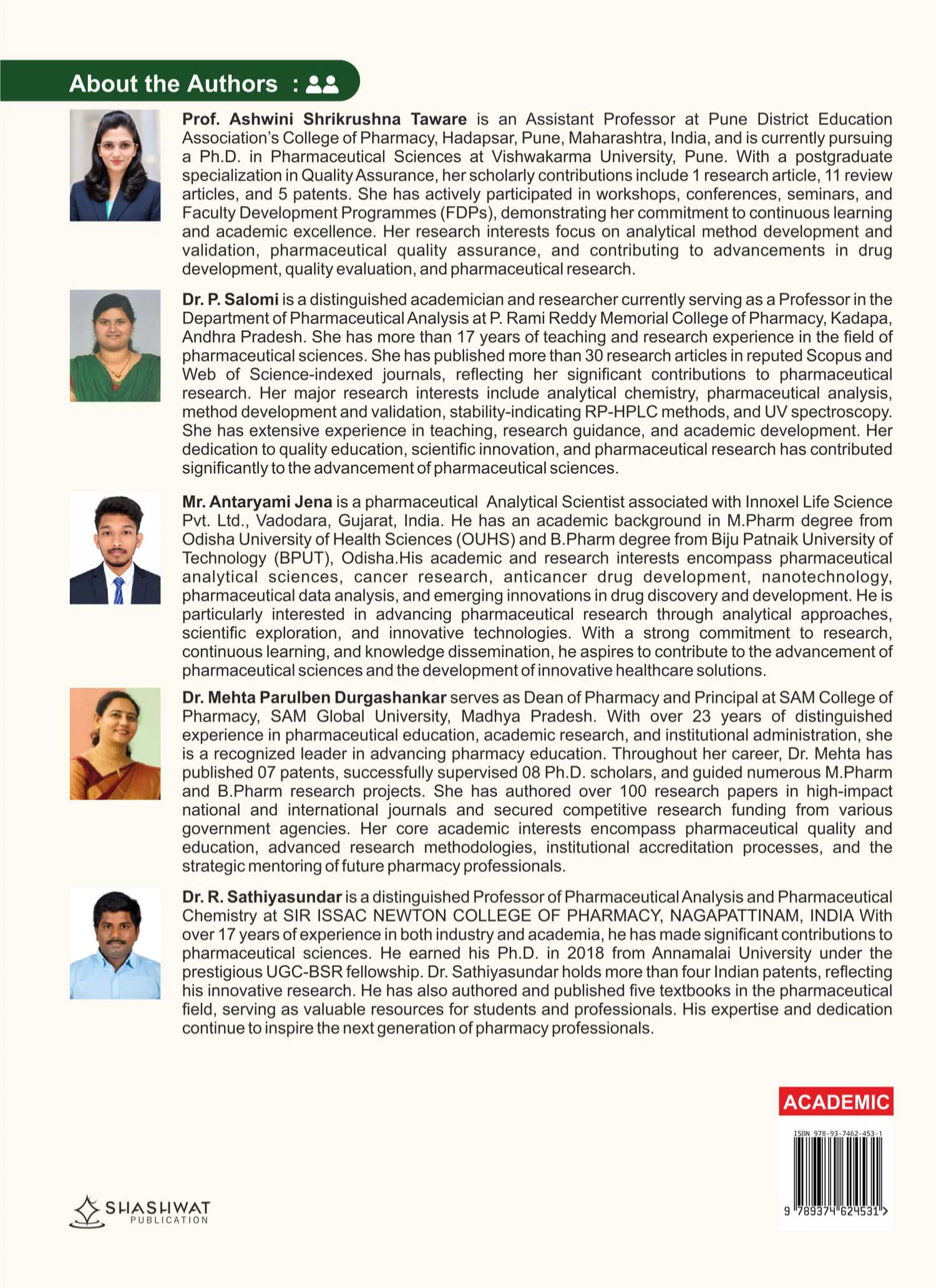
Prof. Ashwini Shrikrushna Taware is an Assistant Professor at Pune District Education Association’s College of Pharmacy, Hadapsar, Pune, Maharashtra, India, and is currently pursuing a Ph.D. in Pharmaceutical Sciences at Vishwakarma University, Pune. With a postgraduate specialization in Quality Assurance, her scholarly contributions include 1 research article, 11 review articles, and 5 patents. She has actively participated in workshops, conferences, seminars, and Faculty Development Programmes (FDPs), demonstrating her commitment to continuous learning and academic excellence. Her research interests focus on analytical method development and validation, pharmaceutical quality assurance, and contributing to advancements in drug development, quality evaluation, and pharmaceutical research. Prof. (Dr.) Salomi Patta is a distinguished academician and researcher currently serving as a Professor in the Department of Pharmaceutical Analysis at P. Rami Reddy Memorial College of Pharmacy, Kadapa, Andhra Pradesh. She has more than 17 years of teaching and research experience in the field of pharmaceutical sciences. She has published more than 30 research articles in reputed Scopus and Web of Science-indexed journals, reflecting her significant contributions to pharmaceutical research. Her major research interests include analytical chemistry, pharmaceutical analysis, method development and validation, stability-indicating RP-HPLC methods, and UV spectroscopy. She has extensive experience in teaching, research guidance, and academic development. Her dedication to quality education, scientific innovation, and pharmaceutical research has contributed significantly to the advancement of pharmaceutical sciences. Mr. Antaryami Jena is a pharmaceutical Analytical Scientist associated with Innoxel Life Science Pvt. Ltd., Vadodara, Gujarat, India. He has an academic background in M.Pharm degree from Odisha University of Health Sciences (OUHS) and B.Pharm degree from Biju Patnaik University of Technology (BPUT), Odisha. His academic and research interests encompass pharmaceutical analytical sciences, cancer research, anticancer drug development, nanotechnology, pharmaceutical data analysis, and emerging innovations in drug discovery and development. He is particularly interested in advancing pharmaceutical research through analytical approaches, scientific exploration, and innovative technologies. With a strong commitment to research, continuous learning, and knowledge dissemination, he aspires to contribute to the advancement of pharmaceutical sciences and the development of innovative healthcare solutions. Dr. Mehta Parulben Durgashankar serves as Dean of Pharmacy and Principal at SAM College of Pharmacy, SAM Global University, Madhya Pradesh. With over 23 years of distinguished experience in pharmaceutical education, academic research, and institutional administration, she is a recognized leader in advancing pharmacy education. Throughout her career, Dr. Mehta has published 07 patents, successfully supervised 08 Ph.D. scholars, and guided numerous M.Pharm and B.Pharm research projects. She has authored over 100 research papers in high-impact national and international journals and secured competitive research funding from various government agencies. Her core academic interests encompass pharmaceutical quality and education, advanced research methodologies, institutional accreditation processes, and the strategic mentoring of future pharmacy professionals. Dr. R. Sathiyasundar is a distinguished Professor of Pharmaceutical Analysis and Pharmaceutical Chemistry at SIR ISSAC NEWTON COLLEGE OF PHARMACY, NAGAPATTINAM, INDIA With over 17 years of experience in both industry and academia, he has made significant contributions to pharmaceutical sciences. He earned his Ph.D. in 2018 from Annamalai University under the prestigious UGC-BSR fellowship. Dr. Sathiyasundar holds more than four Indian patents, reflecting his innovative research. He has also authored and published five textbooks in the pharmaceutical field, serving as valuable resources for students and professionals. His expertise and dedication continue to inspire the next generation of pharmacy professionals.

Customer Reviews


Book from same catalogue

Books From Same Author