ISBN : 978-93-7462-270-4
Category : Academic
Catalogue : Computer
ID : SB22310
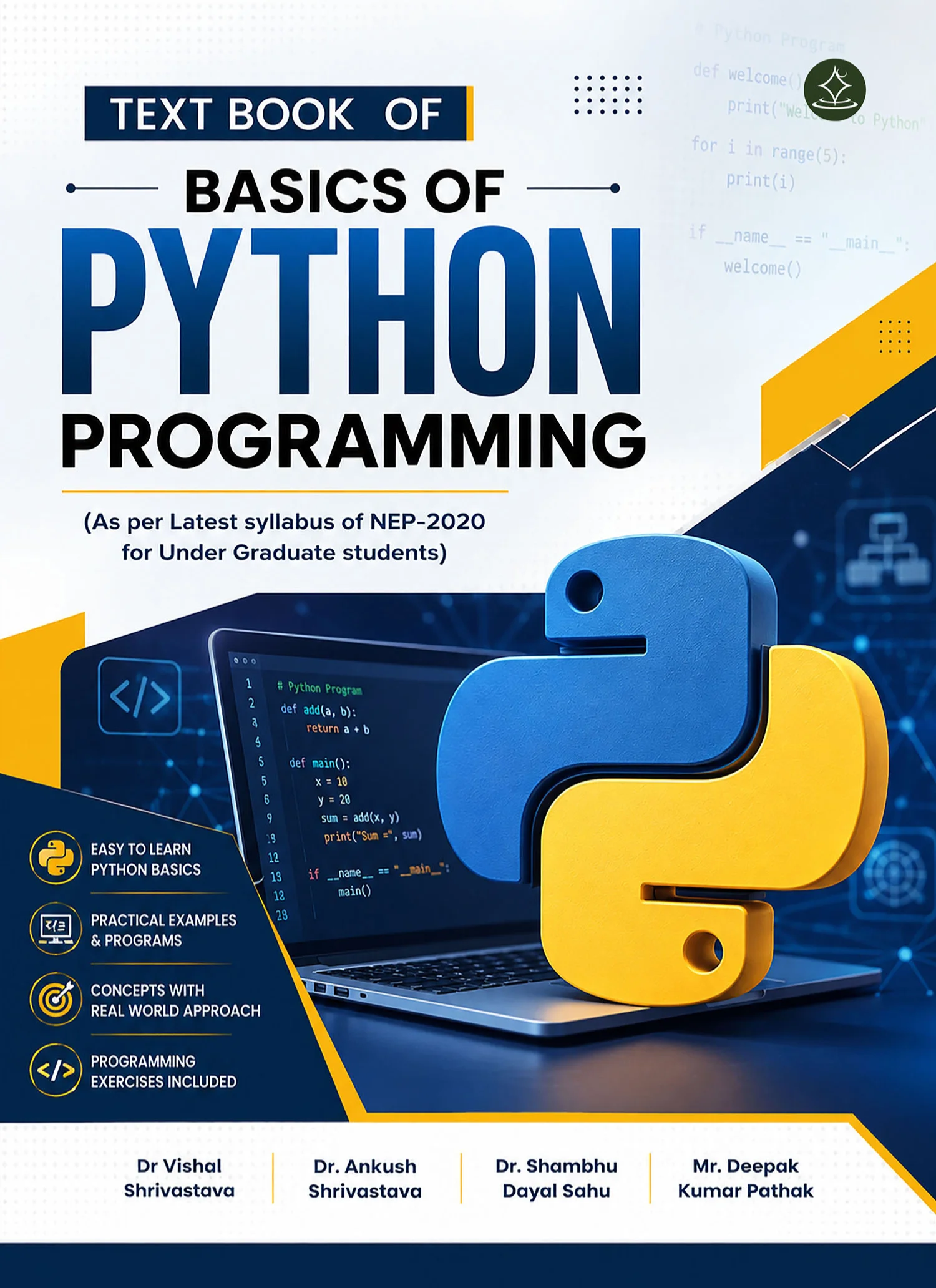
TEXT BOOK OF BASICS OF PYTHON PROGRAMMING
As per Latest syllabus of NEP-2020 for Under Graduate students
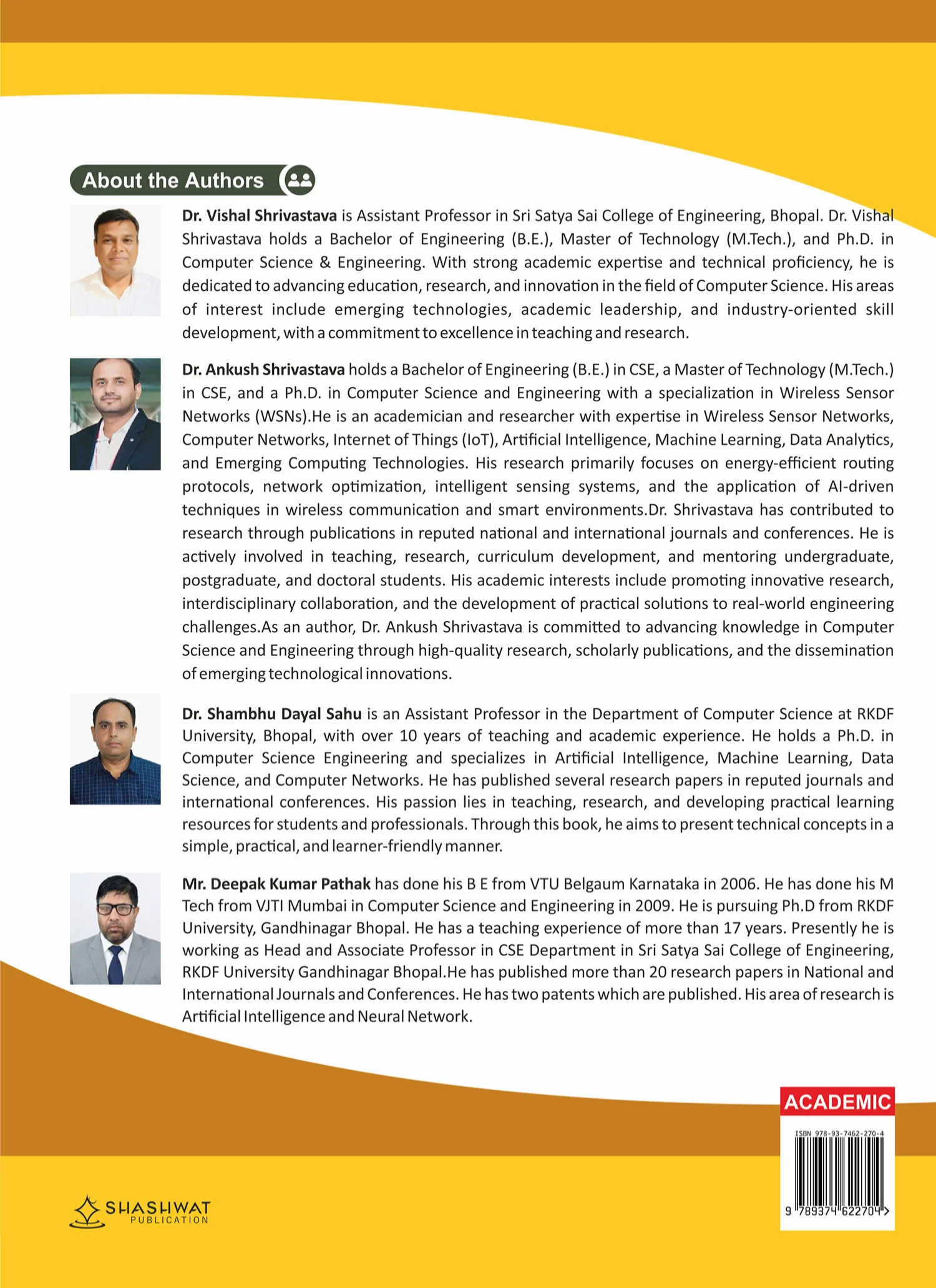
Dr Vishal Shrivastava, Dr. Ankush Shrivastava, Dr. Shambhu Dayal Sahu, Mr. Deepak Kumar Pathak
Paperback
919.00
e Book
599.00
Pages : 302
Language : English
About Book
TEXT BOOK OF BASICS OF PYTHON PROGRAMMING is designed to provide a clear, systematic, and comprehensive introduction to Python programming for beginners, students, and learners from different academic disciplines. The book begins with the fundamentals of programming and introduces Python, its features, applications, history, versions, installation, programming environment, IDLE, editors, and integrated development environments. It explains the basic structure of Python programs, syntax, indentation, comments, keywords, identifiers, variables, constants, and input-output operations in a simple and understandable manner. The book provides detailed coverage of Python data types, including integers, floating-point numbers, complex numbers, Boolean values, and strings, along with type conversion and type casting. Various operators, such as arithmetic, relational, logical, assignment, bitwise, membership, and identity operators, are discussed along with operator precedence and expression evaluation. Decision-making and looping concepts are explained through conditional statements, for and while loops, nested loops, the range() function, and loop control statements such as break, continue, and pass. The book further develops programming skills through practical applications and pattern-based programs. A comprehensive discussion of strings and Python collections introduces string operations, indexing, slicing, formatting, lists, tuples, sets, and dictionaries along with their important methods and applications. Functions are presented as an essential component of structured programming, covering built-in and user-defined functions, different types of arguments, return statements, variable scope, lambda functions, and recursion. The concepts of modules and packages are also introduced to encourage modular and reusable programming. File handling covers text and binary files, file modes, reading, writing, appending, file methods, and basic CSV file operations. Exception handling is explained through syntax and runtime errors, try-except statements, else and finally blocks, multiple exceptions, and raising exceptions. The fundamentals of object-oriented programming are covered through classes, objects, constructors, instance and class variables, methods, encapsulation, inheritance, polymorphism, and method overriding. The book also introduces important Python libraries and modules, including math, random, NumPy, Pandas, and Matplotlib. Basic numerical operations, array manipulation, data handling, Series, DataFrames, and data visualization are presented to provide exposure to modern computational applications. The final sections highlight the growing applications of Python in data science, artificial intelligence, machine learning, science, engineering, research, and business. With its progressive organization and emphasis on fundamental concepts and practical programming, this book aims to develop logical thinking, computational skills, problem-solving ability, and a strong foundation for advanced study and real-world applications of Python.
Customer Reviews