ISBN : 978-93-7462-434-0
Category : Academic
Catalogue : Computer
ID : SB22399
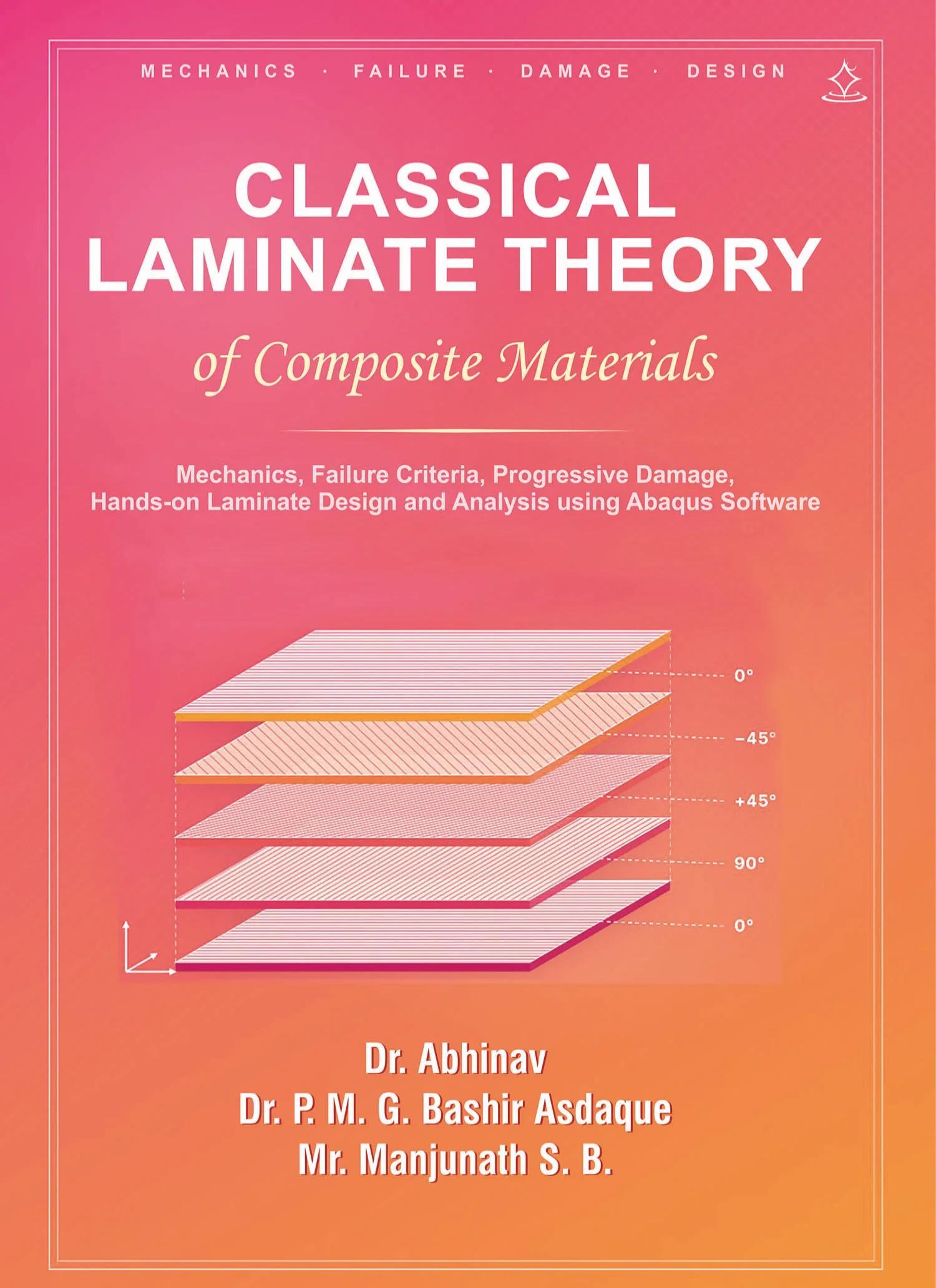
CLASSICAL LAMINATE THEORY OF COMPOSITE MATERIALS
Mechanics, Failure Criteria, Progressive Damage , Hands-on Laminate Design and Analysis using Abaqus Software
Dr. Abhinav, Dr. P. M. G. Bashir Asdaque , Mr. Manjunath S. B.
Paperback
3500.00
e Book
2000.00
Pages : 190
Language : English
About Book
Classical Laminate Theory of Composite Materials is written for readers who want to understand not only what the equations of laminate mechanics are, but why they take their form and how they are used to make real design decisions. The book follows a single, continuous thread — from constituent materials, to a single ply, to a multidirectional laminate, to its failure — and keeps the same material data and notation throughout, so that every result can be traced back to the elastic constants from which it came. Salient features: • A gentle but rigorous progression from the fundamentals of composite materials to laminate analysis, failure prediction and progressive damage. • Clear explanations of the physical meaning of every matrix in CLT — [S], [Q], [Q̄], [A], [B] and [D] — supported by summary tables. • Fully worked numerical examples in which every substitution is shown, including the complete analysis of an unsymmetric laminate from engineering constants to ply stresses. • A comparative treatment of eight lamina failure criteria with practical guidance on selecting the right criterion for the task in hand. • An introduction to progressive damage mechanics and its implementation in the Abaqus finite element program. • A dedicated hands-on chapter with fifteen graded exercises, a mini design project, an assessment rubric and practice problems with answers. • A complete, illustrated Abaqus/Explicit tutorial on the progressive damage analysis of a laminated plate with a hole, from geometry to post-processing. • Fully worked, step-by-step solutions to all practice problems (Appendix C). • Ready-to-use Python code, spreadsheet guidance and an Abaqus verification procedure. • Learning objectives, chapter summaries, review questions and suggested reading in every chapter, together with a list of symbols, a glossary, a formula summary, a materials database and a consolidated list of references. Intended readership The book is suitable as a textbook for undergraduate and postgraduate courses on composite materials, mechanics of composite structures and lightweight design, and as a laboratory manual for computational mechanics courses. Research scholars and practising engineers in the aerospace, automotive, marine, wind-energy and civil sectors will find it a concise, applied reference for laminate analysis and preliminary design. How the book is organised: Chapter 1 introduces composite materials, their history, constituents, classification, manufacturing processes and future trends. Chapter 2 develops the mechanics of a composite lamina and the complete CLT formulation. Chapter 3 applies the theory to fully worked problems. Chapter 4 presents composite failure criteria and failure envelopes. Chapter 5 introduces progressive damage mechanics and finite element damage modelling. Chapter 6 brings everything together in hands-on exercises on laminate composite design and analysis, including an Abaqus tutorial. The appendices provide a formula summary, a materials database and step-by-step solutions to the practice problems.
Customer Reviews