ISBN : 978-93-7462-351-0
Category : Academic
Catalogue : Medical And Nursing
ID : SB22346
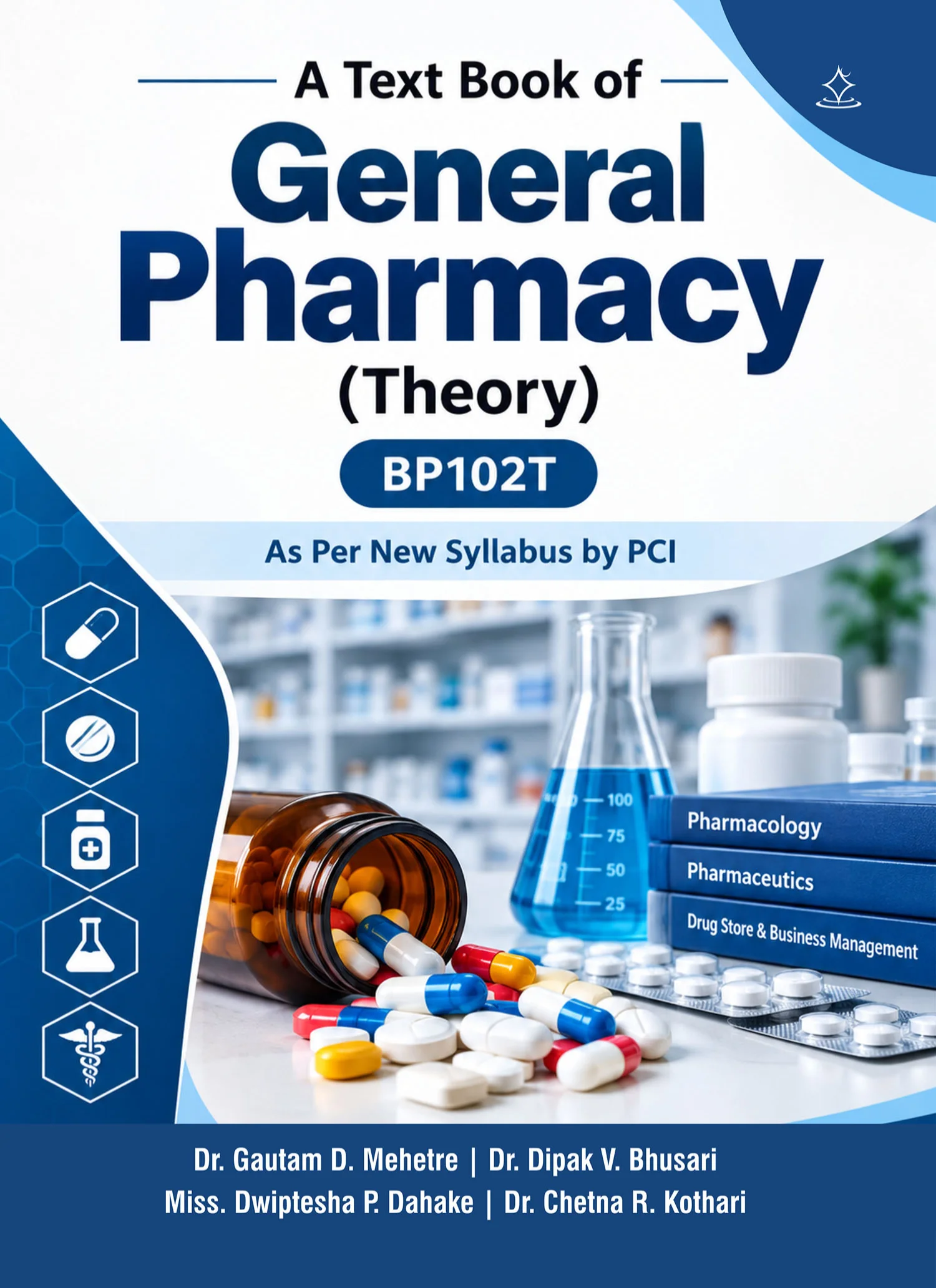
A Text Book of General Pharmacy (Theory) BP102T
As Per New Syllabus by PCI
Dr. Gautam D. Mehetre, Dr. Dipak V. Bhusari, Miss Dwiptesha P. Dahake, Dr. Chetana R. Kothari
Paperback
1119.00
e Book
699.00
Pages : 324
Language : English
About Book
This book has been developed in accordance with the New Education Policy (NEP 2020) to provide a strong foundation for pharmacy students in their early years of study. It introduces the essentials of the pharmacy profession, dosage forms, pharmaceutical calculations, and the evolving role of pharmacists in healthcare systems. By blending conceptual understanding with skill-based learning, this book prepares students for advanced courses in pharmaceutical technology and practice. The content is structured across five comprehensive units that progress logically from the history and scope of pharmacy in India to the scientific and practical aspects of pharmaceutical dosage forms. Students begin by learning about the development of pharmacy as a profession, the importance of pharmacopoeias and official standards, and the ethical responsibilities of pharmacists. This foundation is then expanded into practical areas such as prescription handling, pharmaceutical calculations, and the preparation of various solid, liquid, semisolid, and suppository dosage forms. The book emphasizes competency-based learning outcomes, as envisioned in NEP 2020, by integrating knowledge with practical application. Students will develop the ability to: • Understand the historical evolution and scope of pharmacy as a profession. • Apply pharmaceutical calculations in formulation and compounding. • Recognize the role of APIs and excipients in dosage form design. • Gain practical exposure to the preparation and evaluation of dosage forms. • Strengthen communication skills for patient counselling and inter-professional collaboration. • Develop a sense of professional ethics, responsibility, and accountability as healthcare providers. This book aligns with NEP 2020’s vision of multidisciplinary and holistic education, equipping pharmacy graduates with the knowledge, skills, values, and attitudes required for effective participation in healthcare delivery. It aspires to nurture socially accountable pharmacists who can adapt to future challenges in the pharmaceutical sciences, clinical practice, and healthcare technology. Pharmacy is one of the oldest and most respected professions in the field of healthcare, with its roots deeply embedded in the history of medicine and human civilization. Over time, the profession has undergone significant transformation, evolving from traditional compounding practices to a highly specialized and technology-driven discipline. In the modern healthcare system, pharmacists play a crucial role not only in the preparation and dispensing of medicines but also in ensuring their safe, effective, and rational use. The introduction of the New Education Policy (NEP 2020) has brought a paradigm shift in the way professional education is imparted in India. The policy emphasizes holistic and multidisciplinary learning, critical thinking, skill development, and real-world application of knowledge. In line with these objectives, this book has been carefully designed to meet the academic and professional needs of undergraduate pharmacy students. This book aims to provide a comprehensive introduction to the fundamental principles of pharmacy, forming a strong base for advanced subjects in pharmaceutical sciences. It covers essential topics such as the history and scope of pharmacy, pharmacopoeias and official standards, pharmaceutical calculations, prescription handling, and various pharmaceutical dosage forms. By presenting these concepts in a structured and systematic manner, the book enables students to develop both theoretical understanding and practical skills. The content of the book is divided into five well-organized units. The first unit focuses on the evolution and scope of pharmacy, highlighting its development in India and the role of pharmacists in healthcare systems. It also introduces students to important concepts such as pharmacopoeias, drug standards, and professional ethics, which are essential for maintaining quality and integrity in pharmaceutical practice. The second unit deals with pharmaceutical calculations, an integral part of pharmacy practice. Accurate calculations are crucial for the preparation and dispensing of medications, ensuring patient safety and therapeutic efficacy. This section provides a clear understanding of various calculation methods and their practical applications. The third unit introduces students to prescription handling, including the interpretation of prescriptions, identification of errors, and legal aspects associated with dispensing medicines. This knowledge is essential for pharmacists to ensure the correct and safe use of medications. The fourth and fifth units focus on pharmaceutical dosage forms, which are the means by which drugs are delivered to the body. These units provide detailed information on the formulation, preparation, and evaluation of various dosage forms, including solid, liquid, semisolid, and suppository preparations. Students are also introduced to the role of active pharmaceutical ingredients (APIs) and excipients, which are critical components in dosage form design. A key feature of this book is its emphasis on competency-based learning, as advocated by NEP 2020. The book encourages students to apply their knowledge in practical situations, develop problem-solving abilities, and enhance their communication skills. It also highlights the importance of professional ethics, responsibility, and accountability in pharmacy practice. In addition to academic learning, the book aims to prepare students for their future roles as healthcare professionals. Pharmacists are increasingly becoming integral members of healthcare teams, contributing to patient care, medication management, and public health initiatives. Therefore, it is essential for students to develop not only technical knowledge but also interpersonal and ethical competencies. This book has been written in a simple and clear language to facilitate easy understanding of complex concepts. It serves as a foundational text that will support students throughout their academic journey and professional career. By aligning with the goals of NEP 2020, the book strives to produce competent, skilled, and socially responsible pharmacists who can adapt to the changing landscape of healthcare and contribute effectively to society. In conclusion, this book is an effort to provide a balanced blend of theory and practice, preparing students to meet the challenges of modern pharmacy and to excel in their chosen profession.
Customer Reviews