About Book
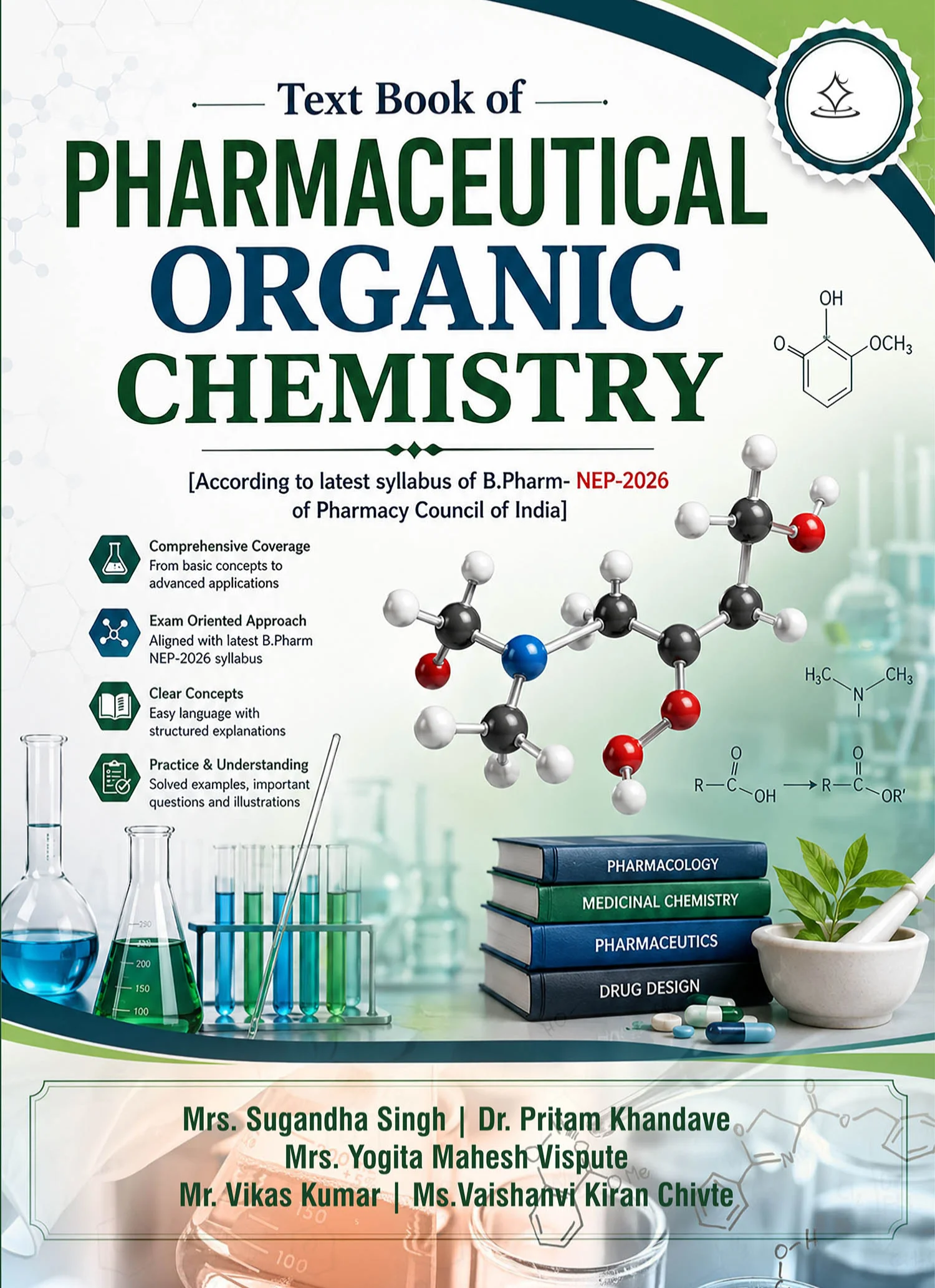
This textbook, Pharmaceutical Organic Chemistry, provides a comprehensive and systematic introduction to the fundamental principles of organic chemistry with special reference to pharmaceutical sciences. The book begins with the basic concepts of organic chemistry and explains the versatility of carbon through its tetravalency, catenation, and suitable atomic size. It introduces the classification and IUPAC nomenclature of aliphatic organic compounds in a clear and student-friendly manner. Important organic reactions such as addition, elimination, substitution, and rearrangement reactions are discussed with suitable examples. The formation, stability, and significance of reactive intermediates, including free radicals, carbocations, and carbanions, are also explained. The book highlights important electron displacement effects such as inductive, electromeric, mesomeric, and hyperconjugative effects and describes their role in determining the reactivity of organic compounds. The concept of hybridization and its significance in alkanes, alkenes, and alkynes are presented in detail. The chemistry of alkanes is covered through various methods of preparation, including the Wurtz reaction, Kolbe’s reaction, Clemmensen reduction, and Wolff–Kishner reduction. The free-radical substitution mechanism of alkanes is illustrated through halogenation reactions. Pharmaceutical applications of liquid paraffin, soft paraffin, and hard paraffin are also included. The section on cycloalkanes explains Baeyer’s strain theory, its limitations, the Coulson–Moffitt modification, and the Sachse–Mohr theory. The chemistry of alkenes includes their preparation by dehydration of alcohols, dehydrohalogenation of alkyl halides, dehalogenation of vicinal dihalides, and the Wittig reaction. Electrophilic addition reactions of alkenes are explained with reference to Markovnikov’s rule, anti-Markovnikov addition, hydration, and ozonolysis. The book also discusses the stability and reactions of conjugated dienes, including 1,2-addition, 1,4-addition, and the Diels–Alder reaction. The chemistry of alkyl halides is presented through detailed explanations of SN1, SN2, E1, and E2 reaction mechanisms. The influence of kinetics, substrate structure, solvent effects, and stereochemistry on substitution and elimination reactions is carefully described. Zaitsev’s rule and the competition between substitution and elimination reactions are explained with examples. The pharmaceutical applications of chloroform, iodoform, and trichloroethylene are also highlighted. The chemistry of benzene and its derivatives includes IUPAC nomenclature, resonance, molecular orbital structure, aromaticity, and Hückel’s rule. Important electrophilic aromatic substitution reactions, including nitration, halogenation, sulphonation, Friedel–Crafts alkylation, and Friedel–Crafts acylation, are explained systematically. The effect of substituents on the reactivity and orientation of monosubstituted benzene derivatives is also discussed. The final section focuses on carbonyl compounds such as aldehydes and ketones. It explains their preparation by oxidation of alcohols, the Reimer–Tiemann reaction, and Friedel–Crafts acylation. Important nucleophilic addition and condensation reactions, including aldol condensation, crossed aldol condensation, Cannizzaro reaction, crossed Cannizzaro reaction, benzoin condensation, and Perkin condensation, are described with suitable examples. Oxidation and reduction reactions of carbonyl compounds are also included. The pharmaceutical uses of compounds such as chloral, paraldehyde, and ketoprofen are discussed to connect theoretical concepts with practical applications. Overall, this book is designed to provide pharmacy students with a strong conceptual understanding of organic chemistry and its relevance to pharmaceutical compounds, drug development, and medicinal applications.
About Author
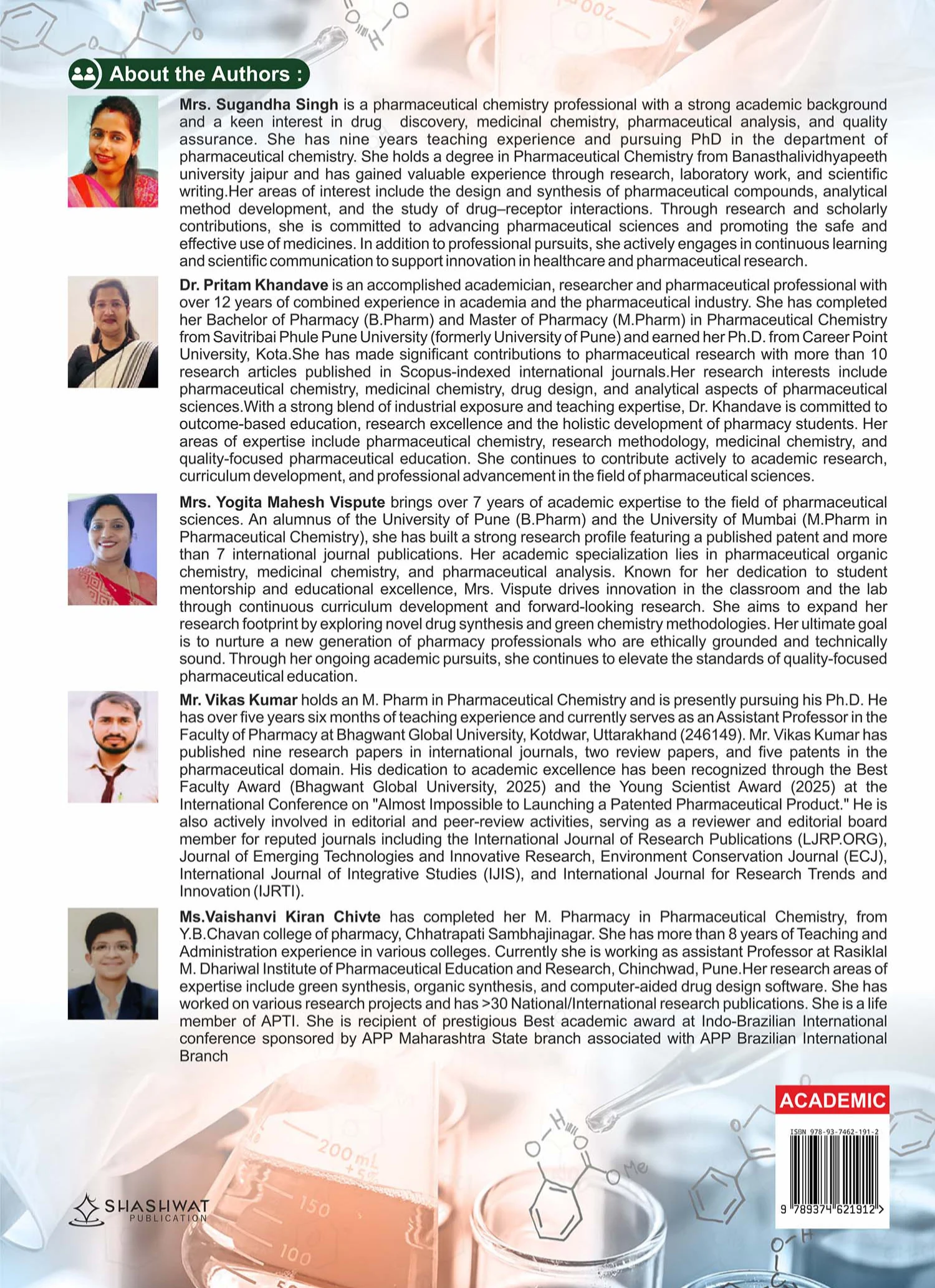
Mrs. Sugandha Singh is a pharmaceutical chemistry professional with a strong academic background and a keen interest in drug discovery, medicinal chemistry, pharmaceutical analysis, and quality assurance. She has nine years teaching experience and pursuing PhD in the department of pharmaceutical chemistry. She holds a degree in Pharmaceutical Chemistry from Banasthali vidhyapeeth university jaipur and has gained valuable experience through research, laboratory work, and scientific writing.Her areas of interest include the design and synthesis of pharmaceutical compounds, analytical method development, and the study of drug–receptor interactions. Through research and scholarly contributions, she is committed to advancing pharmaceutical sciences and promoting the safe and effective use of medicines. In addition to professional pursuits, she actively engages in continuous learning and scientific communication to support innovation in healthcare and pharmaceutical research.
Dr. Pritam Khandave is an accomplished academician, researcher and pharmaceutical professional with over 12 years of combined experience in academia and the pharmaceutical industry. She has completed her Bachelor of Pharmacy (B.Pharm) and Master of Pharmacy (M.Pharm) in Pharmaceutical Chemistry from Savitribai Phule Pune University (formerly University of Pune) and earned her Ph.D. from Career Point University, Kota.She has made significant contributions to pharmaceutical research with more than 10 research articles published in Scopus-indexed international journals.Her research interests include pharmaceutical chemistry, medicinal chemistry, drug design, and analytical aspects of pharmaceutical sciences.With a strong blend of industrial exposure and teaching expertise, Dr. Khandave is committed to outcome-based education, research excellence and the holistic development of pharmacy students. Her areas of expertise include pharmaceutical chemistry, research methodology, medicinal chemistry, and quality-focused pharmaceutical education. She continues to contribute actively to academic research, curriculum development, and professional advancement in the field of pharmaceutical sciences.
Mrs. Yogita Mahesh Vispute brings over 7 years of academic expertise to the field of pharmaceutical sciences. An alumnus of the University of Pune (B.Pharm) and the University of Mumbai (M.Pharm in Pharmaceutical Chemistry), she has built a strong research profile featuring a published patent and more than 7 international journal publications. Her academic specialization lies in pharmaceutical organic chemistry, medicinal chemistry, and pharmaceutical analysis. Known for her dedication to student mentorship and educational excellence, Mrs. Vispute drives innovation in the classroom and the lab through continuous curriculum development and forward-looking research. She aims to expand her research footprint by exploring novel drug synthesis and green chemistry methodologies. Her ultimate goal is to nurture a new generation of pharmacy professionals who are ethically grounded and technically sound. Through her ongoing academic pursuits, she continues to elevate the standards of quality-focused pharmaceutical education.
Mr. Vikas Kumar holds an M. Pharm in Pharmaceutical Chemistry and is presently pursuing his Ph.D. He has over five years six months of teaching experience and currently serves as an Assistant Professor in the Faculty of Pharmacy at Bhagwant Global University, Kotdwar, Uttarakhand (246149). Mr. Vikas Kumar has published nine research papers in international journals, two review papers, and five patents in the pharmaceutical domain. His dedication to academic excellence has been recognized through the Best Faculty Award (Bhagwant Global University, 2025) and the Young Scientist Award (2025) at the International Conference on "Almost Impossible to Launching a Patented Pharmaceutical Product." He is also actively involved in editorial and peer-review activities, serving as a reviewer and editorial board member for reputed journals including the International Journal of Research Publications (LJRP.ORG), Journal of Emerging Technologies and Innovative Research, Environment Conservation Journal (ECJ), International Journal of Integrative Studies (IJIS), and International Journal for Research Trends and Innovation (IJRTI).
Ms.Vaishanvi Kiran Chivte has completed her M. Pharmacy in Pharmaceutical Chemistry, from Y.B.Chavan college of pharmacy, Chhatrapati Sambhajinagar. She has more than 8 years of Teaching and Administration experience in various colleges. Currently she is working as assistant Professor at Rasiklal M. Dhariwal Institute of Pharmaceutical Education and Research, Chinchwad, Pune.Her research areas of expertise include green synthesis, organic synthesis, and computer-aided drug design software. She has worked on various research projects and has >30 National/International research publications. She is a life member of APTI. She is recipient of prestigious Best academic award at Indo-Brazilian International conference sponsored by APP Maharashtra State branch associated with APP Brazilian International Branch