ISBN : 978-93-7462-215-5
Category : Academic
Catalogue : Medical And Nursing
ID : SB22270
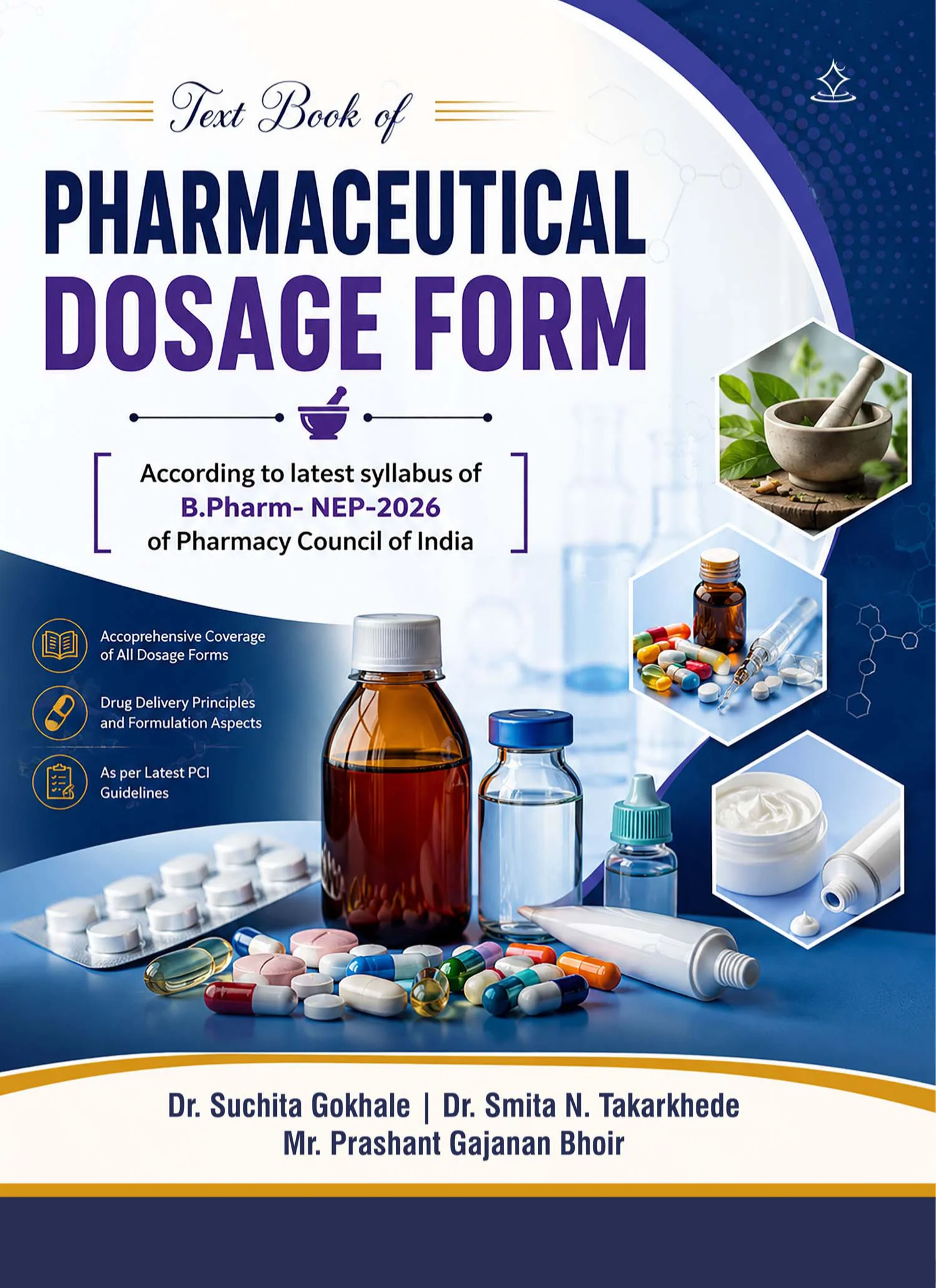
TEXT BOOK OF PHARMACEUTICAL DOSAGE FORM
According to latest syllabus of B. Pharm -NEP-2026 of Pharmacy Council of India
Dr. Suchita Gokhale, Dr. Smita N. Takarkhede, Mr. Prashant Gajanan Bhoir
Paperback
919.00
e Book
699.00
Pages : 295
Language : English
About Book
The Textbook of Pharmaceutical Dosage Forms provides a comprehensive understanding of the principles, formulation, manufacturing, evaluation, quality control, and packaging of conventional and advanced pharmaceutical dosage forms. It is designed to develop a strong conceptual and practical foundation in pharmaceutics for undergraduate pharmacy students. The book begins with the fundamentals of preformulation studies and explains the importance of solubility, pKa, polymorphism, particle size, flow properties, and drug–excipient compatibility in dosage-form development. It presents the formulation, manufacturing, quality control, and packaging of medicated powders and granules in a systematic manner. Detailed coverage is provided on tablet formulation, excipients, tooling, manufacturing methods, equipment, in-process quality control, finished-product testing, common manufacturing defects, and their remedies. Various tablet-coating techniques, including sugar coating, film coating, compression coating, and enteric coating, are also discussed. The book explains the composition, manufacturing, filling, evaluation, packaging, and stability of hard and soft gelatin capsules, along with non-gelatin capsule shells and modern filling techniques. Monophasic liquid dosage forms such as pharmaceutical solutions, syrups, elixirs, and powders for reconstitution are described with emphasis on solvents, vehicles, additives, solubility-enhancement techniques, manufacturing processes, and quality control. Pharmaceutical waters, their preparation, quality requirements, storage, and distribution systems are also covered. The section on pressurized dosage forms includes aerosols and metered-dose inhalers, with detailed discussion of propellants, valves, containers, formulation, manufacturing, and performance evaluation. A dedicated section focuses on sterile dosage forms, including parenteral and ophthalmic preparations, their routes of administration, classification, regulatory requirements, and current good manufacturing practices. Water for Injection, Purified Water, aseptic processing, terminal sterilization, filtration, radiation, gas sterilization, dehydrogenation, isotonicity adjustment, buffering, preservation, and stabilization are explained in detail. The book also covers packaging materials and container–closure systems such as ampoules, vials, infusion bottles, prefilled syringes, ophthalmic containers, rubber closures, and integrity testing. Important quality-control tests, including sterility testing, bacterial endotoxin testing, particulate-matter testing, clarity, pH, osmolarity, fill volume, leak testing, validation, and stability studies, are clearly presented. The principles, formulation, manufacture, evaluation, packaging, and stability of pharmaceutical suspensions and emulsions are discussed thoroughly. Scientific concepts such as Stokes’ law, DLVO theory, Brownian movement, sedimentation, flocculation, creaming, coalescence, cracking, and phase inversion are explained in an easy-to-understand manner. Advanced delivery systems, including nanosuspensions, nano emulsions, microemulsions, SMEDDS, SNEDDS, dry powders for reconstitution, and raft-forming systems, are introduced with their pharmaceutical applications. Overall, this textbook serves as a valuable academic and practical resource for students, teachers, researchers, and pharmaceutical professionals involved in the development and evaluation of pharmaceutical dosage forms.
Customer Reviews