ISBN : 978-93-7462-164-6
Category : Academic
Catalogue : Computer
ID : SB22111
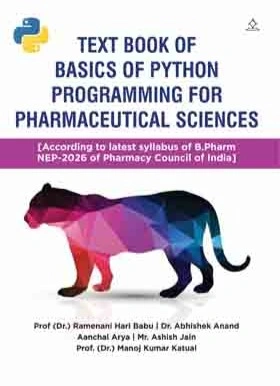
TEXT BOOK OF BASICS OF PYTHON PROGRAMMING FOR PHARMACEUTICAL SCIENCES
According to latest syllabus of B.Pharm- NEP-2026 of Pharmacy Council of India
Ramenani Hari Babu, Dr. Abhishek Anand, Aanchal Arya, Mr. Ashish Jain, Prof. (Dr.) Manoj Kumar Katual
Paperback
999.00
e Book
599.00
Pages : 301
Language : English
34 Copies sold till date
About Book
Textbook of Basics of Python Programming for Pharmaceutical Sciences is a comprehensive and application-oriented resource designed to introduce pharmacy students to the fundamentals of Python programming in a structured and meaningful way.The book begins with a clear introduction to Python, emphasizing its relevance in modern pharmaceutical research, data analysis, and healthcare applications. It guides learners through the installation of Python and popular Integrated Development Environments such as Jupyter Notebook, PyCharm, and VS Code, highlighting their practical advantages. Core programming concepts including variables, data types, operators, and input-output operations are explained with clarity and simplicity. Special attention is given to string manipulation and the use of standard and third-party libraries, enabling learners to extend Python’s capabilities. The section on control structures builds logical thinking through conditional statements, loops, and flow control mechanisms. Functions are introduced to promote modular programming and code reusability. Practical pharmaceutical examples such as dosage and BMI calculations make learning more relevant and engaging. The book further explores essential data structures including lists, tuples, and dictionaries. Students learn indexing, slicing, and manipulation techniques crucial for handling real-world data. An introduction to NumPy provides a foundation for numerical computing and array-based operations. File handling concepts enable learners to read and write CSV files efficiently. The text emphasizes working with structured healthcare datasets to build practical data skills. Learners are guided in importing and manipulating pharmaceutical datasets for meaningful insights. The Pandas library is introduced as a powerful tool for data analysis and management. Concepts such as Series and DataFrames are explained with practical examples. Students learn to read CSV and Excel files related to pharmacokinetics and adverse drug reactions. Data inspection techniques using functions like head(), tail(), info(), and describe() are thoroughly covered. The book also focuses on data cleaning, handling missing values, and preparing datasets for analysis. Filtering, selection, grouping, and aggregation techniques are explained in a step-by-step manner. Visualization using Matplotlib is introduced to enhance data interpretation skills. Different types of plots such as line graphs, histograms, scatter plots, and box plots are demonstrated. Pharmaceutical applications like concentration-time curves and dissolution profiles are visualized effectively. The importance of labeling, legends, and scientific presentation is emphasized. Each chapter integrates theoretical concepts with practical applications to ensure deeper understanding. Overall, this book serves as a valuable bridge between programming and pharmaceutical sciences, preparing students for data-driven healthcare environments.
Customer Reviews