ISBN : 978-93-7462-883-6
Category : Academic
Catalogue : Reference
ID : SB21942
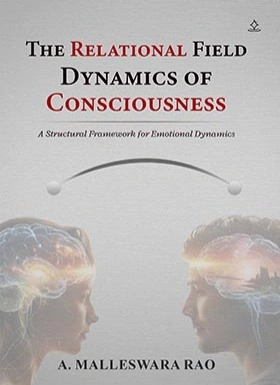
The Relational Field Dynamics of Consciousness
NA
A. Malleswara Rao
Paperback
699.00
e Book
349.00
Pages : 248
Language : English
About Book
The Relational Field Dynamics of Consciousness presents a non-diagnostic, first-order analytical framework for understanding human consciousness as a relational field rather than an isolated internal phenomenon. Moving beyond individualistic and reductionist models, the book examines how perception, emotion, relational distance, bandwidth, and contextual forces interact to shape lived experience. Drawing from philosophy, psychology, systems thinking, and experiential observation, the work offers a structured yet non-prescriptive approach that avoids moral judgement, clinical categorisation, and ideological positioning. It is intended as a conceptual mirror rather than a therapeutic manual, allowing readers to recognise patterns of coherence, instability, and relational tension without imposing conclusions. The book is particularly relevant to readers interested in consciousness studies, relational psychology, interdisciplinary philosophy, and reflective inquiry into human experience within contemporary social and relational contexts. Extended Description / Back-of-Book Copy (Optional) This book explores consciousness not as a private, self-contained entity, but as a dynamic relational field shaped continuously by internal states, interpersonal relationships, and contextual forces. Rather than offering prescriptions or diagnoses, it introduces a first-order analytical language for observing how stability, instability, emotional bandwidth, and relational distance emerge and interact. The work consciously avoids clinical labels and normative judgement. Instead, it presents consciousness as a measurable yet fluid field, allowing patterns to be recognised without converting them into pathologies or ideologies. Advanced analysis is deliberately separated, preserving clarity and accessibility. Designed for thoughtful readers, practitioners, and scholars, The Relational Field Dynamics of Consciousness functions as both a conceptual framework and a reflective instrument—inviting observation, not compliance; recognition, not belief.
Customer Reviews