ISBN : 978-93-7462-231-5
Category : Academic
Catalogue : Pharmacy and Medical Sciences
ID : SB22285
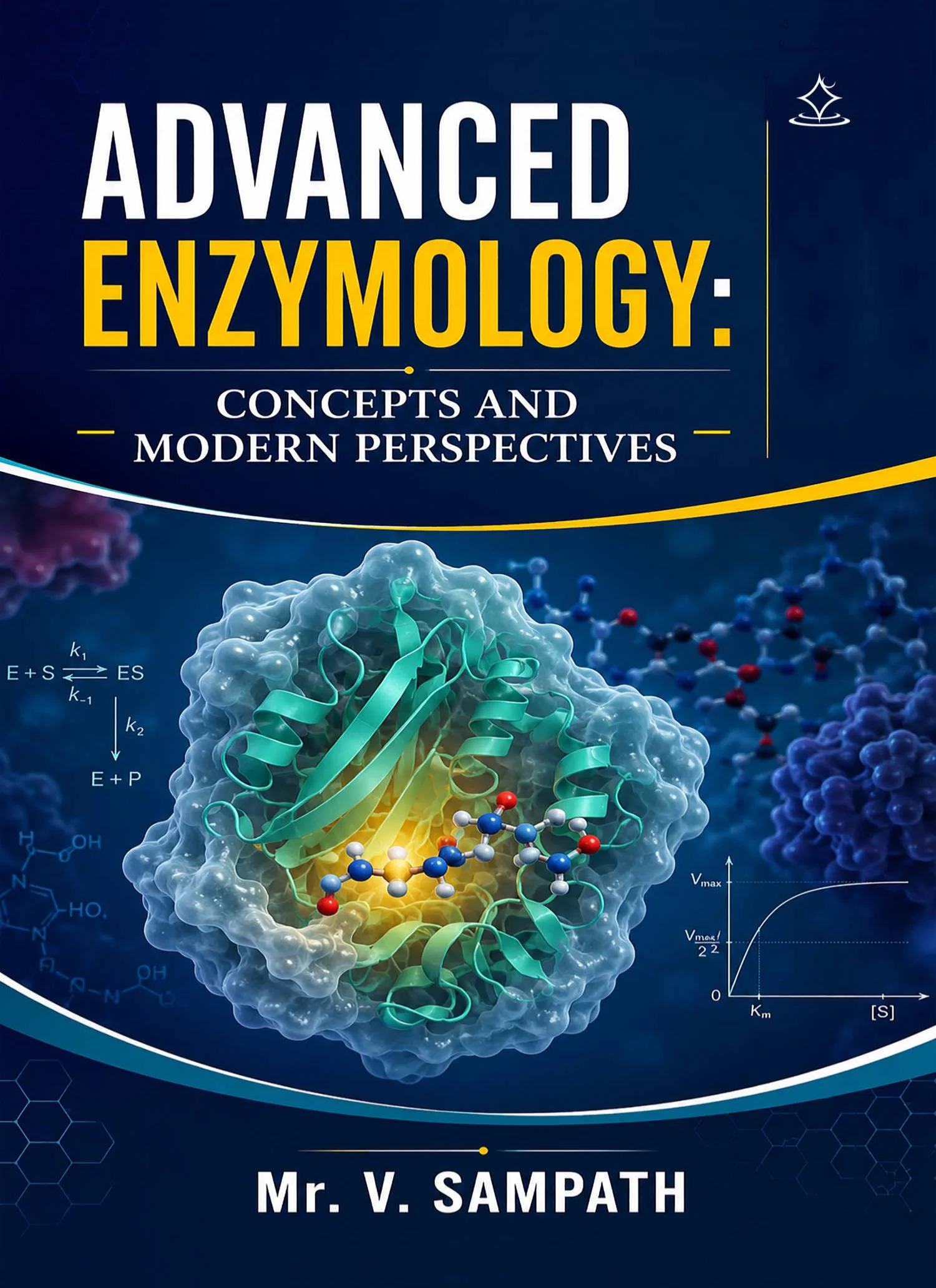
ADVANCED ENZYMOLOGY: CONCEPTS AND MODERN PERSPECTIVES
ADVANCED ENZYMOLOGY: CONCEPTS AND MODERN PERSPECTIVES
Mr. V. SAMPATH
Paperback
619.00
e Book
299.00
Pages : 192
Language : English
About Book
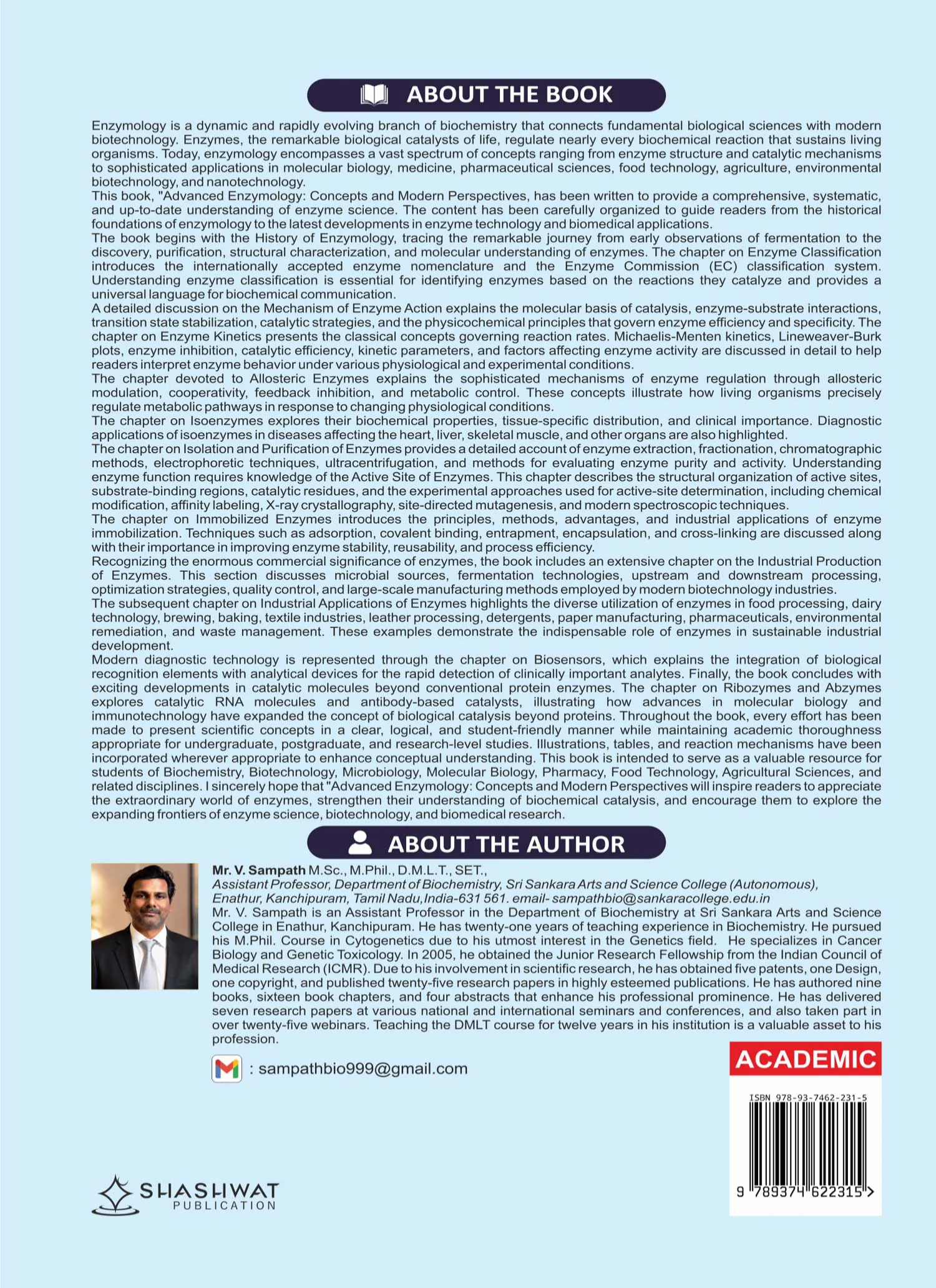
Enzymology is a dynamic and rapidly evolving branch of biochemistry that connects fundamental biological sciences with modern biotechnology. Enzymes, the remarkable biological catalysts of life, regulate nearly every biochemical reaction that sustains living organisms. Today, enzymology encompasses a vast spectrum of concepts ranging from enzyme structure and catalytic mechanisms to sophisticated applications in molecular biology, medicine, pharmaceutical sciences, food technology, agriculture, environmental biotechnology, and nanotechnology. This book, "Advanced Enzymology: Concepts and Modern Perspectives, has been written to provide a comprehensive, systematic, and up-to-date understanding of enzyme science. The content has been carefully organized to guide readers from the historical foundations of enzymology to the latest developments in enzyme technology and biomedical applications. The book begins with the History of Enzymology, tracing the remarkable journey from early observations of fermentation to the discovery, purification, structural characterization, and molecular understanding of enzymes. The chapter on Enzyme Classification introduces the internationally accepted enzyme nomenclature and the Enzyme Commission (EC) classification system. Understanding enzyme classification is essential for identifying enzymes based on the reactions they catalyze and provides a universal language for biochemical communication. A detailed discussion on the Mechanism of Enzyme Action explains the molecular basis of catalysis, enzyme-substrate interactions, transition state stabilization, catalytic strategies, and the physicochemical principles that govern enzyme efficiency and specificity. The chapter on Enzyme Kinetics presents the classical concepts governing reaction rates. Michaelis-Menten kinetics, Lineweaver-Burk plots, enzyme inhibition, catalytic efficiency, kinetic parameters, and factors affecting enzyme activity are discussed in detail to help readers interpret enzyme behavior under various physiological and experimental conditions. The chapter devoted to Allosteric Enzymes explains the sophisticated mechanisms of enzyme regulation through allosteric modulation, cooperativity, feedback inhibition, and metabolic control. These concepts illustrate how living organisms precisely regulate metabolic pathways in response to changing physiological conditions. The chapter on Isoenzymes explores their biochemical properties, tissue-specific distribution, and clinical importance. Diagnostic applications of isoenzymes in diseases affecting the heart, liver, skeletal muscle, and other organs are also highlighted. The chapter on Isolation and Purification of Enzymes provides a detailed account of enzyme extraction, fractionation, chromatographic methods, electrophoretic techniques, ultracentrifugation, and methods for evaluating enzyme purity and activity. Understanding enzyme function requires knowledge of the Active Site of Enzymes. This chapter describes the structural organization of active sites, substrate-binding regions, catalytic residues, and the experimental approaches used for active-site determination, including chemical modification, affinity labeling, X-ray crystallography, site-directed mutagenesis, and modern spectroscopic techniques. The chapter on Immobilized Enzymes introduces the principles, methods, advantages, and industrial applications of enzyme immobilization. Techniques such as adsorption, covalent binding, entrapment, encapsulation, and cross-linking are discussed along with their importance in improving enzyme stability, reusability, and process efficiency. Recognizing the enormous commercial significance of enzymes, the book includes an extensive chapter on the Industrial Production of Enzymes. This section discusses microbial sources, fermentation technologies, upstream and downstream processing, optimization strategies, quality control, and large-scale manufacturing methods employed by modern biotechnology industries. The subsequent chapter on Industrial Applications of Enzymes highlights the diverse utilization of enzymes in food processing, dairy technology, brewing, baking, textile industries, leather processing, detergents, paper manufacturing, pharmaceuticals, environmental remediation, and waste management. These examples demonstrate the indispensable role of enzymes in sustainable industrial development. Modern diagnostic technology is represented through the chapter on Biosensors, which explains the integration of biological recognition elements with analytical devices for the rapid detection of clinically important analytes. Finally, the book concludes with exciting developments in catalytic molecules beyond conventional protein enzymes. The chapter on Ribozymes and Abzymes explores catalytic RNA molecules and antibody-based catalysts, illustrating how advances in molecular biology and immunotechnology have expanded the concept of biological catalysis beyond proteins. Throughout the book, every effort has been made to present scientific concepts in a clear, logical, and student-friendly manner while maintaining academic thoroughness appropriate for undergraduate, postgraduate, and research-level studies. Illustrations, tables, and reaction mechanisms have been incorporated wherever appropriate to enhance conceptual understanding. This book is intended to serve as a valuable resource for students of Biochemistry, Biotechnology, Microbiology, Molecular Biology, Pharmacy, Food Technology, Agricultural Sciences, and related disciplines. I sincerely hope that "Advanced Enzymology: Concepts and Modern Perspectives will inspire readers to appreciate the extraordinary world of enzymes, strengthen their understanding of biochemical catalysis, and encourage them to explore the expanding frontiers of enzyme science, biotechnology, and biomedical research. Mr. V. Sampath
Customer Reviews