support@shashwatpublication.com +91 7000072109 B-75, Krishna Vihar, Koni, Bilaspur, C.G 495001
Mon - Sat 10:00 AM to 5:00 PM
Book Image
Book Image
Book Image

ISBN : 978-93-7462-380-0

Category : Academic

Catalogue : Pharmacy and Medical Sciences

ID : SB22353

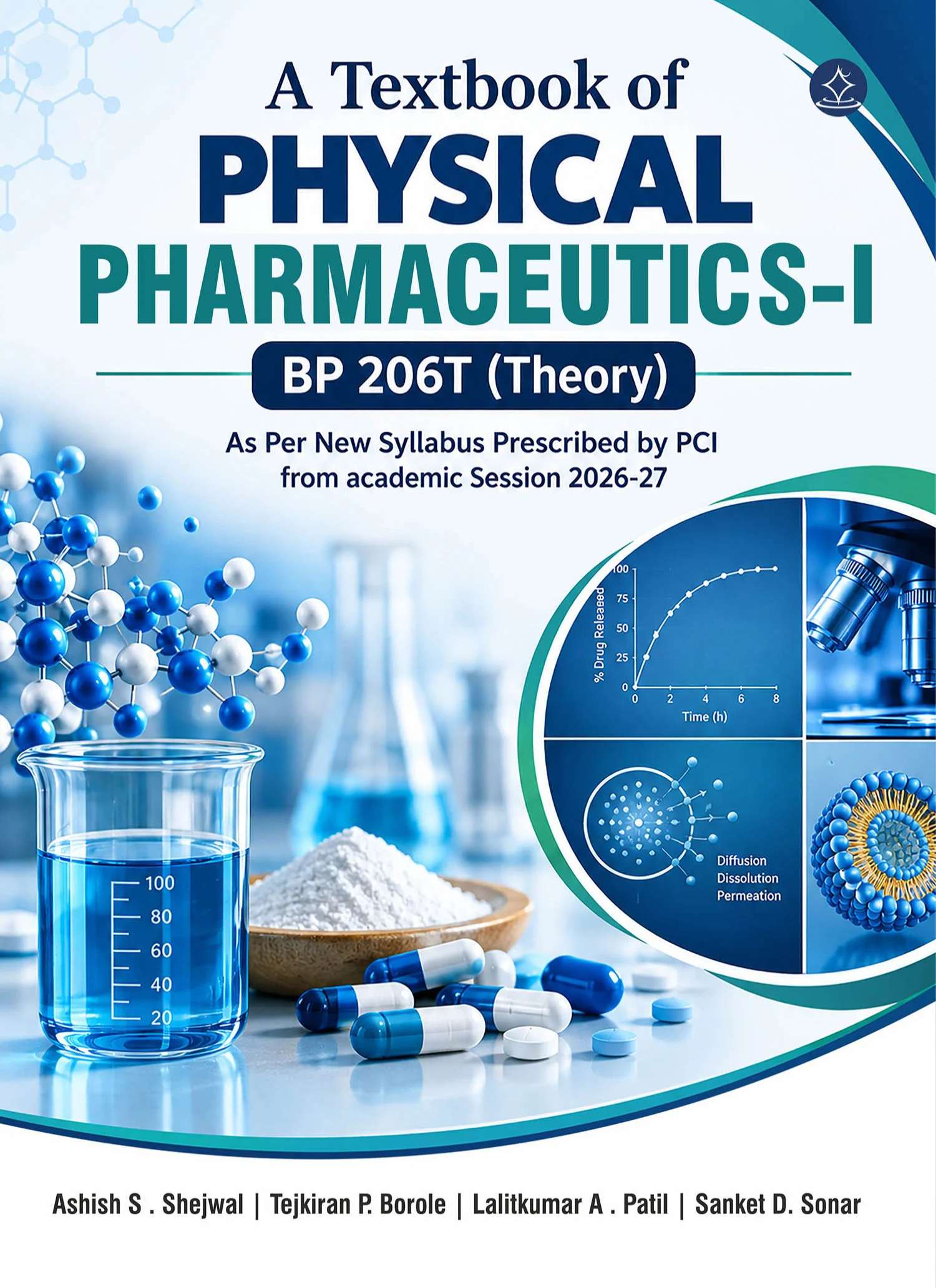
A Textbook of Physical Pharmaceutics BP 302 T

As Per New Syllabus Prescribed by PCI from academic Session 2026-27

Ashish S . Shejwal, Tejkiran P. Borole, Lalitkumar A . Patil, Sanket D. Sonar

Paperback

999.00

e Book

699.00

Pages : 299

Language : English

PAPERBACK Price : 999.00

About Book

Physical Pharmaceutics I provides a comprehensive foundation in the physical and physicochemical principles that govern the development, formulation, stability, and performance of pharmaceutical dosage forms. The book integrates fundamental concepts of physical chemistry with their practical applications in pharmacy, enabling students to understand how physicochemical properties influence the design and quality of pharmaceutical formulations. The book begins with solubility, distribution phenomena, and buffer systems, covering solubility expressions, solute–solvent interactions, factors affecting solubility, partition coefficient, critical solution temperature, and the effect of pH on drug solubility. It also explains pharmaceutical and biological buffer systems, methods of pH determination, buffer equations, buffer capacity, buffer preparation, and indicators. The subsequent section focuses on interfacial phenomena, including surface and interfacial tension, surface free energy, spreading coefficient, surface-active agents, hydrophilic–lipophilic balance (HLB), detergency, adsorption, wetting, contact angle, and the electrical properties of interfaces. These concepts provide an essential understanding of the behavior of pharmaceutical ingredients at solid–liquid and liquid–liquid interfaces. The book further discusses colloidal and coarse dispersions, with detailed treatment of lyophilic, lyophobic, and association colloids, their optical, kinetic, and electrical properties, stability, peptization, and protective action. The principles of suspensions and emulsions are explained through sedimentation, Stokes’ law, flocculation, controlled flocculation, theories of emulsification and stabilization, and physical instability phenomena such as creaming, coalescence, breaking, and phase inversion. A dedicated section on rheology explains Newtonian and non-Newtonian flow, thixotropy, negative thixotropy, viscosity measurement, viscoelasticity, and psycho-rheology. The pharmaceutical applications of rheological principles are emphasized to demonstrate their importance in the formulation and evaluation of liquid, semisolid, and other dosage forms. The final section covers micromeritics, including particle size and size distribution, particle shape, surface area, powder flow properties, methods of measurement, and techniques for improving powder flow. Advanced powder flow characterization using powder flow testers is also discussed. Overall, the book connects theoretical physicochemical principles with pharmaceutical applications, making it a valuable resource for B.Pharm students. It provides the conceptual foundation required for understanding preformulation, dosage-form design, formulation development, drug stability, dissolution, drug delivery, and pharmaceutical manufacturing.


About Author

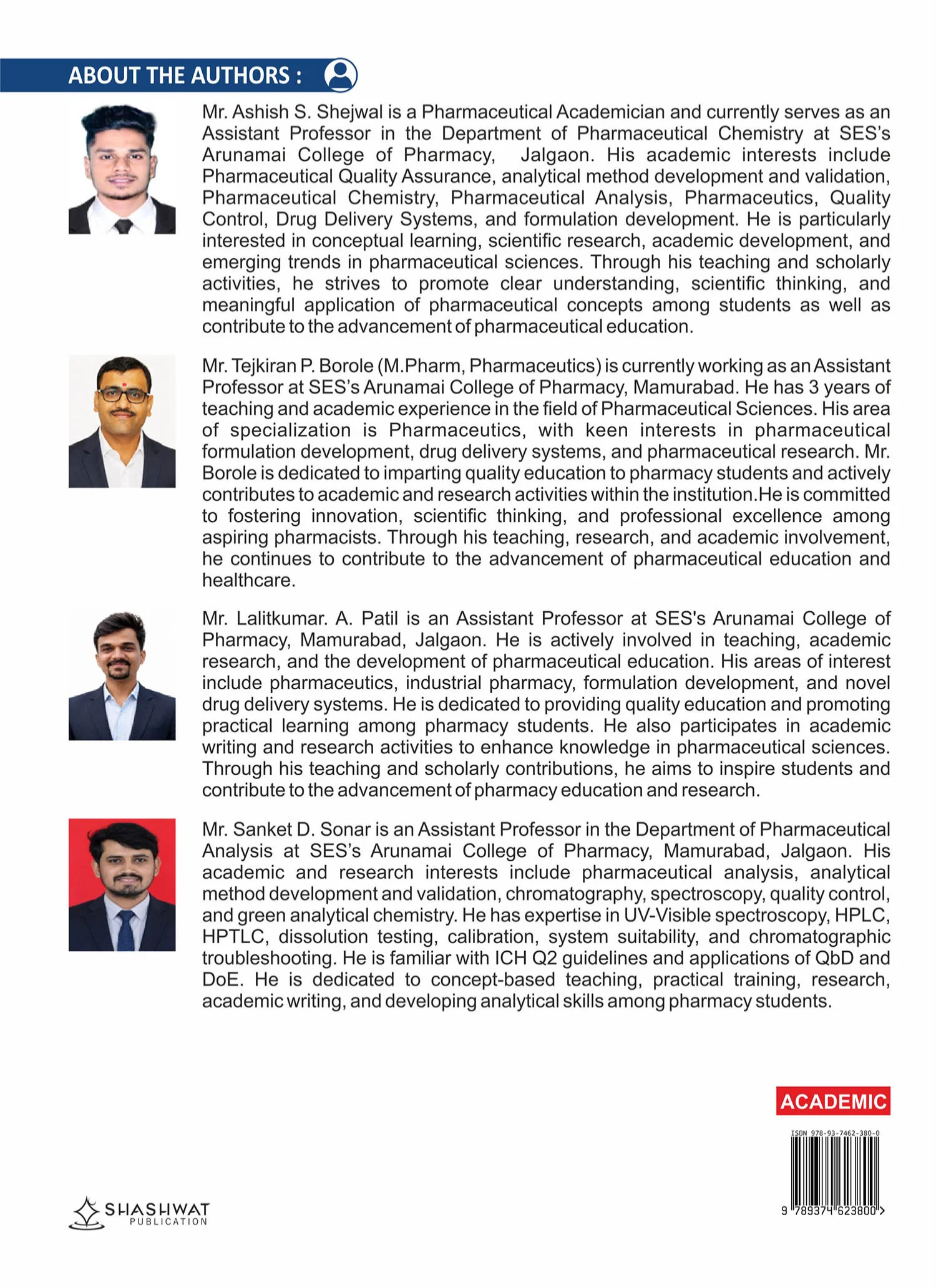
Mr. Ashish S. Shejwal is a Pharmaceutical Academician and currently serves as an Assistant Professor in the Department of Pharmaceutical Chemistry at SES’s Arunamai College of Pharmacy, Jalgaon. His academic interests include Pharmaceutical Quality Assurance, analytical method development and validation, Pharmaceutical Chemistry, Pharmaceutical Analysis, Pharmaceutics, Quality Control, Drug Delivery Systems, and formulation development. He is particularly interested in conceptual learning, scientific research, academic development, and emerging trends in pharmaceutical sciences. Through his teaching and scholarly activities, he strives to promote clear understanding, scientific thinking, and meaningful application of pharmaceutical concepts among students as well as contribute to the advancement of pharmaceutical education. Mr. Tejkiran P. Borole (M.Pharm, Pharmaceutics) is currently working as an Assistant Professor at SES’s Arunamai College of Pharmacy, Mamurabad. He has 3 years of teaching and academic experience in the field of Pharmaceutical Sciences. His area of specialization is Pharmaceutics, with keen interests in pharmaceutical formulation development, drug delivery systems, and pharmaceutical research. Mr. Borole is dedicated to imparting quality education to pharmacy students and actively contributes to academic and research activities within the institution.He is committed to fostering innovation, scientific thinking, and professional excellence among aspiring pharmacists. Through his teaching, research, and academic involvement, he continues to contribute to the advancement of pharmaceutical education and healthcare. Mr. Lalitkumar. A. Patil is an Assistant Professor at SES's Arunamai College of Pharmacy, Mamurabad, Jalgaon. He is actively involved in teaching, academic research, and the development of pharmaceutical education. His areas of interest include pharmaceutics, industrial pharmacy, formulation development, and novel drug delivery systems. He is dedicated to providing quality education and promoting practical learning among pharmacy students. He also participates in academic writing and research activities to enhance knowledge in pharmaceutical sciences. Through his teaching and scholarly contributions, he aims to inspire students and contribute to the advancement of pharmacy education and research. Mr. Sanket D. Sonar is an Assistant Professor in the Department of Pharmaceutical Analysis at SES’s Arunamai College of Pharmacy, Mamurabad, Jalgaon. His academic and research interests include pharmaceutical analysis, analytical method development and validation, chromatography, spectroscopy, quality control, and green analytical chemistry. He has expertise in UV-Visible spectroscopy, HPLC, HPTLC, dissolution testing, calibration, system suitability, and chromatographic troubleshooting. He is familiar with ICH Q2 guidelines and applications of QbD and DoE. He is dedicated to concept-based teaching, practical training, research, academic writing, and developing analytical skills among pharmacy students.

Customer Reviews


Book from same catalogue

Books From Same Author