ISBN : 978-93-7462-343-5
Category : Academic
Catalogue : Medical And Nursing
ID : SB21905
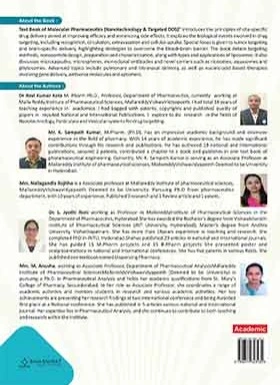
TEXT BOOK OF MOLECULAR PHARMACEUTICS (NANO TECHNOLOGY & TARGETED DDS)
According to latest syllabus of M. Pharm of Pharmacy Council of India
Dr Ravi Kumar Kota, Mr K. Sampath Kumar, Mrs. Nallagandla Rajitha, Dr L. Jyothi Rani, Mrs M. Anusha
Paperback
899.00
e Book
399.00
Pages : 232
Language : English
About Book
Text Book of Molecular Pharmaceutics (Nanotechnology & Targeted DDS)" introduces students to advanced concepts of site-specific drug delivery. It explains why targeted drug delivery systems are needed to improve therapeutic efficacy and reduce side effects. The book describes the basic concepts and key events involved when a targeted carrier travels from the administration site to the target tissue. Biological processes that govern drug targeting, such as recognition, circulation, extravasation and cellular uptake, are clearly highlighted. Special emphasis is given to tumor targeting strategies, including the principles of selective accumulation in cancer tissues. Brain-specific drug delivery is discussed with focus on overcoming the blood–brain barrier and improving CNS drug transport. A dedicated unit on targeting methods presents their introduction, basic design principles and classification. It explains different approaches for the preparation of targeting systems and the critical parameters that influence their performance. Types of nanoparticles used in drug delivery are described along with their advantages over conventional dosage forms. The text outlines common techniques for nanoparticle preparation and methods used to characterize them. Different types of liposomes are presented as versatile carriers for drugs, proteins and genes. Students are guided through the preparation of liposomes and the evaluation tests required to ensure their quality. The book defines microcapsules and microspheres and explains their structural and functional features. It describes the types, preparation techniques and evaluation parameters of microcapsules and microspheres in detail. An introduction to monoclonal antibodies is provided, covering their production and role in targeted therapy. Novel carrier systems such as niosomes, aquasomes, phytosomes and electrosomes are explained with their methods of preparation. The pharmaceutical and clinical applications of these novel carriers are highlighted to show their practical importance. Pulmonary drug delivery systems are discussed with special reference to aerosols as efficient lung-targeted dosage forms. The role of propellants, containers and different types of aerosols in pulmonary delivery is clearly explained. Formulation and evaluation of aerosol preparations are described to help students understand product development aspects. The book also introduces intranasal route delivery systems as a simple and noninvasive approach for local and systemic therapy. Types, preparation methods and evaluation of intranasal formulations are systematically discussed. A final unit on nucleic acid based therapeutic delivery systems provides a foundation in gene therapy. It covers ex-vivo and in-vivo gene therapy, viral and nonviral gene transfer systems, and liposomal gene delivery. The text further discusses biodistribution and pharmacokinetics of these advanced systems. It concludes with therapeutic antisense molecules and aptamers, presenting them as promising drugs of the future.
Customer Reviews