About Book
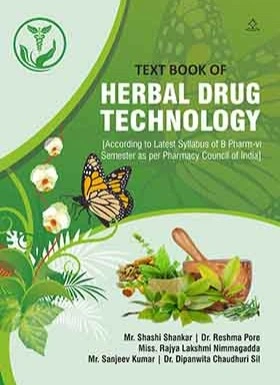
The Text Book of Herbal Drug Technology is a comprehensive and well-structured academic resource that provides an in-depth understanding of herbal drugs from their origin to finished formulations and regulatory compliance. The book begins by explaining herbs as raw materials, clearly defining herbal drugs, herbal medicines, and herbal medicinal products, while emphasizing the importance of proper selection, identification, authentication, and processing of herbal materials. It thoroughly discusses biodynamic agriculture and good agricultural practices, including organic farming and sustainable pest and pest-management strategies using biopesticides and bioinsecticides. A detailed overview of Indian Systems of Medicine—Ayurveda, Siddha, Unani, and Homeopathy—is presented, along with the preparation and standardization of classical Ayurvedic dosage forms such as Aristas, Asawas, Churna, Ghutika, Lehya, and Bhasma. The section on nutraceuticals highlights their general aspects, market growth, scope, and therapeutic role in managing lifestyle and chronic diseases such as diabetes, cardiovascular disorders, cancer, and gastrointestinal ailments, supported by the study of important herbs used as health foods. The book also addresses the clinically significant topic of herbal-drug and herb-food interactions, discussing possible side effects and interactions of commonly used medicinal herbs. Herbal cosmetics and herbal excipients are explained with a focus on natural raw materials and their applications in pharmaceutical and cosmetic formulations. Conventional herbal formulations and novel dosage forms such as phytosomes are systematically described, reflecting advancements in herbal drug delivery. Evaluation of herbal drugs is aligned with WHO and ICH guidelines, including stability testing. The text further elaborates on patenting, intellectual property rights, traditional knowledge protection, and regulatory requirements, supported by relevant case studies. Finally, it provides a comprehensive overview of the herbal industry, regulatory frameworks, GMP requirements, and future prospects, making it an essential textbook for pharmacy students, researchers, and professionals in herbal drug technology.
About Author
Mr. Shashi Shankar is an accomplished Assistant Professor in the Department of Pharmaceutics at Kamla Nehru Institute of Management and Technology, Sultanpur (U.P.), India. He completed his B.Pharm in 2009 from M.M.U College of Pharmacy, Bangalore, and his M.Pharm in 2012 from Gayatri Institute of Science & Technology, Odisha. With 13.5 years of rich teaching experience, he has developed strong academic expertise in pharmaceutics, herbal drug technology, herbal formulation development, and instrumental methods of analysis. He is recognized for his commitment to quality education, with a teaching philosophy that stresses ethical conduct, clinical relevance, and academic discipline among students. Mr. Shashi Shankar has contributed significantly to pharmacy education through dedicated mentoring and classroom engagement. He is also a professional member of the Association of Pharmaceutical Teachers of India (APTI)
Dr. Reshma Pore brings extensive professional expertise to this work, with a career spanning 15 years across the industrial and academic sectors. She dedicated 9 years to Formulation Development in the R&D division of Nicholas Piramal India Ltd., gaining deep insight into industrial pharmaceutical standards, which she now applies to her 6 years of academic service. Her specialized research focus involves the synthesis of novel herbal semisynthetic drugs and the formulation of herbal medicines, effectively bridging traditional pharmacognosy with modern synthetic chemistry and drug delivery systems. Her scholarly contributions have been published in reputed pharmaceutical journals, reflecting her commitment to innovation in the field of natural product-derived therapeutics.
Rajya Lakshmi N. has total 10 years experience in teaching and industry. She is currently working as Assistant Professor at A.M.Reddy Memorial College of Pharmacy, Affiliated to Acharya Nagarjuna University, GUNTUR. She has 5 research publications in Scopus, and Web of science.
Mr. Sanjeev Kumar is an Assistant Professor in the Department of Pharmaceutics at the Department of Pharmacy, MIT Muzaffarpur, Bihar, India. He completed his M. Pharm from Bhagwant University, Ajmer, Rajasthan, in 2022, and earned his B. Pharm from MIT Muzaffarpur in 2020. With 3.5 years of teaching experience, he has developed strong expertise in pharmaceutics and allied pharmaceutical sciences. His areas of specialization include herbal formulation development, herbal drug technology, and instrumental methods of analysis. Mr. Kumar is dedicated to teaching with an emphasis on academic discipline, clinical relevance, and ethical professional practices. He has consistently guided students toward both conceptual clarity and practical application in pharmacy. He is an active member of the Association of Pharmaceutical Teachers of India (APTI), reflecting his commitment to professional growth and academic excellence..
Dr. Dipanwita Chaudhuri Sil is an Assistant Professor in the Department of Botany at Holy Cross College, Agartala, Tripura, India. She holds a Ph.D. in Botany with specialization in Aerobiology and has strong academic and research expertise in the field. She teaches core subjects such as Plant Taxonomy and Aerobiology, guiding students toward a conceptual understanding of plant diversity and atmospheric biology. Dr. Sil is actively involved in research and has published several papers in reputed national journals. Her scholarly work reflects her commitment to advancing botanical sciences and contributing to academic excellence.