ISBN : 978-93-7462-284-1
Category : Academic
Catalogue : Medical And Nursing
ID : SB22137
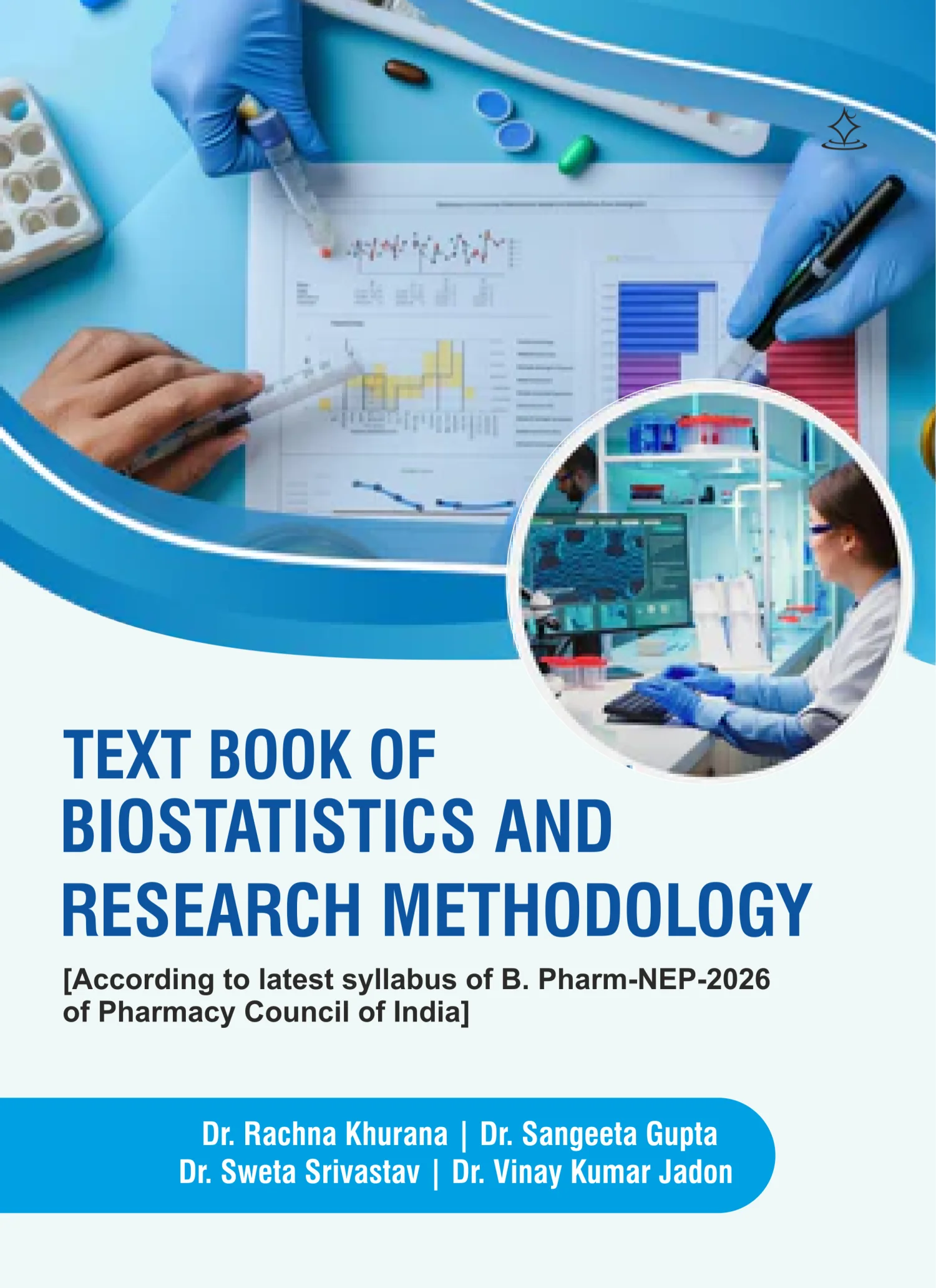
TEXT BOOK OF BIOSTATISTICS AND RESEARCH METHODOLOGY
According to latest syllabus of Under Graduate and Post Graduate students
Dr. Rachna Khurana, Dr. Sangeeta Gupta, Dr. Sweta Srivastav, Dr. Vinay Kumar Jadon
Paperback
999.00
e Book
599.00
Pages : 274
Language : English
About Book
The Textbook of Biostatistics and Research Methodology is a comprehensive academic resource developed to help students and researchers understand the fundamental principles of statistics and their applications in pharmaceutical and biomedical research. The book begins with a clear explanation of the basic statistical concepts such as measures of central tendency, including mean, median, and mode, supported with relevant pharmaceutical examples for better understanding. It further discusses measures of dispersion like range and standard deviation, which are essential for analyzing the variability of experimental data. The text introduces correlation and regression analysis, including Karl Pearson’s coefficient of correlation, curve fitting, and multiple regression techniques to explain relationships between variables. Concepts such as standard error of regression and interpretation of statistical relationships in pharmaceutical research are also described in detail. A significant portion of the book is devoted to probability and statistical distributions, including binomial, normal, and Poisson distributions, which help researchers understand uncertainty in experimental outcomes. The book also explains important statistical concepts such as population, sample, sampling techniques, null hypothesis, alternative hypothesis, and types of statistical errors. The concept of standard error of the mean and its practical significance in pharmaceutical studies is clearly illustrated. In addition, the text covers both parametric and non-parametric statistical tests such as the t-test, ANOVA, Wilcoxon Rank Sum Test, Mann-Whitney U Test, Kruskal-Wallis Test, and Friedman Test. These statistical methods help researchers analyze and interpret research data accurately. The book also introduces research methodology, including research design, experimental planning, and ethical considerations such as plagiarism. Various graphical methods for data presentation, including histograms, pie charts, contour plots, and response surface plots, are explained to improve the visualization of data. The text further discusses advanced topics such as clinical trial design, observational studies, cohort studies, and protocol development. Sample size determination and statistical planning for research studies are also included. Practical guidance on statistical analysis using modern software tools like Excel, SPSS, MINITAB®, and R is provided to support data analysis in research. The book also covers design and analysis of experiments, including factorial design and response surface methodology used in pharmaceutical optimization studies. Each chapter is written in a clear and systematic manner to help students grasp statistical concepts easily. Practical examples from pharmaceutical and biomedical research are included to bridge the gap between theory and application. The text aims to strengthen analytical and research skills among students and researchers. Overall, this textbook serves as an essential guide for pharmacy, biomedical, and life science students who wish to develop a strong foundation in biostatistics and research methodology.
Customer Reviews