support@shashwatpublication.com +91 7000072109 B-75, Krishna Vihar, Koni, Bilaspur, C.G 495001
Mon - Sat 10:00 AM to 5:00 PM
Book Image
Book Image
Book Image

ISBN : 978-93-7462-557-6

Category : Academic

Catalogue : Computer

ID : SB22141

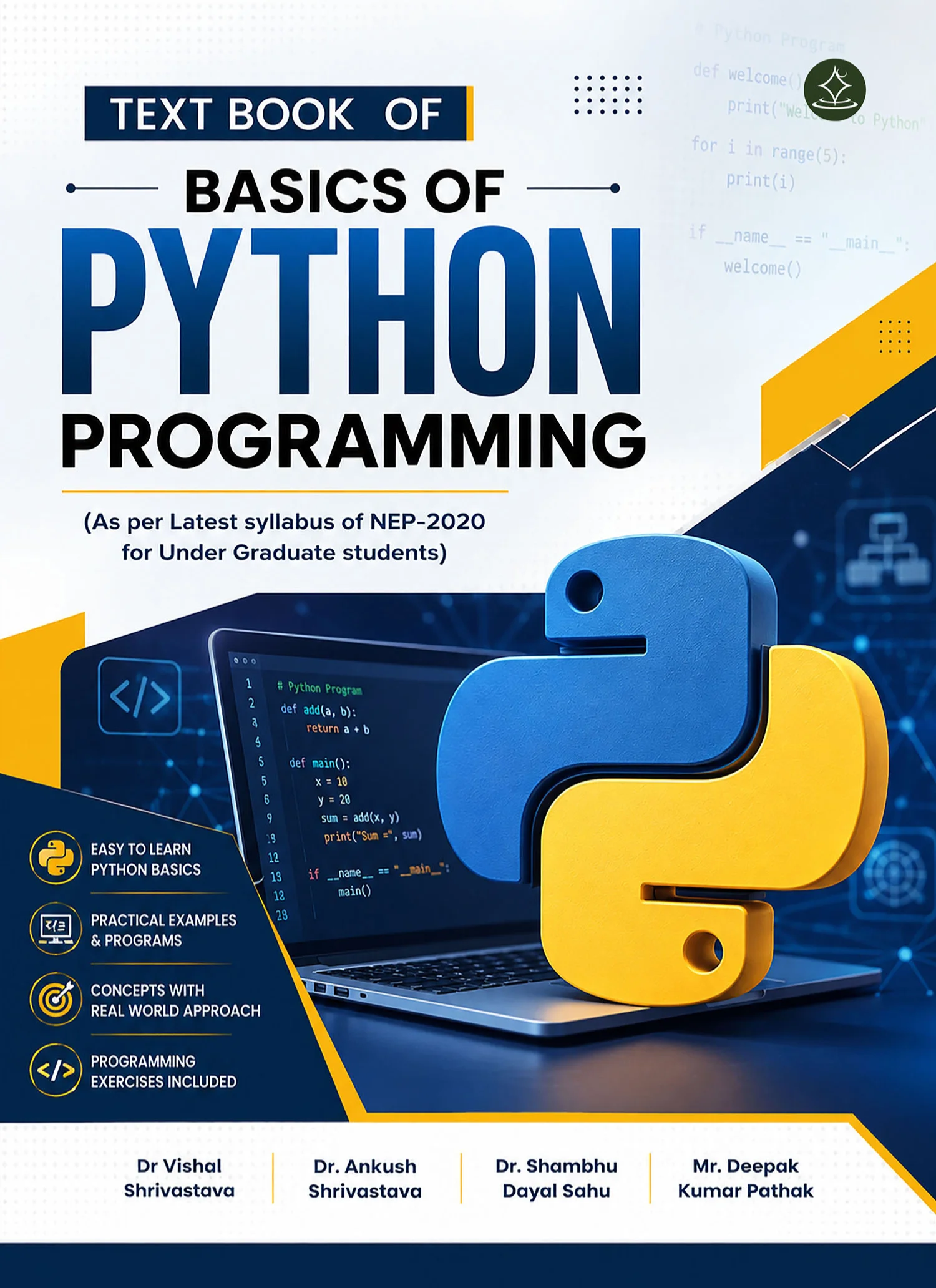
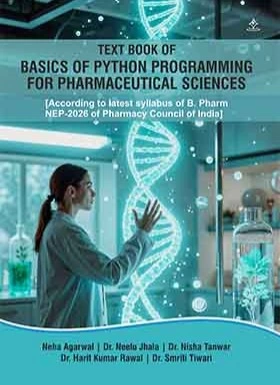
TEXT BOOK OF BASICS OF PYTHON PROGRAMMING FOR PHARMACEUTICAL SCIENCES

According to latest syllabus of B.Pharm- NEP-2026 of Pharmacy Council of India

Neha Agarwal, Dr. Neelu Jhala, Dr. Nisha Tanwar, Dr. Harit Kumar Rawal, Dr. Smriti Tiwari

Paperback

999.00

e Book

699.00

Pages : 270

Language : English

PAPERBACK Price : 999.00

About Book

This book, Text Book of Basics of Python Programming for Pharmaceutical Sciences, is designed to provide a strong foundation in Python programming with special relevance to pharmaceutical and healthcare applications. The book introduces students to the fundamentals of Python, including installation procedures, Integrated Development Environments (IDEs), variables, data types, operators, and input-output operations. It explains programming concepts in a simple and student-friendly manner to support beginners with no prior coding experience. Special emphasis has been given to pharmaceutical applications such as dosage calculations, BMI analysis, and healthcare data handling. The text covers important programming structures including conditional statements, loops, functions, and modular programming techniques. Comprehensive explanations of data structures such as lists, tuples, dictionaries, and NumPy arrays help students develop problem-solving skills in scientific computing. The book also introduces file handling methods and demonstrates the processing of pharmaceutical datasets using CSV and Excel files. A dedicated section on Pandas enables readers to understand data analysis, cleaning, filtering, grouping, and aggregation of healthcare-related information. Practical examples involving PK study datasets and ADR reports enhance the real-world applicability of the concepts. The visualization section introduces Matplotlib for creating scientific plots including concentration-time curves, dissolution profiles, and adverse drug reaction trends. Each chapter combines theoretical concepts with practical exercises to improve analytical and computational abilities. The content has been carefully aligned with the requirements of pharmaceutical sciences and modern data-driven healthcare research. This book aims to bridge the gap between computer programming and pharmaceutical applications by promoting interdisciplinary learning. It encourages students and researchers to utilize computational tools for data analysis, interpretation, and decision-making in pharmacy practice. The language of the book is simple, systematic, and easy to understand for undergraduate and postgraduate learners. Numerous examples and applications make the subject interesting and practically oriented. The book also supports the development of digital and analytical skills required in modern pharmaceutical industries and research laboratories. It provides a strong conceptual understanding of Python programming while encouraging scientific thinking and innovation. The integration of pharmaceutical examples throughout the chapters makes learning more relevant and engaging for pharmacy students. The book is expected to serve as a valuable resource for academic learning, laboratory practice, and self-study. It also promotes computational literacy among pharmacy professionals to meet emerging technological advancements in healthcare. By combining programming fundamentals with pharmaceutical data analysis, the book creates a unique learning experience for students and educators. The systematic presentation of concepts, practical illustrations, and healthcare-oriented datasets make the book highly informative and application-based. It further encourages the use of Python as a powerful tool in pharmaceutical research, clinical data management, and scientific visualization. The content is structured progressively to build confidence and problem-solving ability among learners. Overall, this book reflects a sincere effort to integrate programming knowledge with pharmaceutical sciences for academic excellence, professional development, and future research opportunities.


About Author

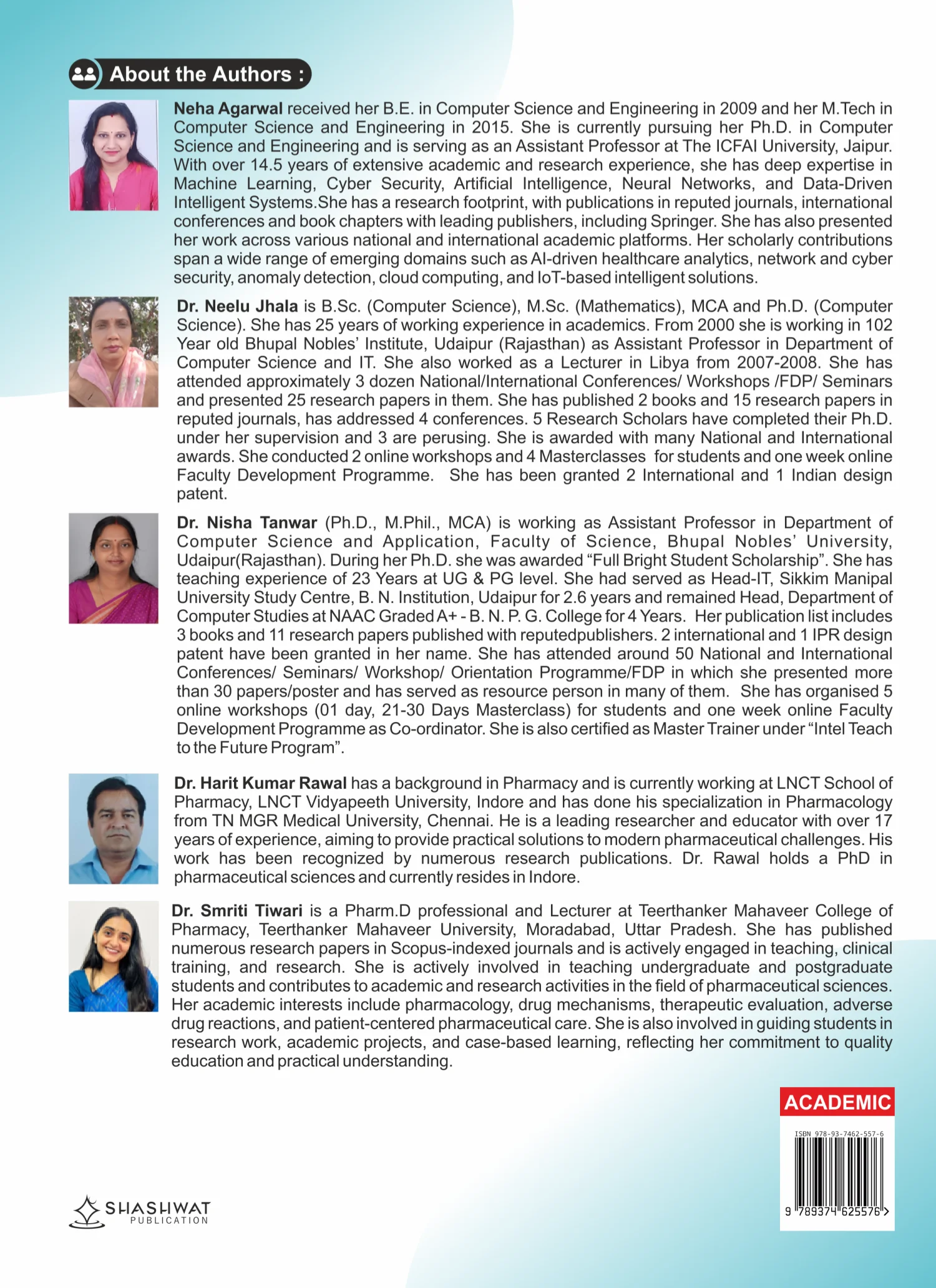
Neha Agarwal received her B.E. in Computer Science and Engineering in 2009 and her M.Tech in Computer Science and Engineering in 2015. She is currently pursuing her Ph.D. in Computer Science and Engineering and is serving as an Assistant Professor at The ICFAI University, Jaipur. With over 14.5 years of extensive academic and research experience, she has deep expertise in Machine Learning, Cyber Security, Artificial Intelligence, Neural Networks, and Data-Driven Intelligent Systems.She has a research footprint, with publications in reputed journals, international conferences and book chapters with leading publishers, including Springer. She has also presented her work across various national and international academic platforms. Her scholarly contributions span a wide range of emerging domains such as AI-driven healthcare analytics, network and cyber security, anomaly detection, cloud computing, and IoT-based intelligent solutions. Dr. Neelu Jhala is B.Sc. (Computer Science), M.Sc. (Mathematics), MCA and Ph.D. (Computer Science). She has 25 years of working experience in academics. From 2000 she is working in 102 Year old Bhupal Nobles’ Institute, Udaipur (Rajasthan) as Assistant Professor in Department of Computer Science and IT. She also worked as a Lecturer in Libya from 2007-2008. She has attended approximately 3 dozen National/International Conferences/ Workshops /FDP/ Seminars and presented 25 research papers in them. She has published 2 books and 15 research papers in reputed journals, has addressed 4 conferences. 5 Research Scholars have completed their Ph.D. under her supervision and 3 are perusing. She is awarded with many National and International awards. She conducted 2 online workshops and 4 Masterclasses for students and one week online Faculty Development Programme. She has been granted 2 International and 1 Indian design patent. Dr. Nisha Tanwar (Ph.D., M.Phil., MCA) is working as Assistant Professor in Department of Computer Science and Application, Faculty of Science, Bhupal Nobles’ University, Udaipur(Rajasthan). During her Ph.D. she was awarded “Full Bright Student Scholarship”. She has teaching experience of 23 Years at UG & PG level. She had served as Head-IT, Sikkim Manipal University Study Centre, B. N. Institution, Udaipur for 2.6 years and remained Head, Department of Computer Studies at NAAC Graded A+ - B. N. P. G. College for 4 Years. Her publication list includes 3 books and 11 research papers published with reputed publishers. 2 international and 1 IPR design patent have been granted in her name. She has attended around 50 National and International Conferences/Seminars/Workshop/Orientation Programme/FDP in which she presented more than 30 papers/poster and has served as resource person in many of them. She has organised 5 online workshops (01 day, 21-30 Days Masterclass) for students and one week online Faculty Development Programme as Co-ordinator. She is also certified as Master Trainer under “Intel Teach to the Future Program”. Dr. Harit Kumar Rawal has a background in Pharmacy and is currently working at LNCT School of Pharmacy, LNCT Vidyapeeth University, Indore and has done his specialization in Pharmacology from TN MGR Medical University, Chennai. He is a leading researcher and educator with over 17 years of experience, aiming to provide practical solutions to modern pharmaceutical challenges. His work has been recognized by numerous research publications. Dr. Rawal holds a PhD in pharmaceutical sciences and currently resides in Indore. Dr. Smriti Tiwari is a Pharm.D professional and Lecturer at Teerthanker Mahaveer College of Pharmacy, Teerthanker Mahaveer University, Moradabad, Uttar Pradesh. She has published numerous research papers in Scopus-indexed journals and is actively engaged in teaching, clinical training, and research. She is actively involved in teaching undergraduate and postgraduate students and contributes to academic and research activities in the field of pharmaceutical sciences. Her academic interests include pharmacology, drug mechanisms, therapeutic evaluation, adverse drug reactions, and patient-centered pharmaceutical care. She is also involved in guiding students in research work, academic projects, and case-based learning, reflecting her commitment to quality education and practical understanding.

Customer Reviews


Book from same catalogue

Books From Same Author