ISBN : 978-93-7462-039-7
Category : Academic
Catalogue : Mathematics and Science
ID : SB22180
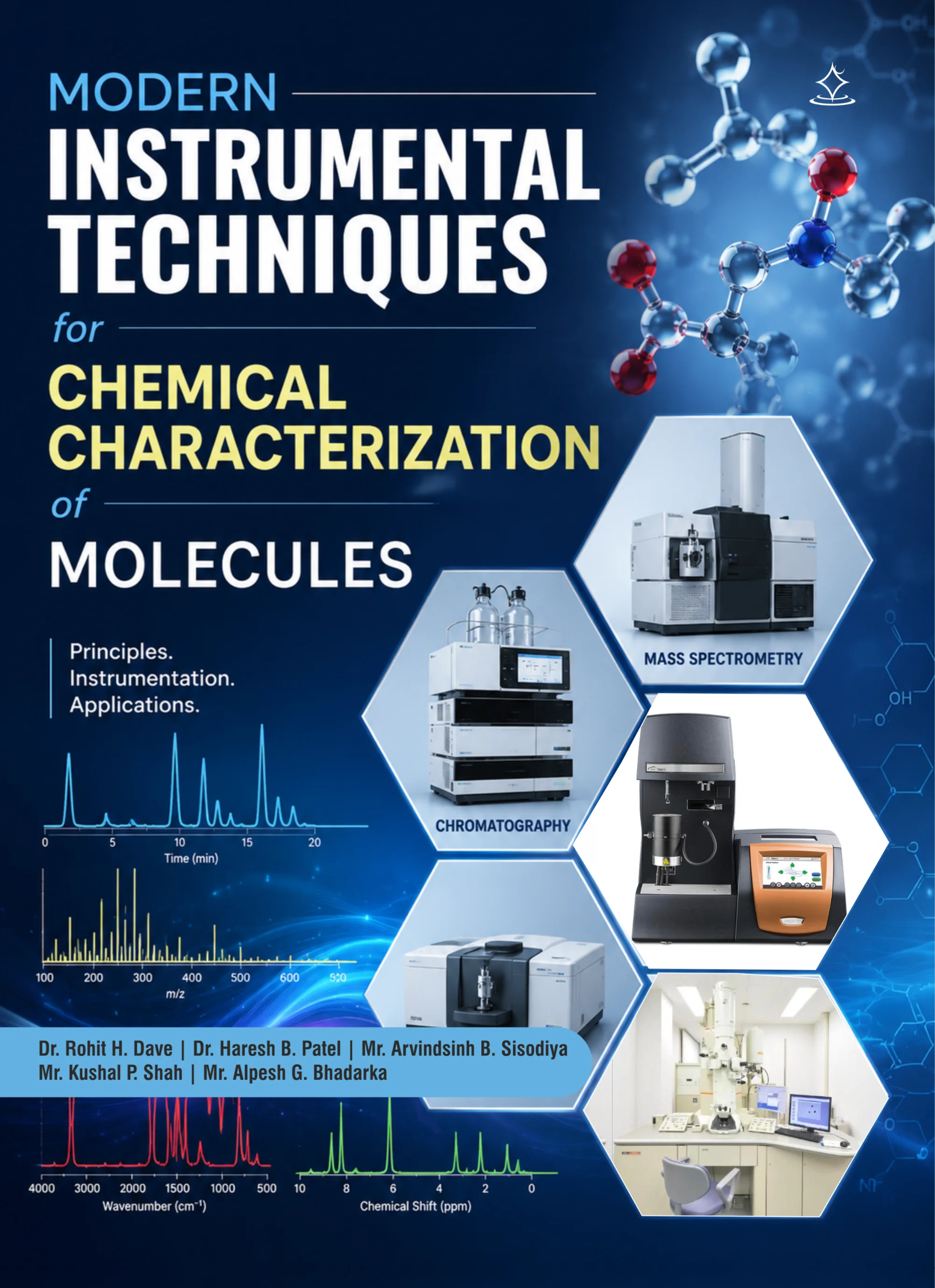
Modern Instrumental Techniques for Chemical Characterization of Molecules
NA
5.0
Dr. Rohit H. Dave, Kushal P. Shah, Arvindsinh B. Sisodiya, Alpesh Gangdas Bhadarka, Dr. Haresh B. Patel
Paperback
550.00
e Book
300.00
Pages : 99
Language : English
About Book
This book chapter provides a comprehensive overview of advanced analytical techniques widely employed in pharmaceutical, chemical, and material sciences. It focuses on the principles, instrumentation, and applications of key techniques such as Liquid Chromatography–Mass Spectrometry (LC-MS), Gas Chromatography–Mass Spectrometry (GC-MS), Gas Chromatography (GC), Thermogravimetric Analysis (TGA), and Particle Size Analysis, Raman Spectroscopy and Transmission Electron Microscopy (TEM). These techniques play a crucial role in qualitative and quantitative analysis, ensuring the safety, efficacy, and quality of pharmaceutical formulations. 1. The Power of Polarizability: Theory and Practice of Raman Spectroscopy Raman Spectroscopy is a powerful, non-destructive analytical technique based on the inelastic scattering of monochromatic light (typically from a laser) when it interacts with molecular vibrations in a sample. This phenomenon, known as the Raman effect, results in a characteristic shift in the scattered light' s energy, which corresponds to the vibrational, rotational, and other low-frequency modes of the material. This chapter includes all the theory and principles, as well as the working of this spectroscopic technique beneficial for the students in many ways. 2. Precision in Separation: Harnessing the Synergies of LC and Mass Spectrometry Liquid Chromatography-Mass Spectrometry (LC-MS) is a powerful, hyphenated analytical technique that combines the superior separation capability of High-Performance Liquid Chromatography (HPLC) with the unparalleled detection and identification power of Mass Spectrometry (MS). This chapter describes the in-depth details about the LC-MS. 3. The Fundamentals of Granulometry: A Guide to Particle Sizing Techniques A Particle Size Analyzer is a critical piece of instrumentation used to measure the size distribution of particulate matter, a fundamental property that dictates the performance, stability, and processing behavior of materials across various industries. Modern analyzers employ diverse physical principles, such as laser diffraction, dynamic light scattering (DLS), or electrical sensing (Coulter principle), to accurately characterize particles ranging from the nanoscale to the millimeter range. The chapter shows how the particle size analyzer is useful and how it works for analysis purposes. 4. A Journey through the Column: Unlocking the Secrets of Volatile Compounds with GC Gas Chromatography (GC) is a powerful separation technique utilized to analyze volatile and semi-volatile compounds in complex mixtures. It operates by separating analytes based on their differential partitioning between a mobile carrier gas (like helium or nitrogen) and a stationary phase coated inside a heated column. The chapter shows the details of the Gas chromatography technique. 5. TEM and the Future of Materials Science: In Situ and Cryo-Techniques Transmission Electron Microscopy (TEM) is a powerful imaging technique that provides structural and chemical information down to the atomic scale by utilizing a high-energy beam of electrons instead of light. Electrons are transmitted through an ultra-thin sample, and the resulting image contrast is generated by differences in mass-thickness and crystal structure across the specimen. 6. Mass and Temperature: A Comprehensive Guide to TGA and Evolved Gas Analysis Thermal Gravimetric Analysis (TGA) is a quantitative thermal analysis technique that continuously measures the mass change of a sample as a function of temperature (or time) in a controlled atmosphere.
Customer Reviews
Rohit Dave :
Best book for graduate and undergratuate students of Chemistry