About Book
ABOUT THE BOOK
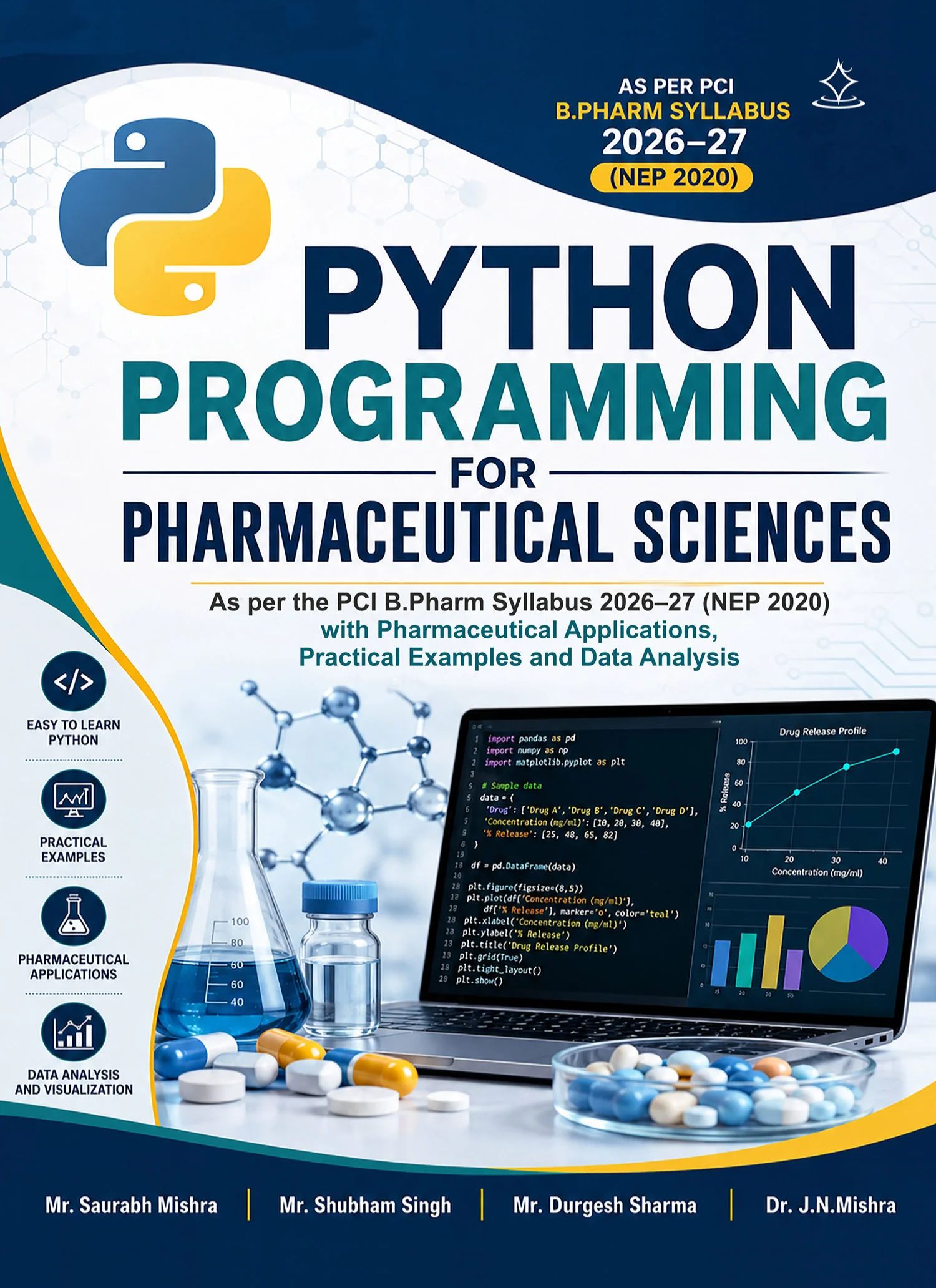
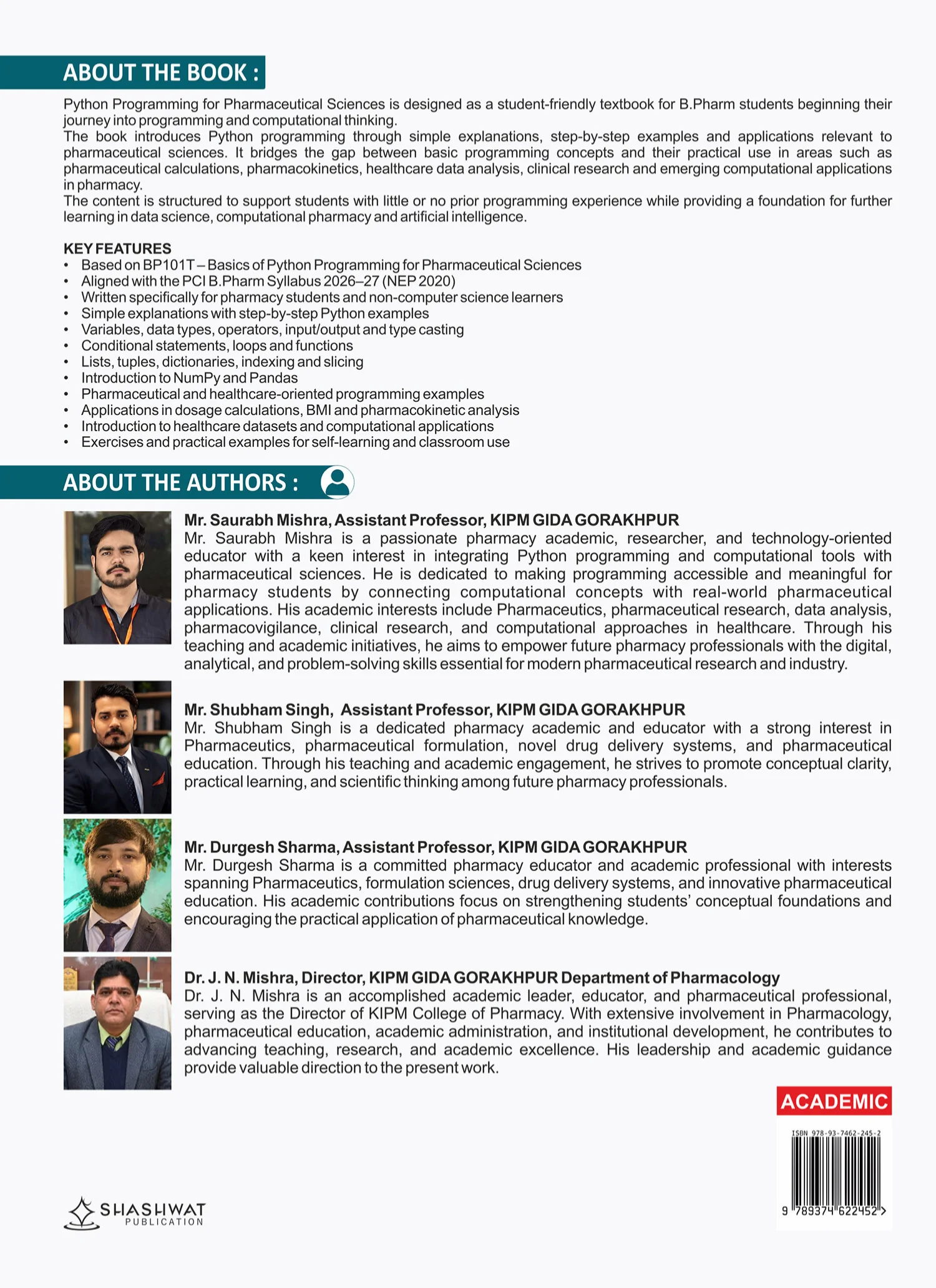
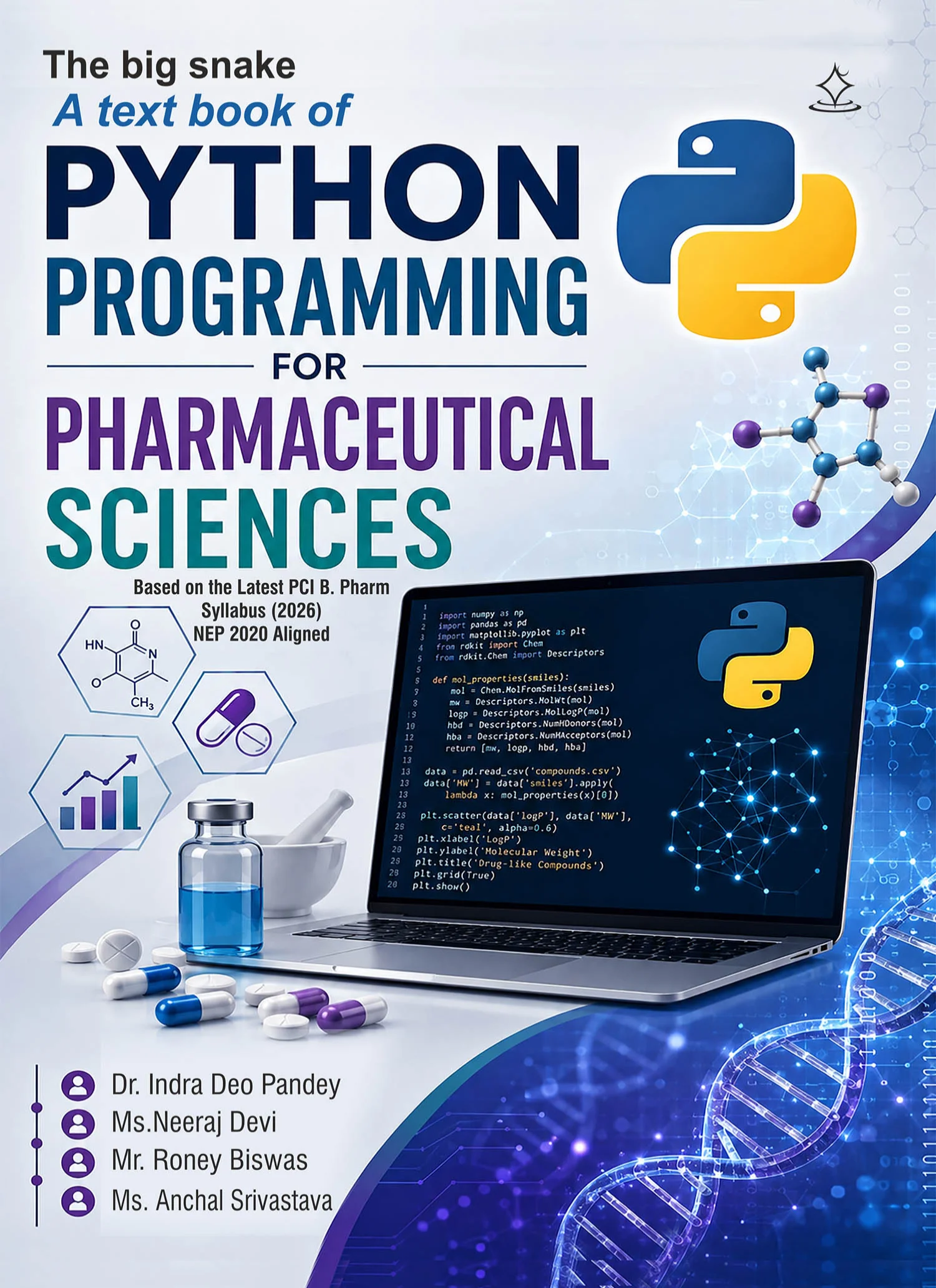
Python Programming for Pharmaceutical Sciences is designed as a student-friendly textbook for B.Pharm students beginning their journey into programming and computational thinking.
The book introduces Python programming through simple explanations, step-by-step examples and applications relevant to pharmaceutical sciences. It bridges the gap between basic programming concepts and their practical use in areas such as pharmaceutical calculations, pharmacokinetics, healthcare data analysis, clinical research and emerging computational applications in pharmacy.
The content is structured to support students with little or no prior programming experience while providing a foundation for further learning in data science, computational pharmacy and artificial intelligence.
KEY FEATURES
• Based on BP101T – Basics of Python Programming for Pharmaceutical Sciences
• Aligned with the PCI B.Pharm Syllabus 2026–27 (NEP 2020)
• Written specifically for pharmacy students and non-computer science learners
• Simple explanations with step-by-step Python examples
• Variables, data types, operators, input/output and type casting
• Conditional statements, loops and functions
• Lists, tuples, dictionaries, indexing and slicing
• Introduction to NumPy and Pandas
• Pharmaceutical and healthcare-oriented programming examples
• Applications in dosage calculations, BMI and pharmacokinetic analysis
• Introduction to healthcare datasets and computational applications
• Exercises and practical examples for self-learning and classroom use
About Author
ABOUT THE AUTHORS
1. Mr. Saurabh Mishra
Assistant Professor, Department of Pharmacy
Mr. Saurabh Mishra is a passionate pharmacy academic, researcher, and technology-oriented educator with a keen interest in integrating Python programming and computational tools with pharmaceutical sciences. He is dedicated to making programming accessible and meaningful for pharmacy students by connecting computational concepts with real-world pharmaceutical applications.
His academic interests include Pharmaceutics, pharmaceutical research, data analysis, pharmacovigilance, clinical research, and computational approaches in healthcare. Through his teaching and academic initiatives, he aims to empower future pharmacy professionals with the digital, analytical, and problem-solving skills essential for modern pharmaceutical research and industry.
2. Mr. Shubham Singh
Assistant Professor, Department of Pharmaceutics
Mr. Shubham Singh is a dedicated pharmacy academic and educator with a strong interest in Pharmaceutics, pharmaceutical formulation, novel drug delivery systems, and pharmaceutical education. Through his teaching and academic engagement, he strives to promote conceptual clarity, practical learning, and scientific thinking among future pharmacy professionals.
3. Mr. Durgesh Sharma
Assistant Professor, Department of Pharmaceutics
Mr. Durgesh Sharma is a committed pharmacy educator and academic professional with interests spanning Pharmaceutics, formulation sciences, drug delivery systems, and innovative pharmaceutical education. His academic contributions focus on strengthening students’ conceptual foundations and encouraging the practical application of pharmaceutical knowledge.
4. Dr. J. N. Mishra
Director, KIPM College of Pharmacy | Department of Pharmacology
Dr. J. N. Mishra is an accomplished academic leader, educator, and pharmaceutical professional, serving as the Director of KIPM College of Pharmacy. With extensive involvement in Pharmacology, pharmaceutical education, academic administration, and institutional development, he contributes to advancing teaching, research, and academic excellence. His leadership and academic guidance provide valuable direction to the present work.
AUTHORS' NOTE
The authors have developed this textbook with the objective of making Python programming accessible to pharmacy students and demonstrating its relevance to pharmaceutical sciences. Through simple explanations, practical examples, and pharmaceutical applications, the book aims to help students develop computational thinking and build a foundation for the use of programming and data-driven approaches in pharmacy.
Learn Python. Understand Data. Apply Programming to Pharmacy.