About Book
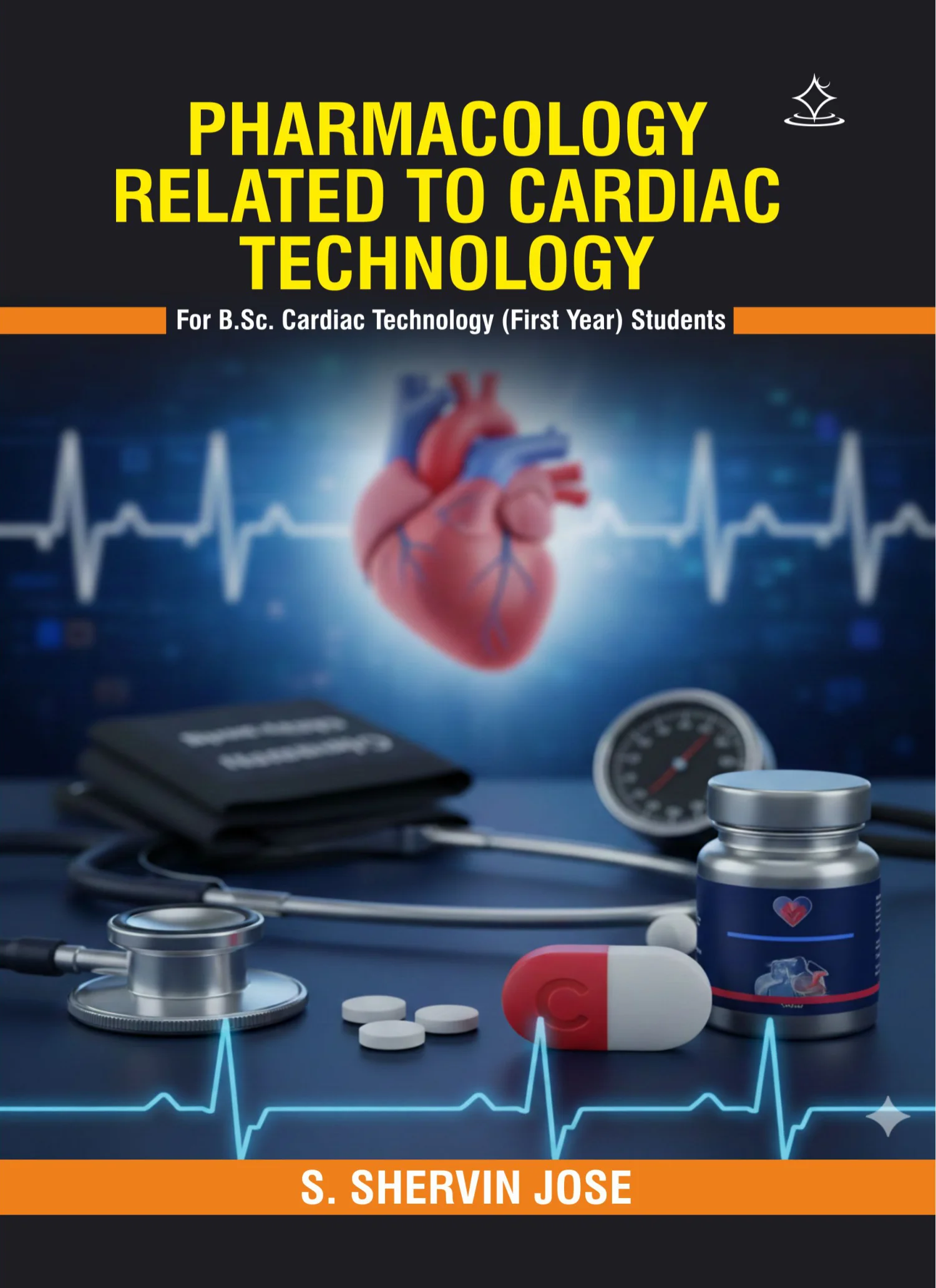
Pharmacology for Cardiac Technology is a carefully structured academic resource developed to meet the specific needs of first-year B.Sc. Cardiac Technology students. The book provides a strong foundation in pharmacological principles while maintaining a clear focus on cardiovascular applications, ensuring that learners can easily connect theory with clinical practice.
The content begins with fundamental concepts such as pharmacokinetics, pharmacodynamics, drug classifications, and routes of administration. These core principles are explained in a simplified and student-friendly manner, making them accessible even to beginners with limited prior exposure to pharmacology.
Building on this foundation, the book explores drugs used in cardiovascular medicine in a systematic and clinically relevant way. Major topics include antihypertensive agents, antianginal drugs, antiarrhythmics, diuretics, anticoagulants, thrombolytics, and lipid-lowering agents. Each drug class is presented with emphasis on mechanism of action, therapeutic uses, adverse effects, contraindications, and monitoring parameters.
A unique feature of this book is its integration of pharmacology with cardiac technology practice. It highlights the role of pharmacological agents in procedures such as ECG monitoring, echocardiography, cardiac catheterization, and intensive cardiac care. This approach helps students understand how drugs influence cardiac function and patient outcomes in real clinical settings.
About Author
S. Shervin Jose's journey into pharmacology began not just as an academic pursuit, but as a deep curiosity about how medicines can alter the course of human life. From his early days as a pharmacy student, he was drawn to questions that went beyond textbooks—questions about why diseases persist, how treatments fail, and what lies ahead in the future of medicine.
This curiosity gradually shaped his path into pharmacology, where he found a meaningful intersection between science, research, and patient care. During his postgraduate training in pharmacology (M.Pharm), he developed a strong interest in understanding disease mechanisms at a deeper level, particularly in complex conditions like cancer. His exploration into areas such as matrix metalloproteinase-9 (MMP-9) and its role in cancer progression reflects his desire to contribute to solving some of medicine’s most challenging problems.
At the same time, he remained closely connected to the roots of traditional medicine. His work in herbal pharmacology and phytochemistry, including studies on plants like Ficus callosa and Jasminum officinale, represents his belief that modern science and traditional knowledge can complement each other in discovering safer and more effective therapies.
Now serving as an Assistant Professor at SNS College of Pharmacy and Health Sciences, Coimbatore, he brings this blend of curiosity, research, and clinical relevance into the classroom. For him, teaching is not just about delivering content—it is about making students think, question, and connect knowledge to real-life patient care. He believes that pharmacology should not feel overwhelming, but instead should empower students to understand the “why” behind every drug they encounter.
Beyond the classroom, he actively engages with the scientific community through platforms such as ResearchGate and Google Scholar, sharing his research and staying connected with ongoing developments in medicine. He also takes a keen interest in emerging breakthroughs, from cancer therapeutics to advances in drug discovery and regenerative medicine.
This book is a reflection of his journey—as a student who once searched for clarity, as a researcher seeking answers, and as a teacher striving to make pharmacology simple, meaningful, and clinically relevant. Through this work, he hopes to guide students, especially those in cardiac technology, to not only learn pharmacology but to truly understand its role in saving lives.